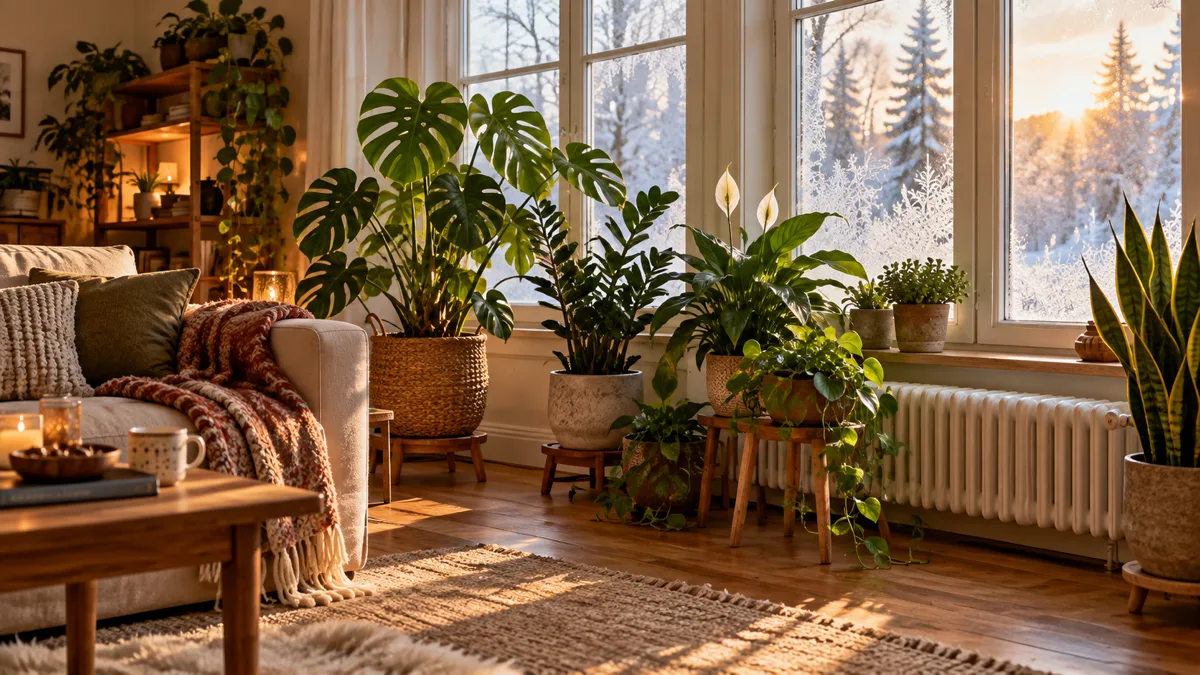
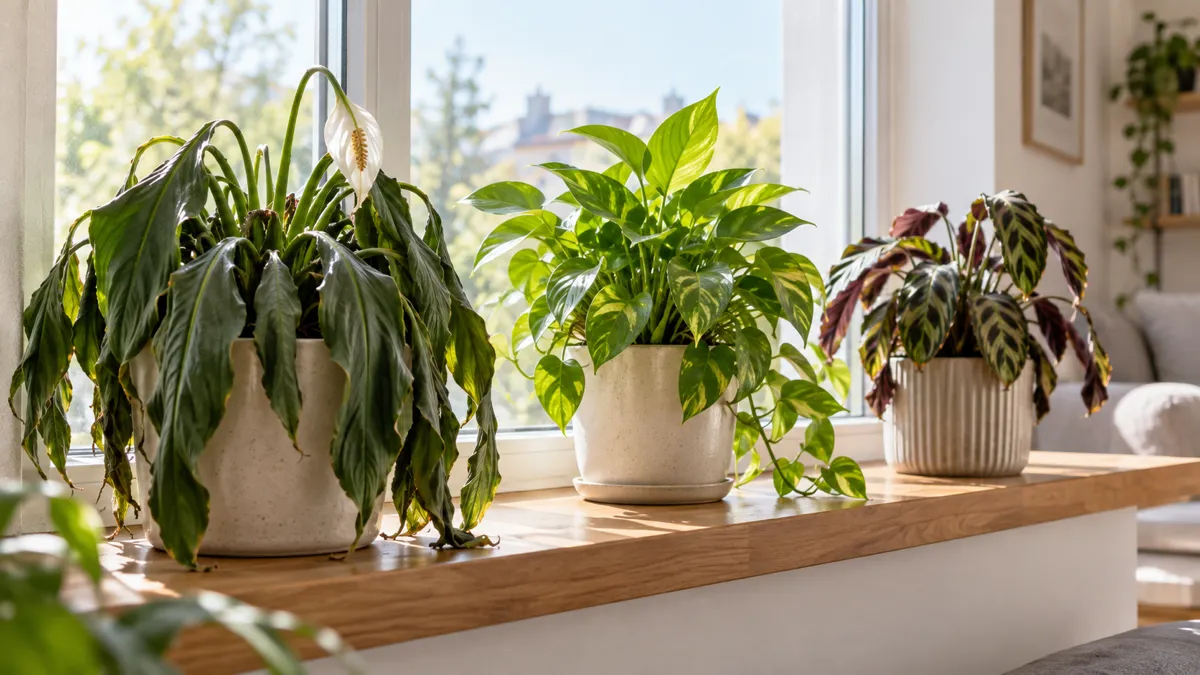
Every houseplant prefers some humidity over none, but the 14 species on this list cross a line: they need moist air the way succulents need drainage — not as a nice-to-have, but as a biological requirement baked into their tissue structure.
The common thread is thin leaves, exposed roots, or specialized cells that evolved to absorb ambient moisture directly. When that moisture drops, no amount of watering the soil fixes the damage.
Below: which species need the most humidity, what each one shows when air is too dry, and one grouping strategy that raises local humidity without a humidifier in every room.
Calathea — the humidity canary that tells you your room's moisture level by leaf curl
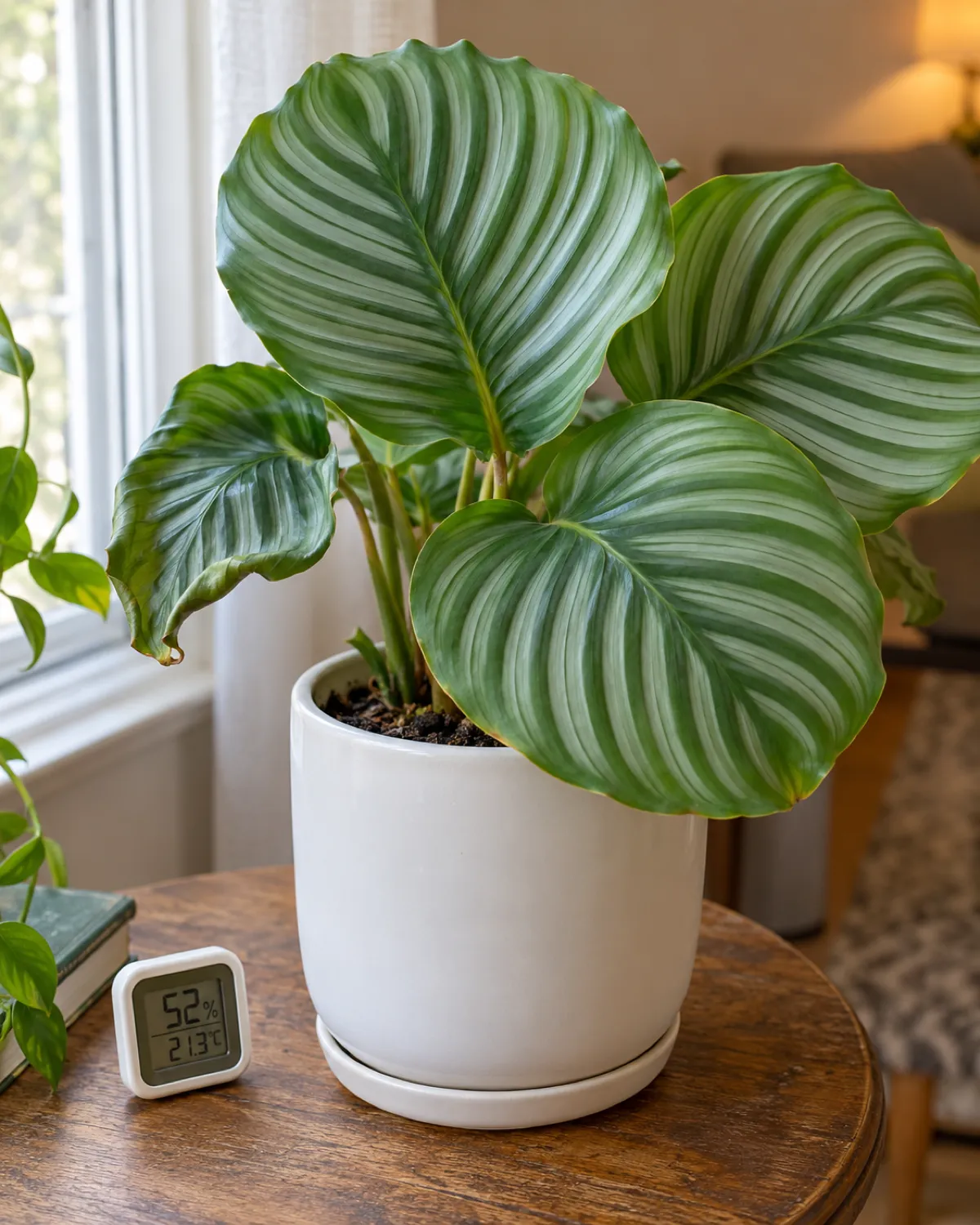
Calathea earns its spot at the top of this list not because it is the most humidity-demanding plant here — ferns hold that title — but because it is the most communicative. When humidity drops below 50 percent, the leaves curl inward along their length into loose tubes. When humidity drops further, the edges brown and crisp in a pattern that moves inward from the margin.
That curl is more reliable as a humidity indicator than most consumer hygrometers. A Calathea leaf that rolls into a tube overnight and refuses to flatten by morning tells you the air dropped below the threshold, not just that you forgot to water.
- Minimum humidity: 50 percent for clean margins; 60 percent for full leaf relaxation
- Stomate density: 2–3× higher than typical houseplants, which is why they dehydrate through leaves faster than roots can compensate
- Diagnostic signal: Rolled leaf that stays rolled by morning = air too dry, not soil too dry
- Best placement: Center of a plant group where transpiration from neighbors raises local humidity
Misting does almost nothing — the moisture evaporates within minutes and barely registers on a hygrometer. A pebble tray or a small humidifier pointed toward the group is the only fix that lasts. The Calathea varieties guide covers the full range of species and their individual sensitivity levels.
Boston Fern — the hanging basket fern that drops fronds like confetti in dry rooms
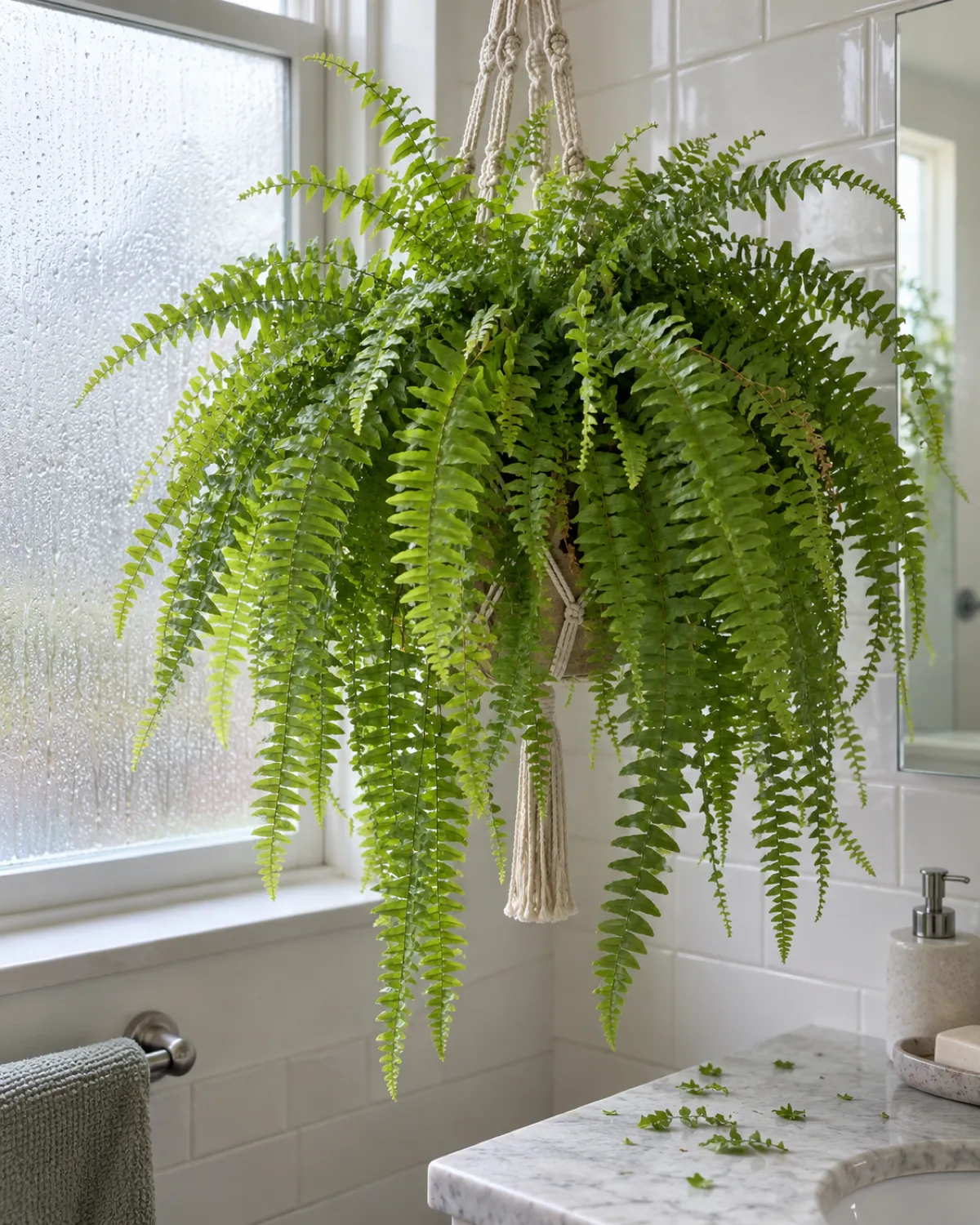
Boston fern is the most humidity-demanding common houseplant on this list. Below 50 percent humidity, it sheds pinnae — the individual leaflets along each frond — at a rate that makes you wonder if the plant is dying. It is not dying. It is shedding surface area to reduce water loss, the same strategy deciduous trees use in autumn.
The difference is that ferns evolved this response for temporary dry spells in tropical forest understories, not for three months of forced-air heating in a living room. Chronic low humidity keeps the shedding going until you have a pot of bare stipes and a floor covered in tiny green confetti.
- Minimum humidity: 50 percent to slow shedding; 60–80 percent to stop it entirely
- Why misting actually helps ferns: Unlike most plants, fern fronds absorb moisture directly through their surface — their ancestors evolved before waterproof cuticles became standard
- Best indoor location: Bathroom or kitchen, where cooking and showering push humidity 10–20 percent above other rooms
- The shed test: Some shedding is normal even in perfect humidity — run your hand along a frond; if more than three pinnae fall, the air is too dry
The Boston fern care guide goes deep on the shedding cycle, pebble tray setups, and the winter humidity crash that kills more Boston ferns than any pest.
Maidenhair Fern — the delicate species that browns overnight in dry air
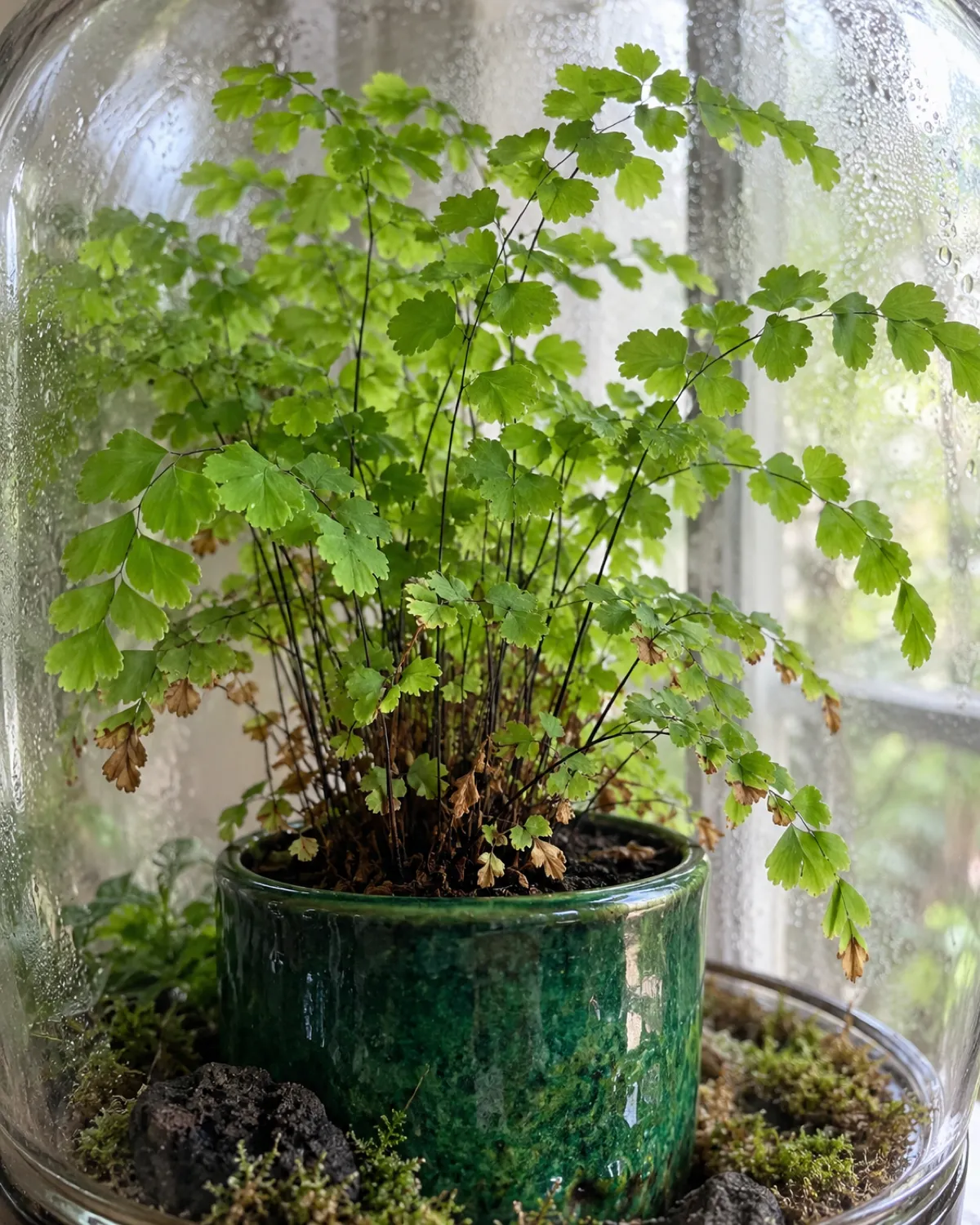
If Boston fern is demanding, maidenhair fern is unreasonable. Adiantum fronds are one cell layer thick in places, which means they lose moisture to the surrounding air faster than almost any houseplant you can buy. A single day below 40 percent humidity can brown entire fronds irreversibly.
The black wiry stems — the "maidenhair" — do not regenerate browned fronds. You cut them off at the base, and the plant pushes new growth from the rhizome. In dry indoor air, this becomes a cycle of growing and browning that exhausts the rhizome within a year.
- Minimum humidity: 60 percent consistently — the highest on this list
- Irreversibility: Browned fronds never recover; you cut and wait for replacements
- Best placement: Inside a terrarium, or directly next to a humidifier in a bathroom
- The one-day rule: A single afternoon below 40 percent damages fronds that took weeks to grow
Maidenhair fern is the strongest argument for terrariums on this entire list. An enclosed glass container holds humidity at 80–90 percent effortlessly, which is why maidenhair thrives in terrariums while struggling on every windowsill.
Staghorn Fern — the mounted epiphyte that absorbs moisture through its fronds
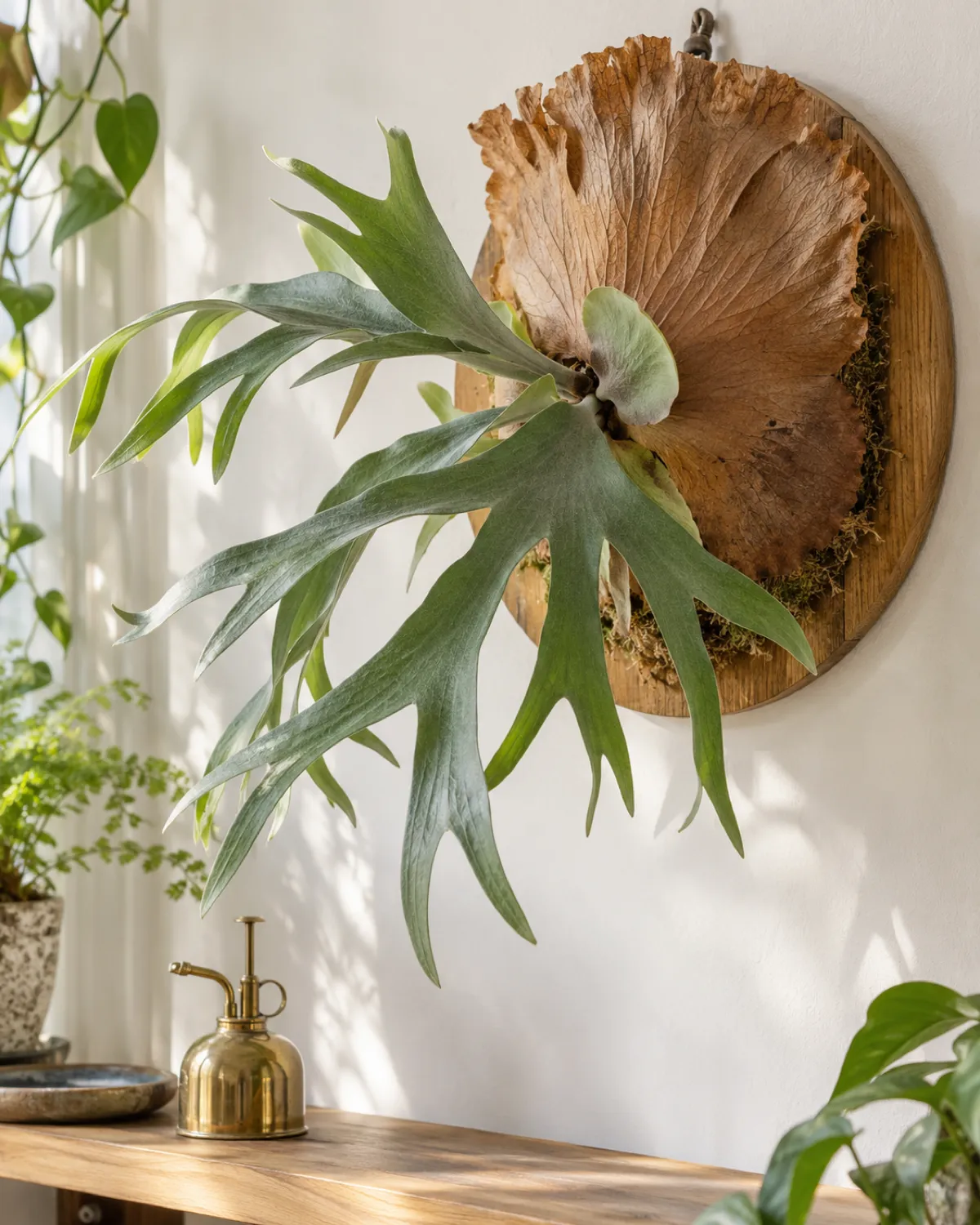
Staghorn fern grows without a pot, without soil, and — in most home settings — without enough moisture. Mounted on a board with only sphagnum moss behind its shield fronds, it relies entirely on air moisture and periodic soaking for its water supply. That setup works beautifully in a humid greenhouse and poorly in a heated living room.
The shield fronds — the flat, round ones that press against the mount — trap moisture against the root mass. The antler fronds have a thin waxy coating that slows moisture loss, but it is not enough when indoor humidity drops below 50 percent. The tips brown, the growth slows, and the antler fronds stay smaller than they should be.
- Minimum humidity: 50–60 percent for clean antler tips
- Soaking routine: Submerge the entire mount in water for 15–20 minutes weekly — this replaces the rainfall it would get in the wild
- Shield frond function: Water reservoir and humidity trap; do not remove brown shield fronds — they are supposed to be papery
- Misting: Works better for staghorns than most plants because the exposed root mass absorbs it directly
The staghorn fern care guide covers mounting methods, soaking frequency, and the shield-frond lifecycle that confuses most new owners.
Nerve Plant — the ground-cover tropical that faints dramatically when air is dry
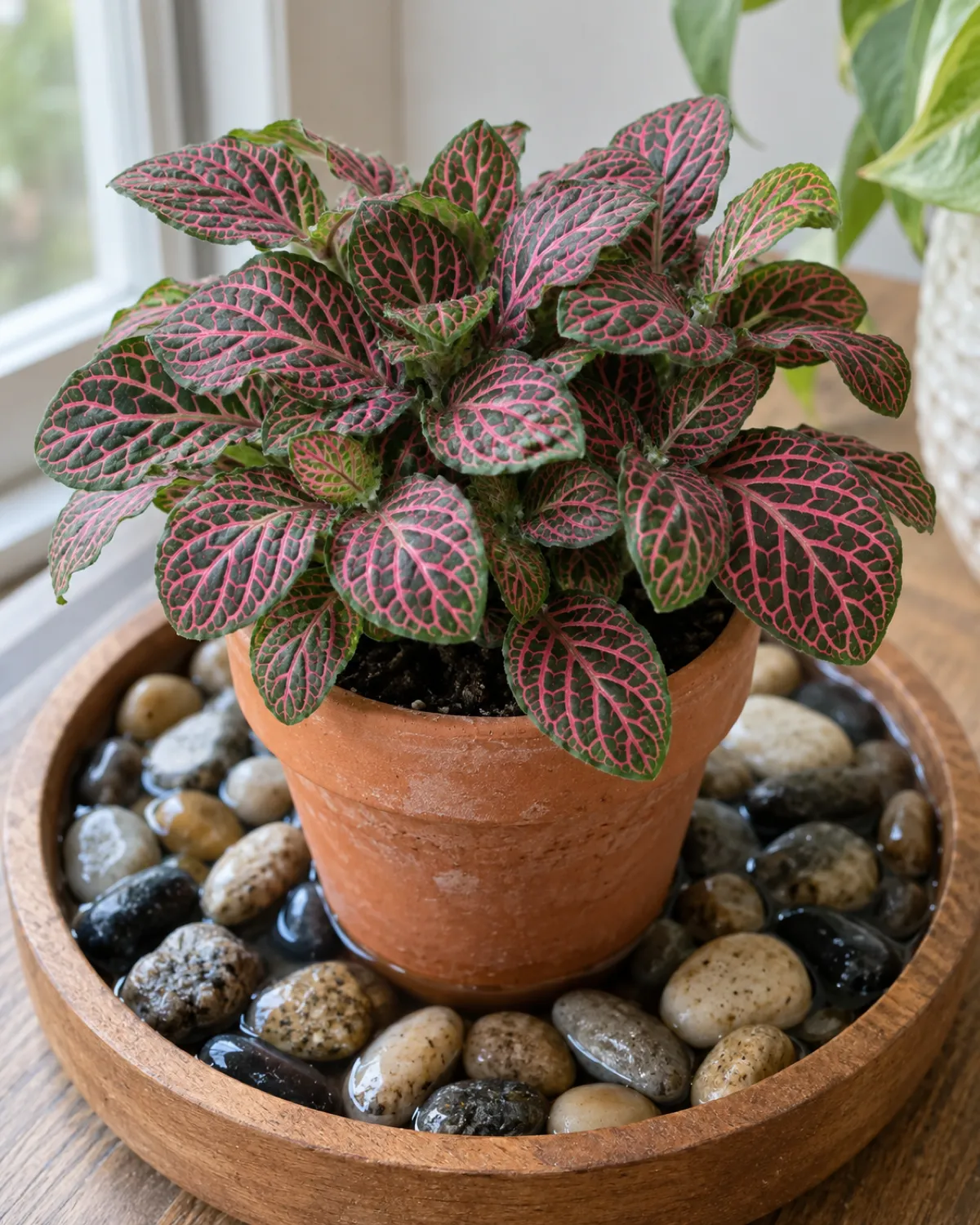
Nerve plant is famous for its dramatic faint — the entire plant collapses flat against the soil when thirsty, then perks back up within an hour of watering. That theatrical response to soil drought gets all the attention, but the quieter damage from dry air is the one that accumulates.
Chronic low humidity causes permanent brown margins on nerve plant leaves. The plant recovers from a soil-drought faint with no lasting damage, but humidity-related browning does not reverse. The margins stay brown and crispy, and over weeks the browning creeps inward until the leaf is half brown, half pink.
- Minimum humidity: 50 percent to prevent margin browning; thrives at 70–80 percent
- Faint vs. browning: Soil drought causes a reversible collapse; air drought causes irreversible brown margins — different symptoms, different causes
- Best placement: Inside a terrarium where enclosed air stays near saturation, or on a pebble tray with other compact plants
- Terrarium champion: The single best terrarium plant on this list because it demands exactly what terrariums provide — high humidity, low light, compact growth
The nerve plant care guide covers the turgor crash in detail, including how to tell whether a faint is a soil problem or an air problem.
Anthurium — the flowering tropical whose blooms brown in arid rooms
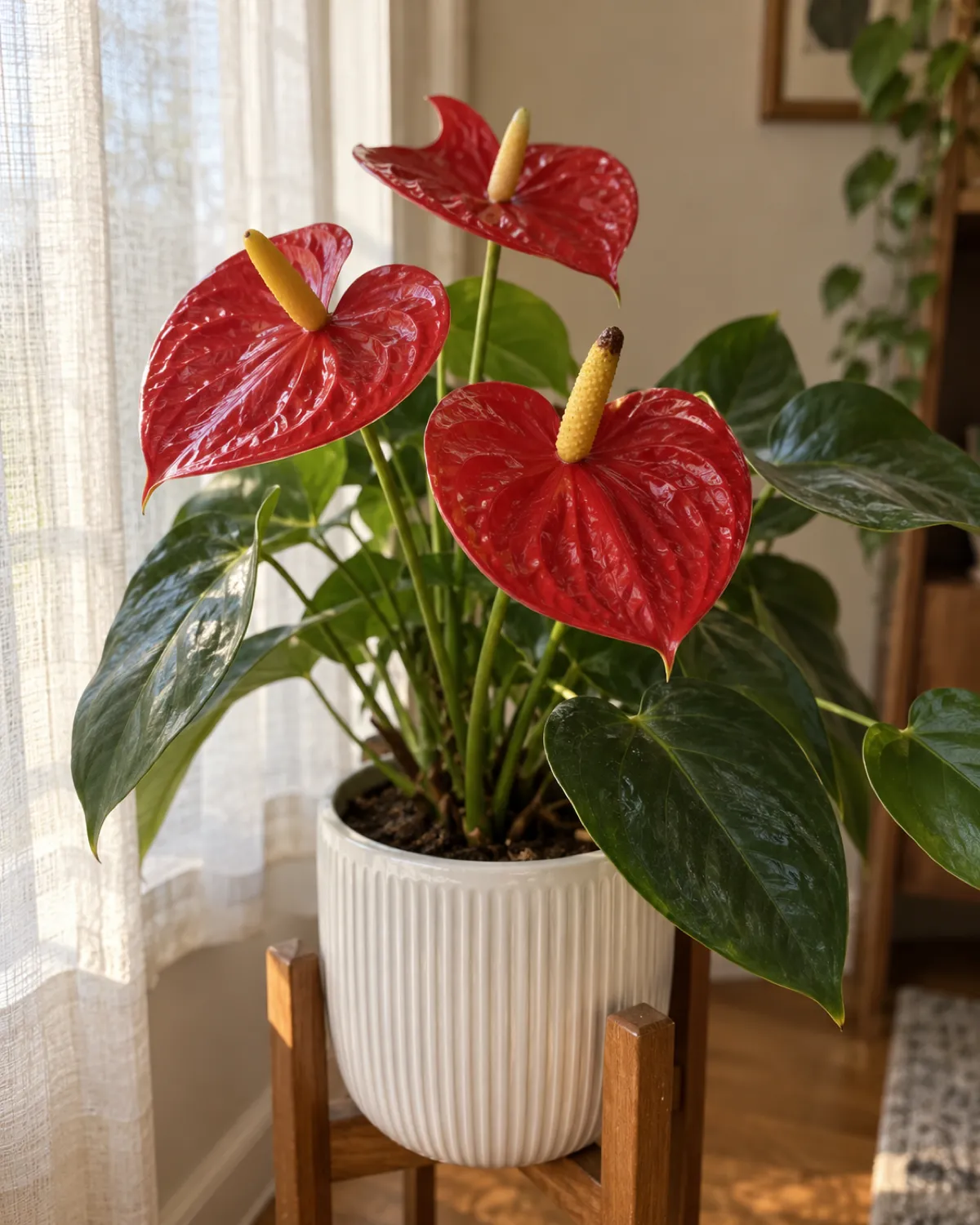
People blame overwatering when anthurium spadixes turn brown at the tips, but it is almost always humidity. The waxy leaves handle dry air surprisingly well — their thick cuticle holds moisture — but the flowers tell a different story. The spadix, the protruding spike in the center of each spathe, is a moisture-sensitive reproductive structure with no waxy protection.
Anthuriums are epiphytic in nature, growing on tree branches in perpetual mist. They never evolved a thick cuticle on their reproductive parts because they never needed one. Indoors, the spadix dries from the tip backward, and the spathe fades weeks sooner than it would in humid air.
- Minimum humidity: 60 percent for clean, long-lasting blooms
- Leaf vs. flower sensitivity: Waxy leaves tolerate down to 40 percent; spadix and spathe do not
- Humidity payoff: Blooms last 4–6 weeks longer in 60 percent humidity compared to 30 percent
- Common misdiagnosis: Brown spadix tips blamed on overwatering when the soil is fine — check the hygrometer before changing the watering schedule
The anthurium care guide covers bloom cycle, spadix anatomy, and the bacterial blight that mimics humidity damage on leaves.
Peace Lily — the forgiving aroid that still gets brown tips below 40 percent humidity
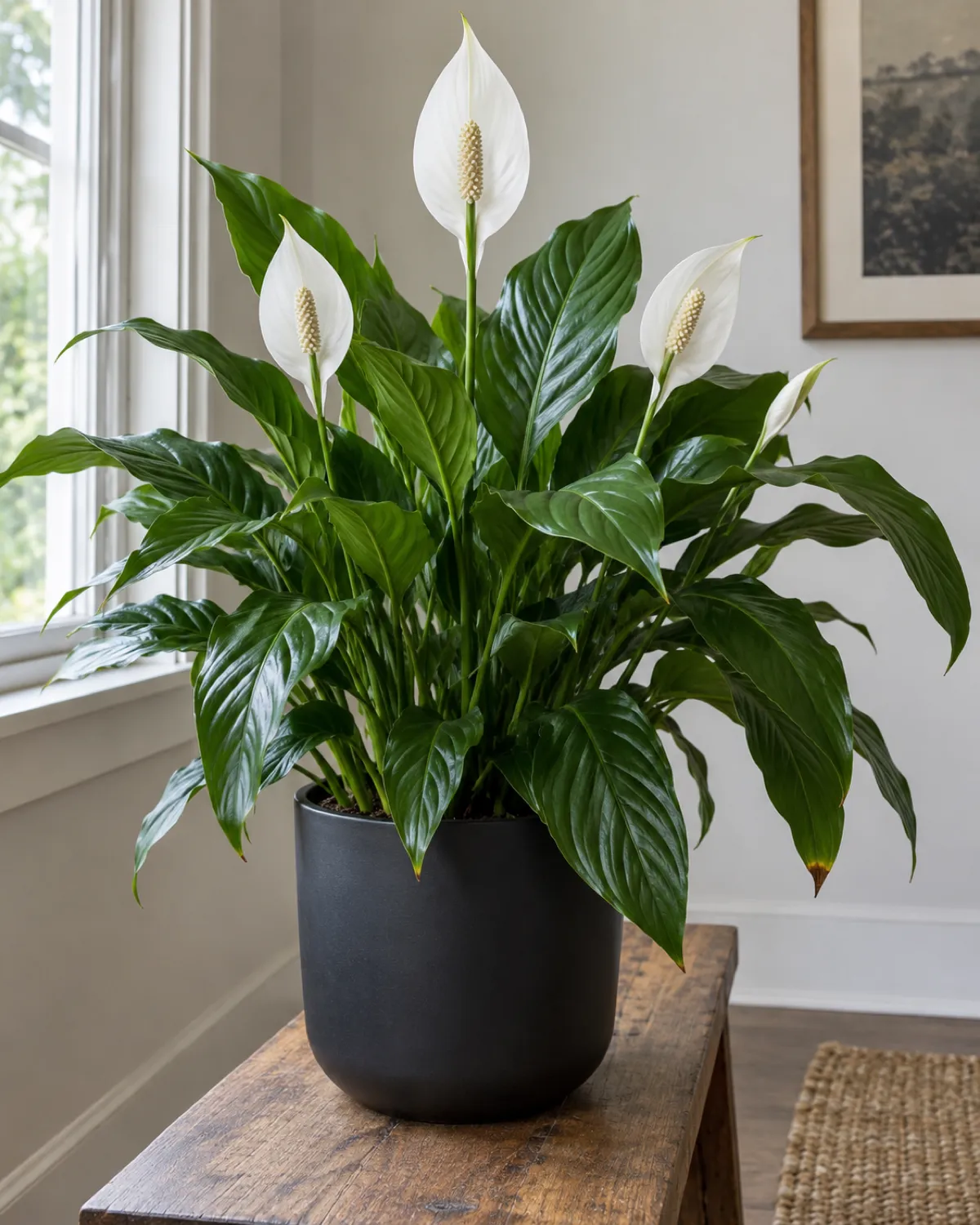
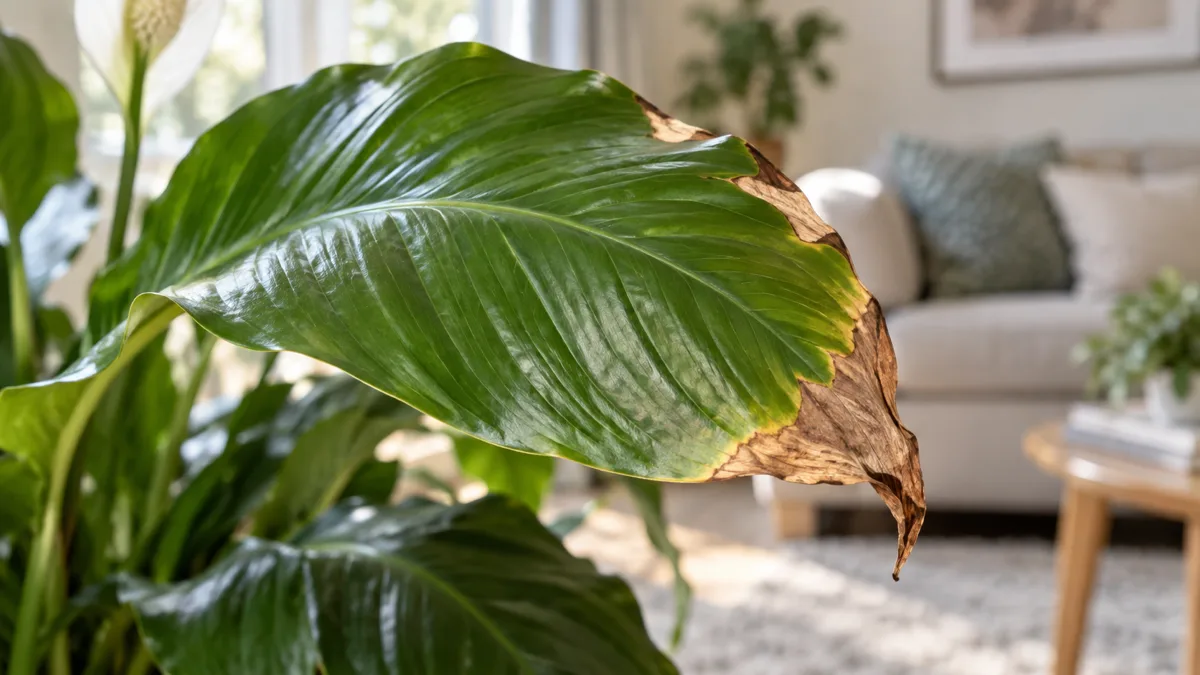
Peace lily appears on "low humidity tolerant" lists, which is technically true and practically misleading. It tolerates dry air the way you tolerate a cold office — by quietly suffering damage that accumulates over time. In this case, the damage is brown leaf tips that march progressively down the margins.
The browning starts at the tip of the newest, thinnest leaves and works outward. Most peace lily owners accept this as normal because the plant looks healthy otherwise. But side-by-side comparisons between a peace lily at 30 percent humidity and one at 55 percent are striking — the second plant has spotless margins and bigger spathes.
- Minimum humidity: 40 percent for survival; 50+ percent for tip-free leaves
- The tolerance trap: It survives dry air so well that owners never realize it is underperforming
- Most affected parts: Newest leaves and spathe edges — old leaves are tougher
- Cost-free fix: Move it to the kitchen or bathroom and the tips stop appearing within one growth cycle
The peace lily care guide covers the droop signal, flowering triggers, and the light level that determines whether it flowers at all.
Alocasia — the jewel-leafed elephant ear that goes dormant when air dries out
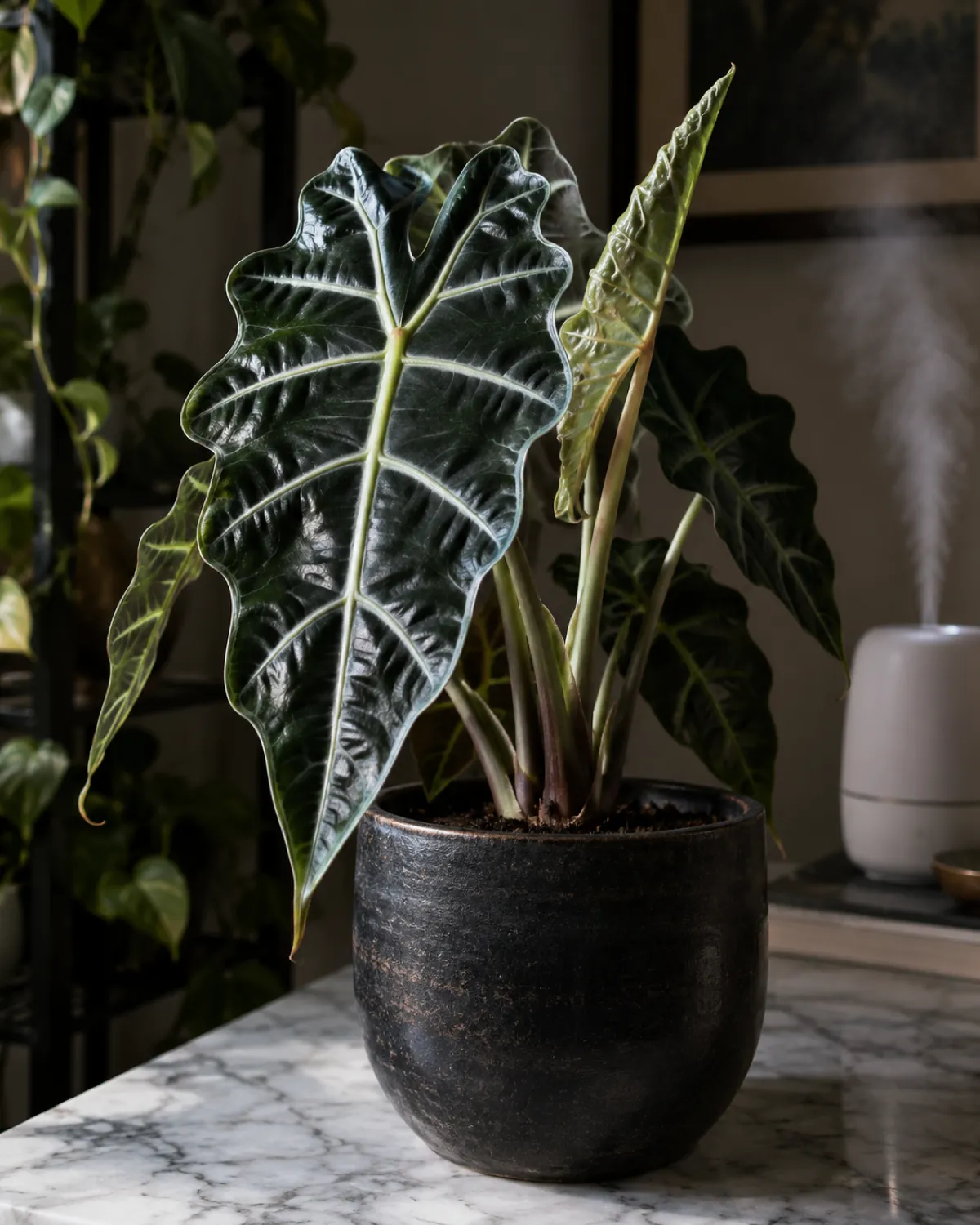
Alocasia leaves are designed for a climate that does not exist inside most homes. The large, thin, arrow-shaped blades have massive surface area relative to their thickness, which means they lose moisture to surrounding air far faster than compact leaves would.
Below 50 percent humidity, the oldest leaf starts browning at the edges. Then the next oldest. One by one, the plant drops leaves it cannot maintain, keeping only the newest growth at the center. In severe cases — below 35 percent humidity sustained — it drops every leaf and retreats to its underground corm, going fully dormant until conditions improve.
- Minimum humidity: 50 percent to keep margins clean; 60+ percent for clean unfurling of new leaves
- Dormancy trigger: Sustained low humidity combined with reduced watering can push Alocasia into corm dormancy — the plant looks dead but usually is not
- Most sensitive species: Polly (Amazonica) and Frydek — both have thinner leaves than hardier species like Regal Shield
- New leaf test: The newest unfurling leaf is the most humidity-sensitive; crispy edges on a leaf that has not finished unfurling mean the air needs more moisture immediately
The Alocasia care guide covers corm dormancy, the arrow-vs-shield leaf types, and the species that tolerate drier air.
Rex Begonia — the painted-leaf begonia that mildews when you try to help
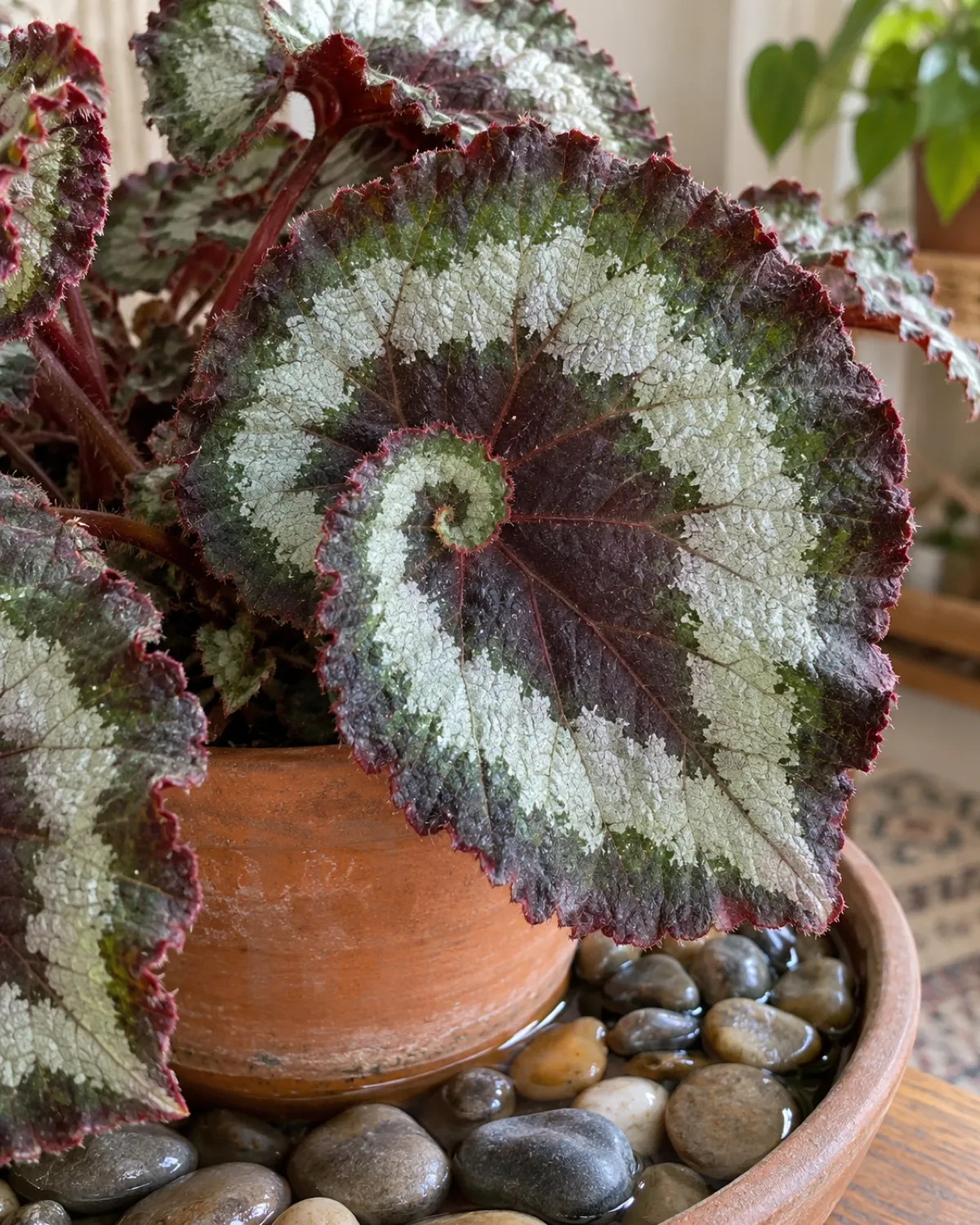
Rex Begonia presents the classic humidity paradox: it needs moist air but hates wet leaves. Below 50 percent humidity, the leaf edges brown and new leaves emerge smaller than normal. But misting — the obvious first instinct — traps water droplets in the textured, creviced leaf surface and creates ideal conditions for powdery mildew.
The metallic patterns that make Rex Begonia spectacular are made of specialized cells with a thin, bumpy surface that holds water longer than a smooth leaf would. What evolved to catch light efficiently in dim forest understories becomes a mildew incubator when you spray it with a misting bottle.
- Minimum humidity: 50 percent for healthy leaf expansion
- The paradox: Needs humidity, gets mildew from misting — the solution is ambient humidity (humidifier, pebble tray), not leaf-surface moisture
- Most vulnerable parts: Metallic patches on new leaves, which are thinnest and most textured
- Mildew symptom: White powdery coating on leaf surfaces, spreading from the center outward — distinct from the natural metallic sheen
The Rex Begonia care guide covers the spiral leaf structure, rhizome watering technique, and the wedge-cutting propagation method that preserves the metallic patterns.
Orchid — the epiphyte whose aerial roots shrivel like paper in dry rooms
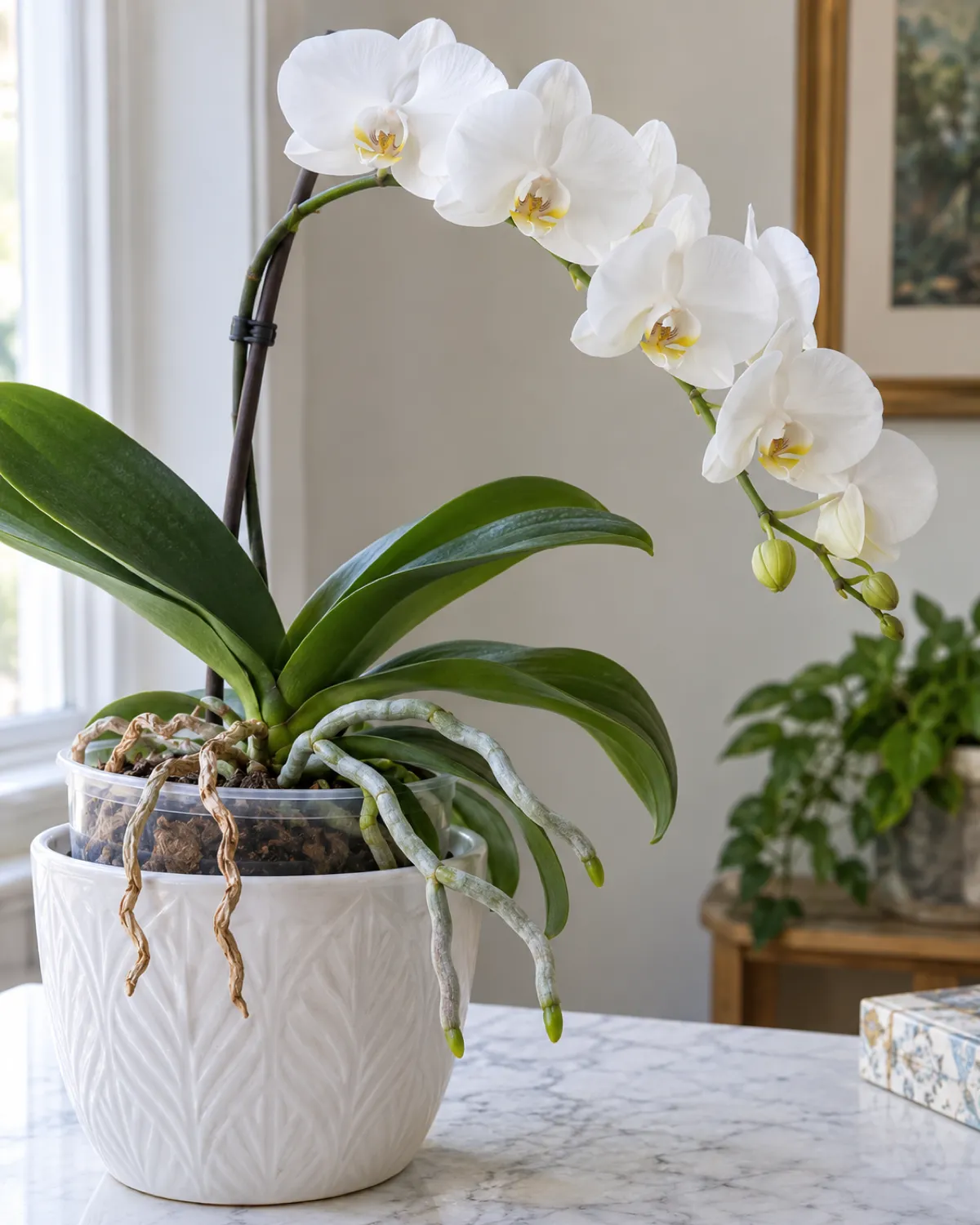
Most orchid owners focus on the roots in the pot and ignore the aerial roots that climb out over the rim. Those aerial roots are the plant's humidity report card. Plump, silvery-green roots with bright green tips mean the air has enough moisture. Shriveled, papery-brown roots mean it does not.
The velamen — the spongy, silvery coating on orchid roots — evolved specifically to absorb water vapor from the air. In a humid greenhouse, aerial roots stay fat and green without ever touching water. In a heated living room at 25 percent humidity, the velamen dries out and the root core dies, one aerial root at a time.
- Minimum humidity: 40 percent for Phalaenopsis survival; 50–60 percent for healthy aerial roots
- Velamen function: Absorbs ambient moisture directly — it is a humidity-harvesting organ, not just a protective layer
- Aerial root diagnosis: Plump + green tip = good; shriveled + papery = dry air; squishy + brown = overwatering (different problem)
- More demanding species: Vandas and oncidiums need 60+ percent; Phalaenopsis is the most tolerant
The orchid care guide covers the root color system, the velamen structure, and the temperature drop that triggers reblooming.
Prayer Plant — the species whose nightly fold angle reveals how dry your air is
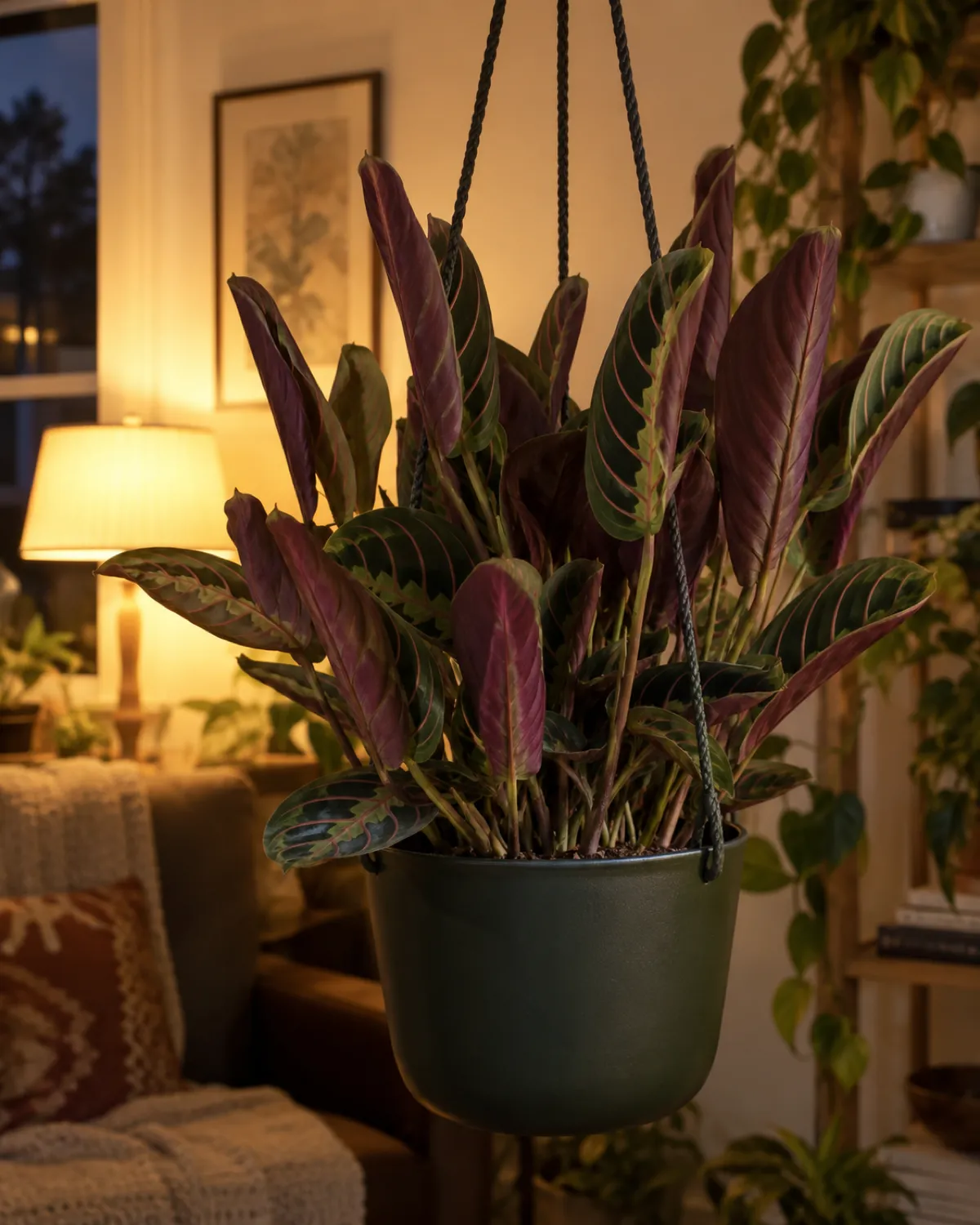
Prayer plant folds its leaves upward every evening — the nyctinastic movement driven by turgor pressure in specialized pulvinus joints at the base of each leaf. That fold is not just a biological curiosity; it is a humidity measurement tool, because turgor pressure depends directly on tissue hydration, which tracks ambient humidity.
At 60 percent humidity or above, the fold is a full 90-degree vertical lift — leaves standing straight up, purple undersides facing outward. At 50 percent, the fold manages roughly 45 degrees. Below 40 percent, the leaves barely twitch. Tracking this angle over a week gives you a humidity trend line.
- Minimum humidity: 50 percent for reliable nightly folding; 60 percent for the full 90-degree lift
- Fold as diagnostic: Full fold = adequate humidity; half fold = borderline; no fold = emergency
- Brown-edge progression: Appears first on the newest leaves, unlike most plants where oldest leaves show stress first
- Marantaceae grouping: Place with Calathea and Stromanthe for mutual transpiration benefit — all three share the same humidity needs and leaf-movement behavior
The prayer plant care guide covers the pulvinus joint in detail, rhizome division for propagation, and why this is one of the safest humidity-loving plants for homes with pets.
Bird of Paradise — the banana-leaf tropical that splits prematurely in dry rooms
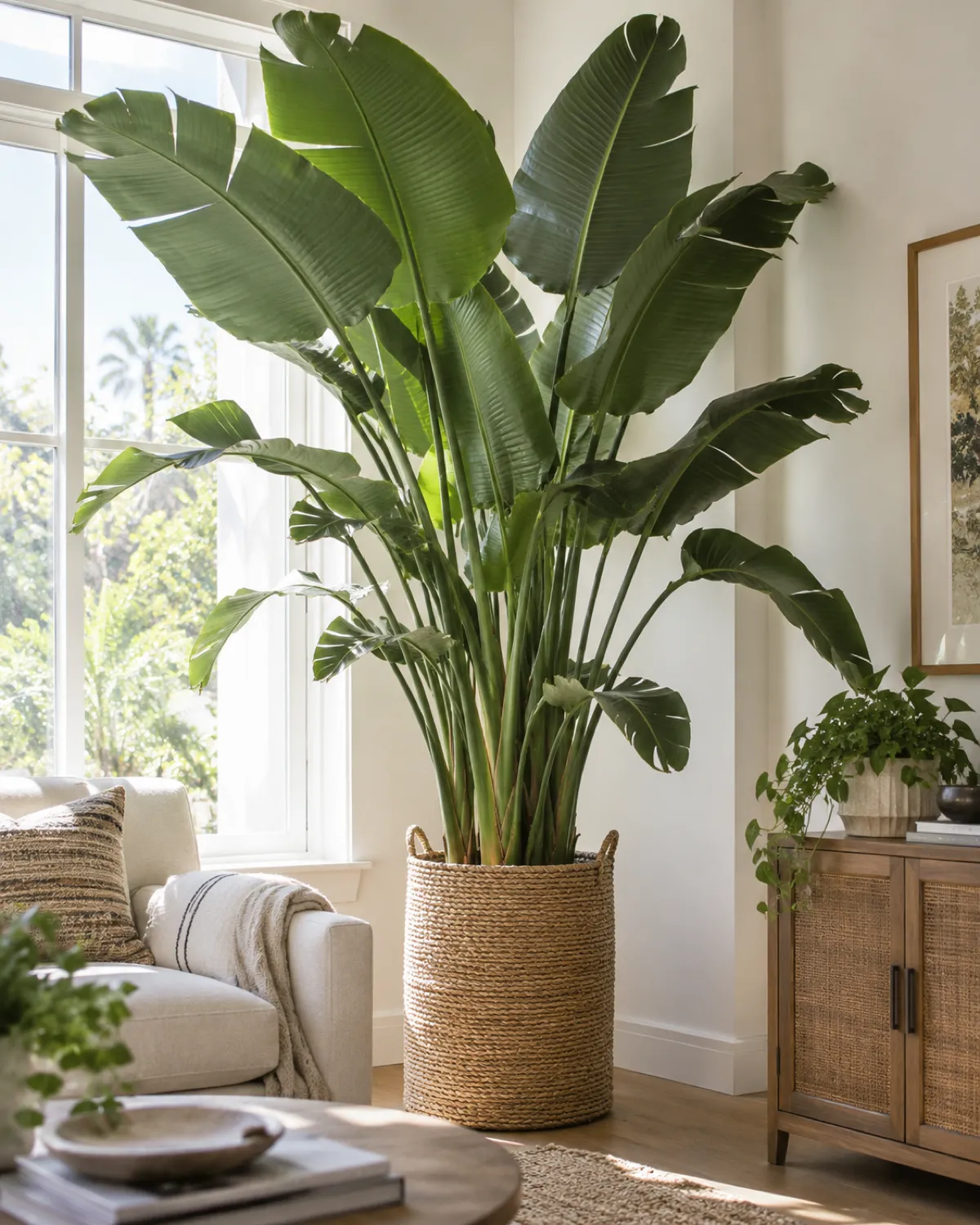
Bird of Paradise leaves are supposed to split — it is a wind adaptation that prevents the huge paddle-shaped blades from catching gusts like sails and tearing the plant down. But indoors, where there is no wind, splitting still happens because dry air dessicates the leaf tissue along the veins, creating weak points that split under their own weight.
Most indoor gardeners accept this as "just how Bird of Paradise looks indoors." It does not have to be. A humidifier or a position near other large plants reduces both the frequency and extent of splitting. The edges also brown less.
- Minimum humidity: 40 percent for survival; 50+ percent to reduce premature splitting
- Split anatomy: Splits follow the secondary veins — they are not random tears but engineered weak points
- Edge browning: Drier air means wider brown margins, especially on the newest unfurling leaf
- Size factor: Larger leaves have more surface area and lose moisture faster — the tallest Bird of Paradise in the room is the first to show stress
The Bird of Paradise care guide covers heteroblastic leaf development, why most indoor specimens never flower, and the light levels that determine whether the plant pushes new leaves or sits dormant.
Air Plant — the rootless bromeliad that absorbs all its water through leaf trichomes
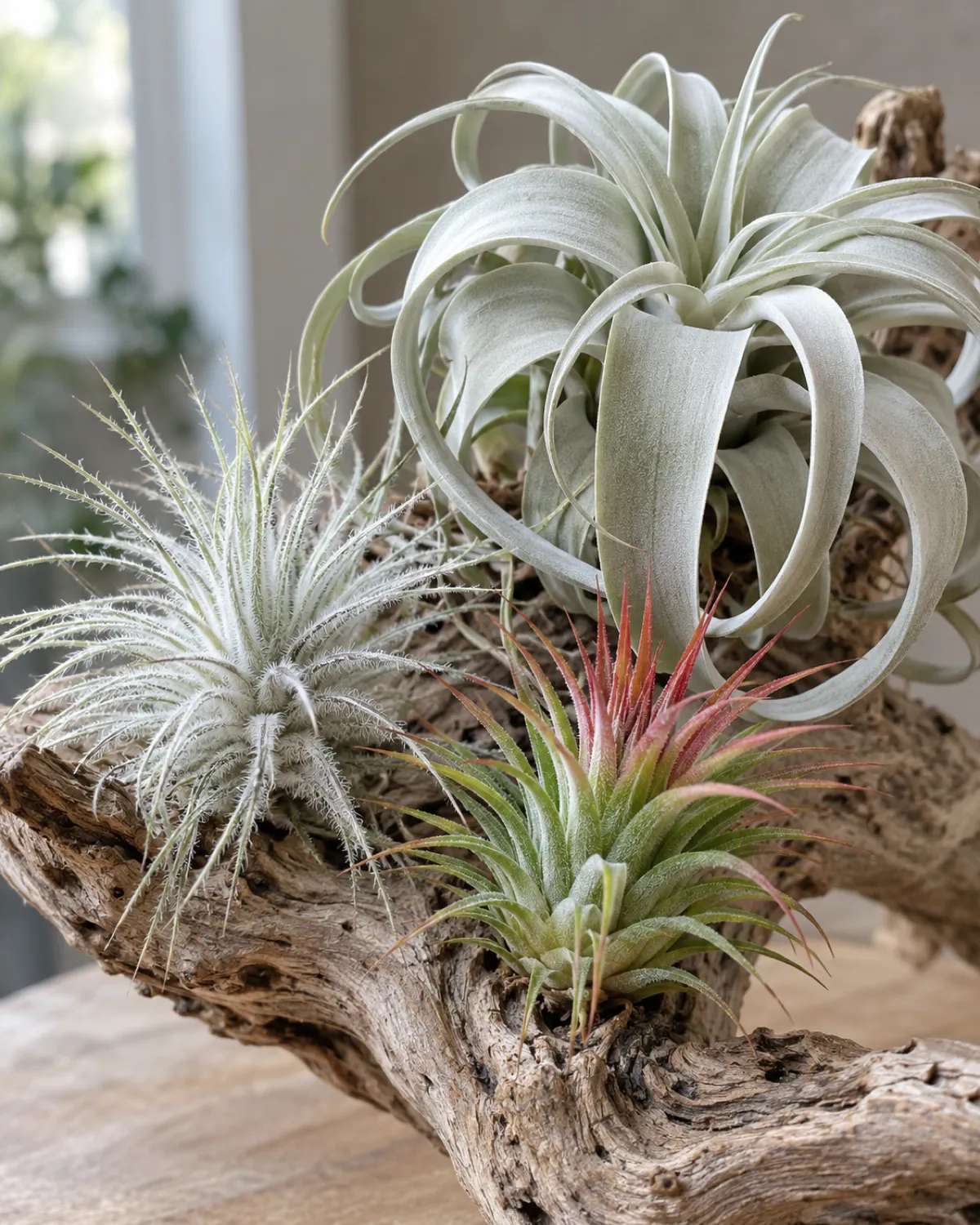
Air plants have no roots, no soil, and no way to absorb water except through specialized cells on their leaf surfaces called trichomes. Those trichomes are the silvery-white fuzz you see on most Tillandsia species, and they are not decorative — each one is a tiny moisture-harvesting organ that opens in humid air and closes in dry air.
Between soakings, the plant relies entirely on ambient humidity to stay hydrated. In a bathroom running at 60 percent humidity, an air plant can go two weeks between soaks. In a heated living room at 25 percent humidity, the same plant shrivels within days of its last soak because the trichomes cannot harvest enough moisture from the air to bridge the gap.
- Minimum humidity: 40 percent between soakings; 50+ percent reduces soaking frequency dramatically
- Trichome function: Opens to absorb moisture, closes to prevent water loss — a biological valve controlled by ambient humidity
- Silver vs. green species: Silver species (tectorum, xerographica) have denser trichomes and handle drier air better; green species (ionantha, bulbosa) need more humidity
- The between-soak gap: Humidity determines how long the plant stays hydrated between weekly soaks — low humidity makes the gap too wide for the trichomes to bridge
The air plant care guide covers the soak-and-shake method, trichome anatomy, and why these monocarpic bromeliads only flower once.
Bromeliad — the tank-forming tropical that fades faster in dry air
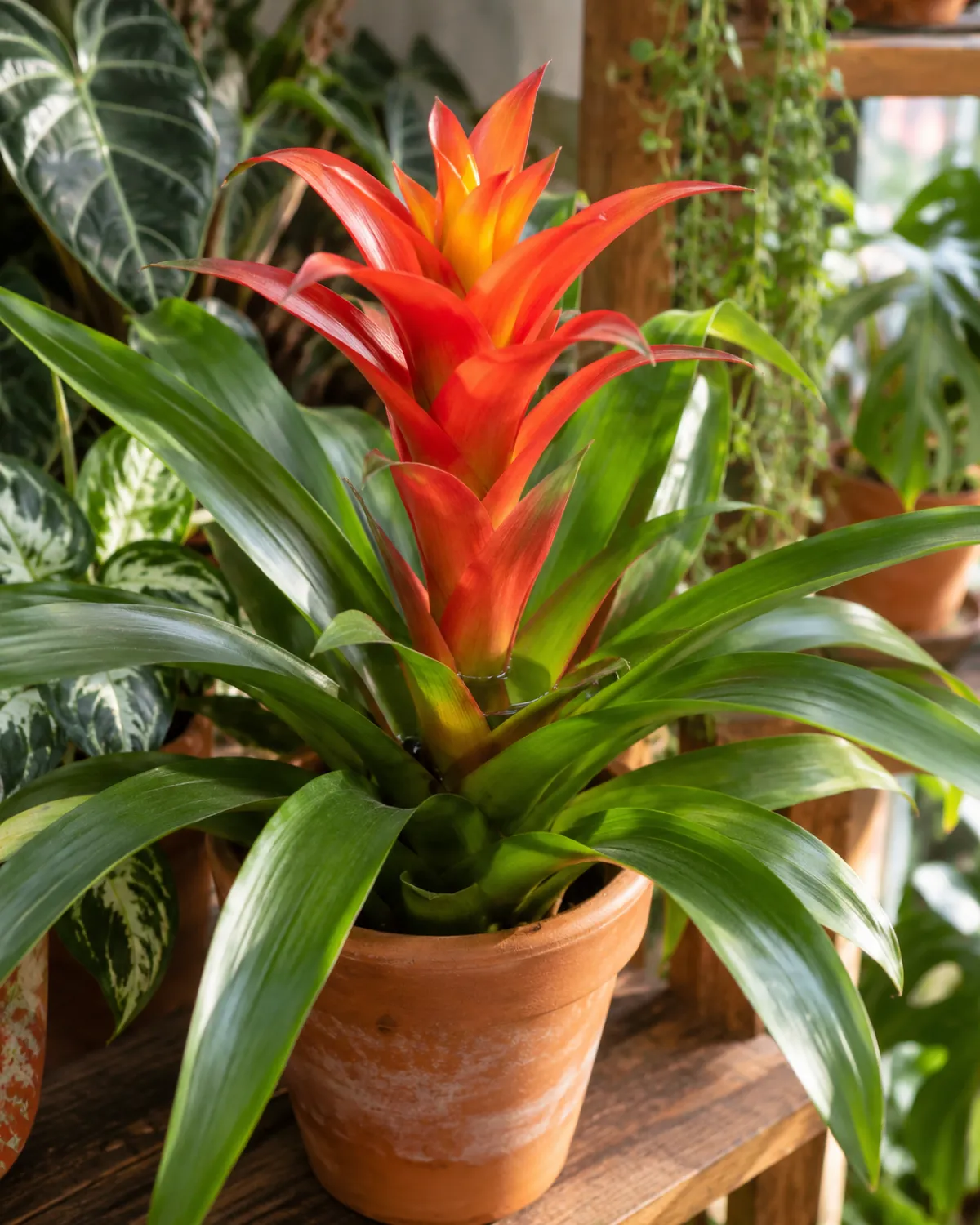
The colorful bracts that most people think are bromeliad flowers are actually modified leaves. They last weeks or months depending on the species, and their longevity is directly tied to ambient humidity. In moist air, a Guzmania bract stays vivid red for eight to twelve weeks. In dry air, the same bract fades and dries within four to six.
The central cup — the funnel formed by the rosette of leaves — collects rainwater in nature, but indoors the real moisture source the plant craves is ambient humidity, not the cup. Filling the cup helps, but it does not replace the ambient moisture that keeps the leaf tips and bract edges from browning.
- Minimum humidity: 50 percent for bract longevity; lower is survivable but the display period shortens
- Bract lifespan: 8–12 weeks in 50+ percent humidity vs. 4–6 weeks in dry air
- Cup watering: Fill with filtered water and flush monthly to prevent bacterial buildup — the cup is a supplement, not a substitute for ambient humidity
- Mounted bromeliads: Epiphytic species (like Tillandsia, its close relative) are even more humidity-dependent when mounted without soil
The bromeliad care guide covers the monocarpic lifecycle, ethylene-triggered flowering, and the pup-removal method that keeps the collection going after the mother plant fades.
Grouping for a Humidity Microclimate
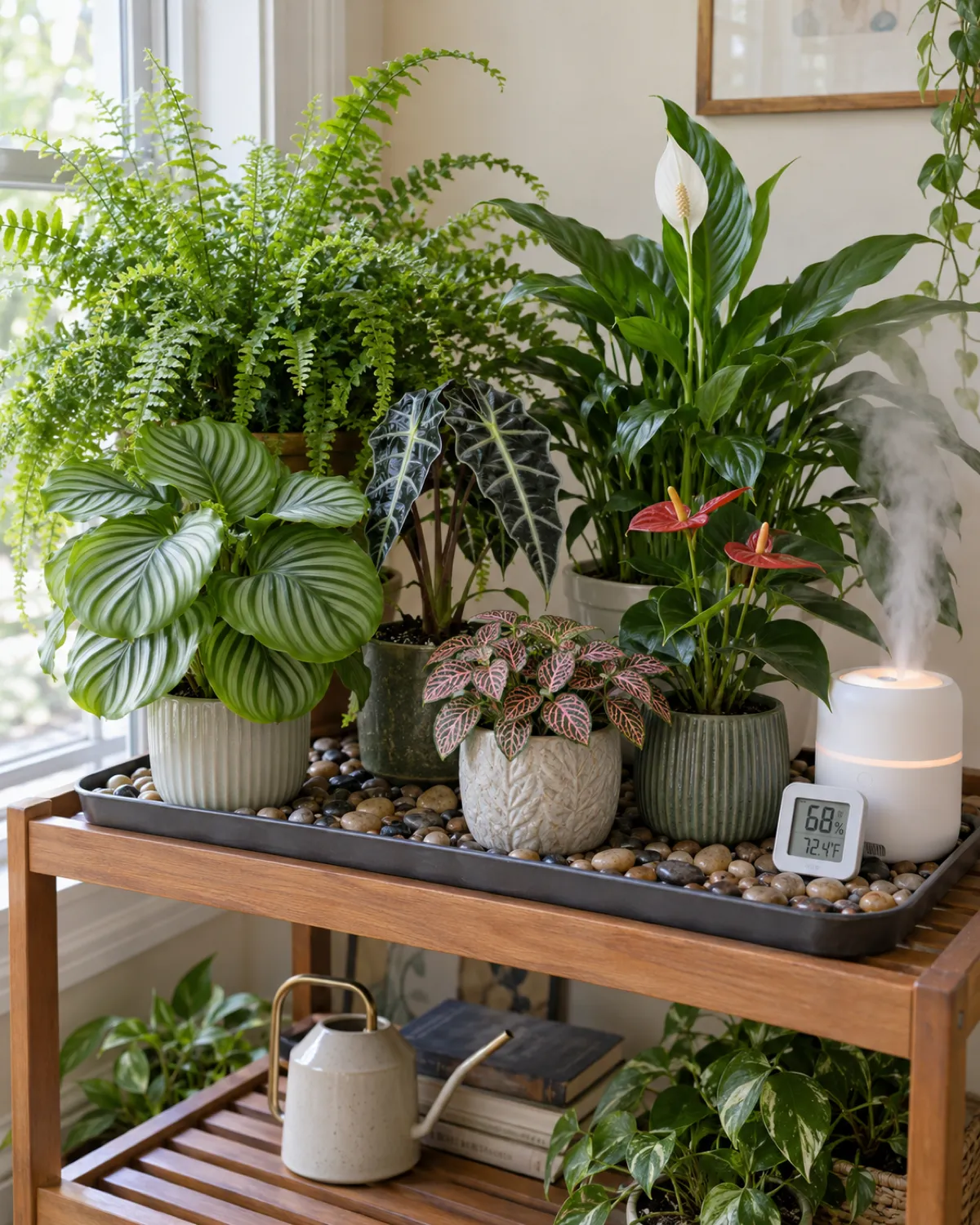
Every plant on this list loses water through its leaves — transpiration. When you cluster humidity-loving plants together, their combined transpiration raises the local humidity by 5 to 15 percent above the room average. Six plants on a shared pebble tray in a room reading 35 percent humidity can create a 45–50 percent microclimate at leaf level without a single piece of equipment.
The trick is placement. Put the thirstiest species — ferns, Calathea — in the center of the group where transpired moisture accumulates. Place tougher species like peace lily and Bird of Paradise at the edges. Add a pebble tray under the entire cluster: a shallow tray with smooth stones and water that evaporates upward through the group.
- Measure at plant level: A hygrometer on the wall across the room reads room average; place it among the leaves to see the actual microclimate
- Best rooms: Bathroom and kitchen naturally run 10–20 percent higher humidity than bedrooms and living rooms
- Avoid: Heating vents (blow dry air directly onto leaves), exterior walls in winter (radiate cold and condense moisture away from plants), and south-facing windows in winter (warm glass + cold air = low humidity zone)
- The $15 rule: A cheap digital hygrometer placed at leaf level reveals whether your grouping strategy is working — if it reads below 45 percent at plant level despite grouping, add a humidifier
The two biggest mistakes are placing humidity plants near a heating vent and misting textured leaves. A grow light can fix the light problem in a dark bathroom, but nothing fixes a heating vent except moving the plants away from it.
14 Houseplants That Like Humidity
- 1Calathea — humidity canaryLeaf curl tells you the room dropped below 50%. More reliable than a cheap hygrometer.
- 2Boston Fern — the shedderDrops pinnae like confetti below 50%. Best in bathrooms.
- 3Maidenhair Fern — the delicate oneOne day below 40% browns fronds irreversibly. Terrarium or humidifier only.
- 4Staghorn Fern — mounted epiphyteNo pot, no soil. Relies on soaking and air moisture for survival.
- 5Nerve Plant — the fainterDramatic soil-drought collapse recovers. Air-drought browning does not.
- 6Anthurium — bloom protectorWaxy leaves handle dry air. Spadix and spathe do not. 60% for lasting flowers.
- 7Peace Lily — the quiet suffererSurvives dry air by sacrificing leaf tips. 50%+ eliminates the browning entirely.
- 8Alocasia — dormancy riskDrops leaves one by one. Below 35% sustained, retreats to its corm.
- 9Rex Begonia — the mildew paradoxNeeds humid air, gets mildew from misting. Use pebble tray, not spray bottle.
- 10Orchid — aerial root report cardPlump green roots = humid enough. Shriveled papery roots = too dry.
- 11Prayer Plant — fold-angle gauge90° fold = good. 45° = borderline. No fold = emergency.
- 12Bird of Paradise — premature splitterSplits from dry air, not wind. Humidifier reduces both splitting and browning.
- 13Air Plant — trichome harvesterNo roots. 100% water intake through leaf trichomes. Humidity bridges soak gaps.
- 14Bromeliad — bract faderColorful bracts last twice as long in 50%+ humidity. Cup water is a supplement, not a fix.
Save this list · Kultivy
FAQ
What humidity level do most tropical houseplants need?
Most species on this list thrive between 50 and 60 percent relative humidity. That is higher than most heated homes in winter (typically 25–35 percent) but achievable with grouping and a pebble tray. Specific thresholds:
- 60%+ mandatory: Maidenhair fern, Calathea, Anthurium blooms
- 50–60% ideal: Boston fern, Alocasia, Rex Begonia, Prayer Plant, Nerve Plant, Staghorn Fern
- 40–50% tolerable: Peace Lily, Orchid (Phalaenopsis), Bird of Paradise, Bromeliad
Does misting actually raise humidity?
A single misting evaporates within minutes and barely registers on a hygrometer. The spike is real but too brief to help most plants. Two exceptions:
- Ferns absorb moisture directly through their fronds, so misting gives them a measurable boost
- Air plants harvest leaf-surface water through trichomes, making misting genuinely useful between soaks
For everything else, a pebble tray or humidifier provides the sustained humidity that matters.
Can a humidifier be too close to plants?
Yes. A cool-mist humidifier blowing directly onto leaves keeps them constantly wet, which promotes fungal disease on textured surfaces like Rex Begonia and Calathea.
Point it toward the group from a few feet away, not at individual plants. Warm-mist types carry a burn risk if leaves touch the outlet. In both cases, air circulation prevents the stagnant humid air that breeds fungus.

Mara Quinn edits Kultivy, where she shares houseplant care, propagation, beginner-friendly plant picks, and plant-styling ideas for anyone who wants their indoor plants to actually thrive. Every guide is image-led and reviewed for clarity, usefulness, image accuracy, and Pinterest-to-page alignment before it goes live. Visit the About page.