From decoding the dramatic faint to humidity, propagation, and the best varieties worth collecting.
The Mosaic Vein Pattern That Gives Nerve Plant Its Name
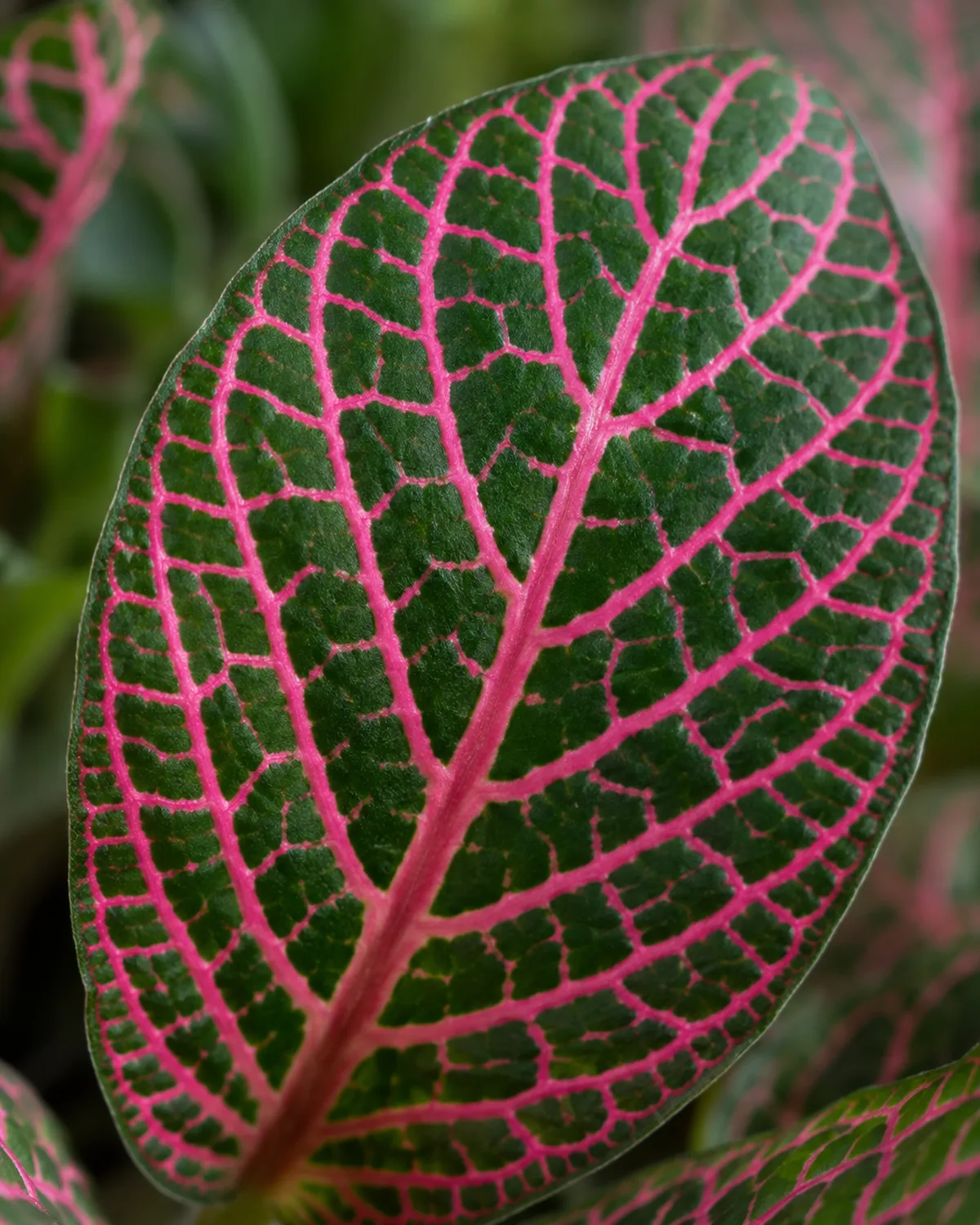
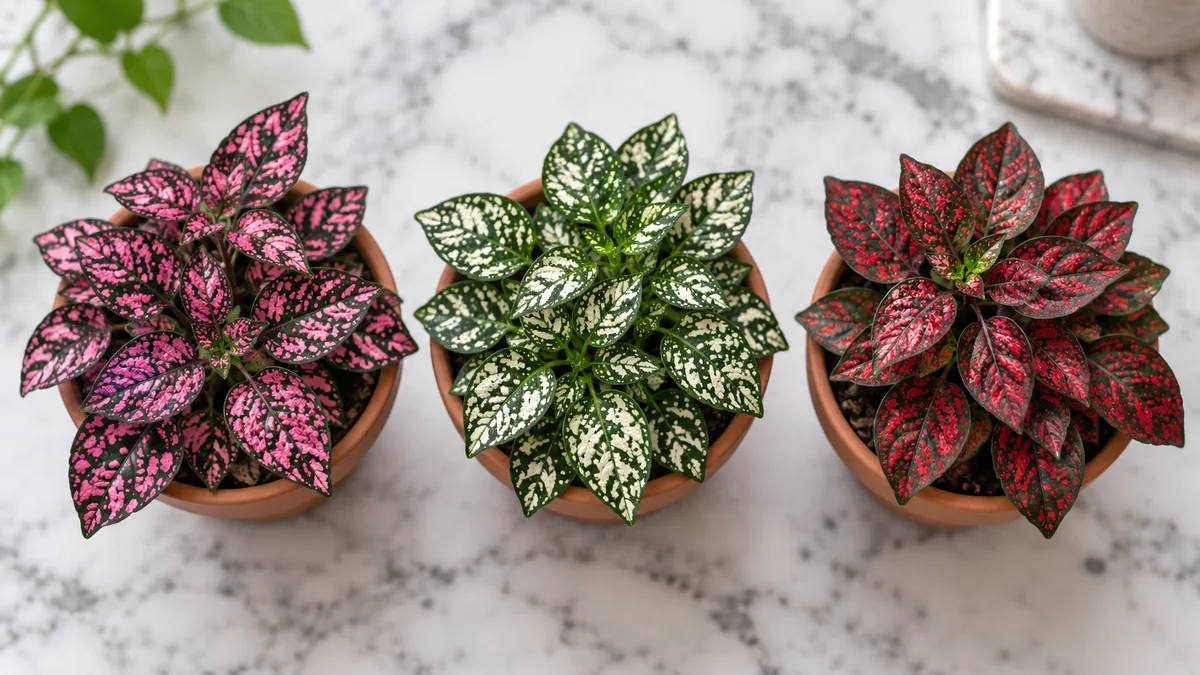
The name says it all. Fittonia albivenis — commonly called nerve plant, mosaic plant, or painted net leaf — wears its vascular system on its surface. Every leaf displays a dense network of contrasting veins in white, pink, or deep rose against a dark green background, creating a pattern that looks hand-painted.
Nerve plants belong to the Acanthaceae family and are native to the tropical rainforest floors of Peru and Colombia. In the wild, they creep along the ground under the canopy in near-constant shade and humidity, rarely growing taller than fifteen centimeters. That origin story explains almost every care requirement: indirect light, consistent moisture, and high humidity.
- Size: compact creeping habit, typically six to fifteen centimeters tall and spreading up to thirty centimeters wide
- Growth pattern: horizontal spreading stems with pairs of oval leaves at each node — the plant fills its pot sideways before it grows up
- Vein color range: white (the classic form), pink (the most popular), hot pink, deep rose-red, and even burgundy depending on the cultivar
- Flowers: small white or reddish spikes that appear occasionally — most growers pinch them off because the flowers are insignificant and divert energy from the foliage
The veins are not just decorative. They are the plant's actual vascular tissue — xylem and phloem — made visible because the leaf tissue between the veins is thin enough to let the contrast show through. The more light the plant receives (without burning), the more vivid the vein color becomes.
Why Your Nerve Plant Faints and How Fast It Recovers
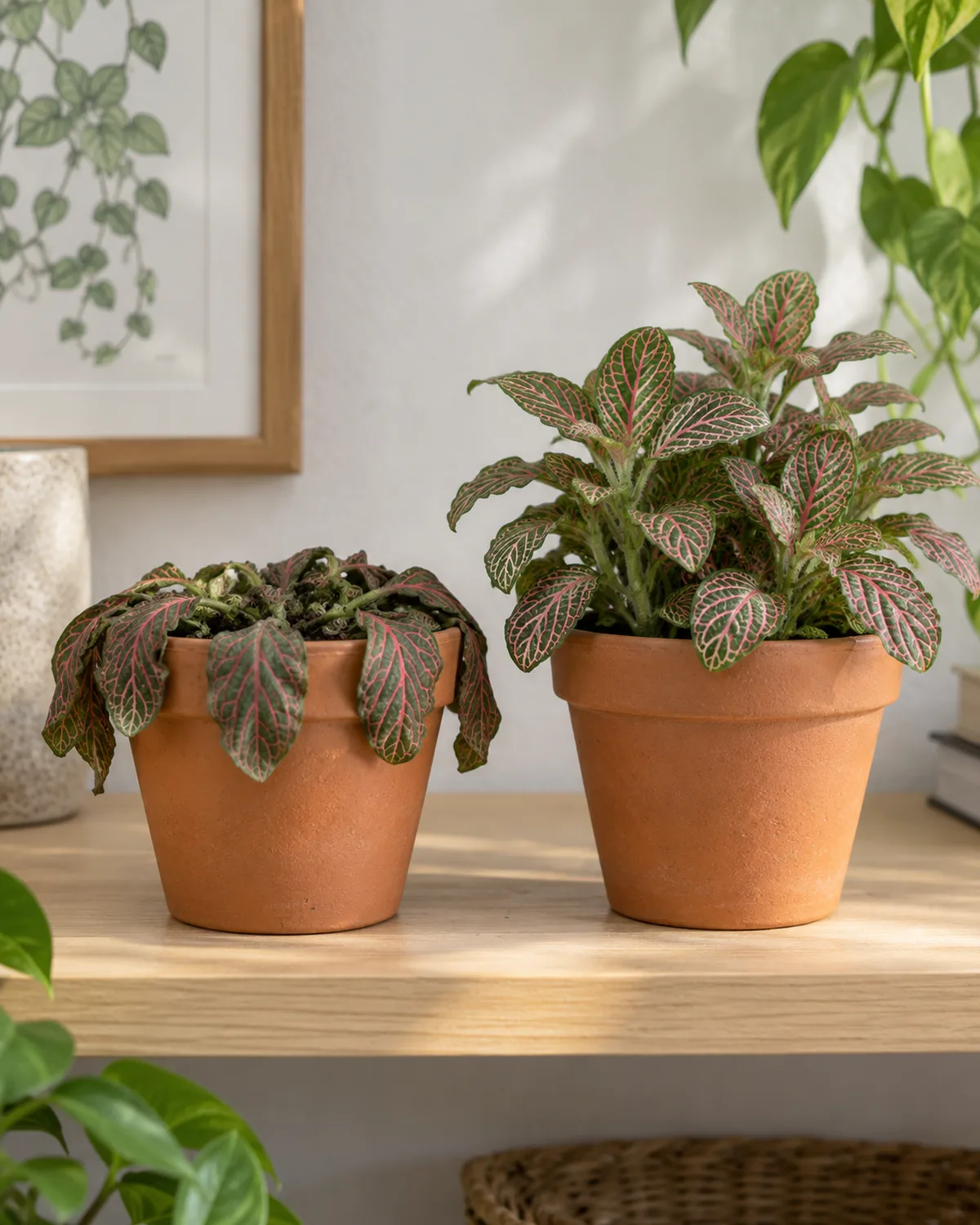
If you have never seen a nerve plant faint, the first time is alarming. The entire plant collapses flat against the soil surface as if it has died overnight. Every leaf droops, every stem goes limp. It looks terminal.
It is not. What you are seeing is a turgor pressure crash. The thin leaves lose water faster than the roots can replace it once the soil dries out, and the cells deflate like tiny balloons. The plant cannot hold itself upright without that internal water pressure.
The fix is absurdly simple: water it. Bottom-water by setting the pot in a tray of lukewarm water for fifteen minutes, or drench from the top until water runs out the drainage holes. Within thirty to ninety minutes, the cells refill, turgor pressure returns, and the plant stands back up as if nothing happened.
- Recovery timeline: most nerve plants are fully upright within one hour of thorough watering — some recover in as little as twenty minutes
- Repeated fainting is stressful: the plant survives individual episodes easily, but chronic under-watering leads to crispy leaf edges that do not bounce back even after rehydration
- The real danger signal: if the plant stays limp after thorough watering, the problem is likely root rot from overwatering rather than under-watering — the roots are too damaged to take up water
Both cause wilting — but the leaves tell you which is which.
Light That Keeps the Veins Vivid Without Burning the Leaves
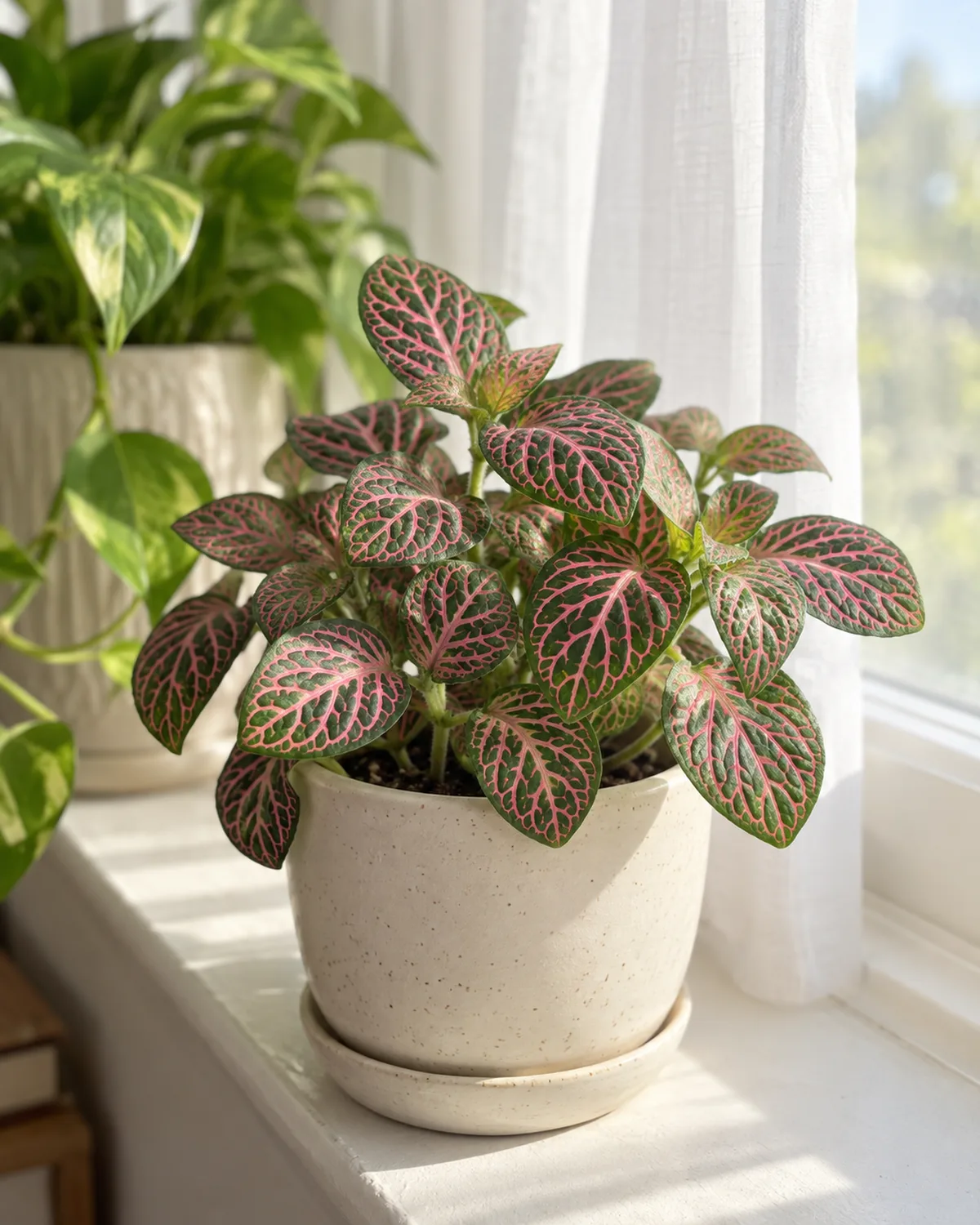
Bright indirect light is the sweet spot for nerve plants, and the window for error is narrower than most houseplants. Too much direct sun bleaches the vein color and scorches the thin leaves within hours — nerve plant leaves have almost no waxy cuticle to protect them from UV damage.
Too little light fades the vein contrast and pushes leggy growth as the stems stretch toward whatever dim source is available.
A north-facing or east-facing window delivers the gentle, consistent light that keeps vein colors vivid without burning. West windows work if the plant sits back from the glass or behind a sheer curtain. South windows are too intense for all but the earliest morning hours.
- Vein color and light are directly linked: brighter indirect light produces more vivid pink, red, or white veins — dim conditions fade the contrast and make the foliage look washed out
- Direct sun damage is fast: even thirty minutes of unfiltered afternoon sun can leave bleached or brown patches on nerve plant leaves that do not recover
- Grow lights work well: position a full-spectrum LED twenty-five to thirty centimeters above the plant on a twelve-hour timer — nerve plants thrive under artificial light because the intensity stays consistent
The forest-floor origin is the key to understanding nerve plant light needs. In Peru, these plants grow under a multi-layered canopy that filters out nearly all direct sunlight. What reaches the forest floor is soft, diffused, and consistent — exactly what a sheer curtain or north window provides in a home.
The Watering Rhythm a Nerve Plant Actually Needs
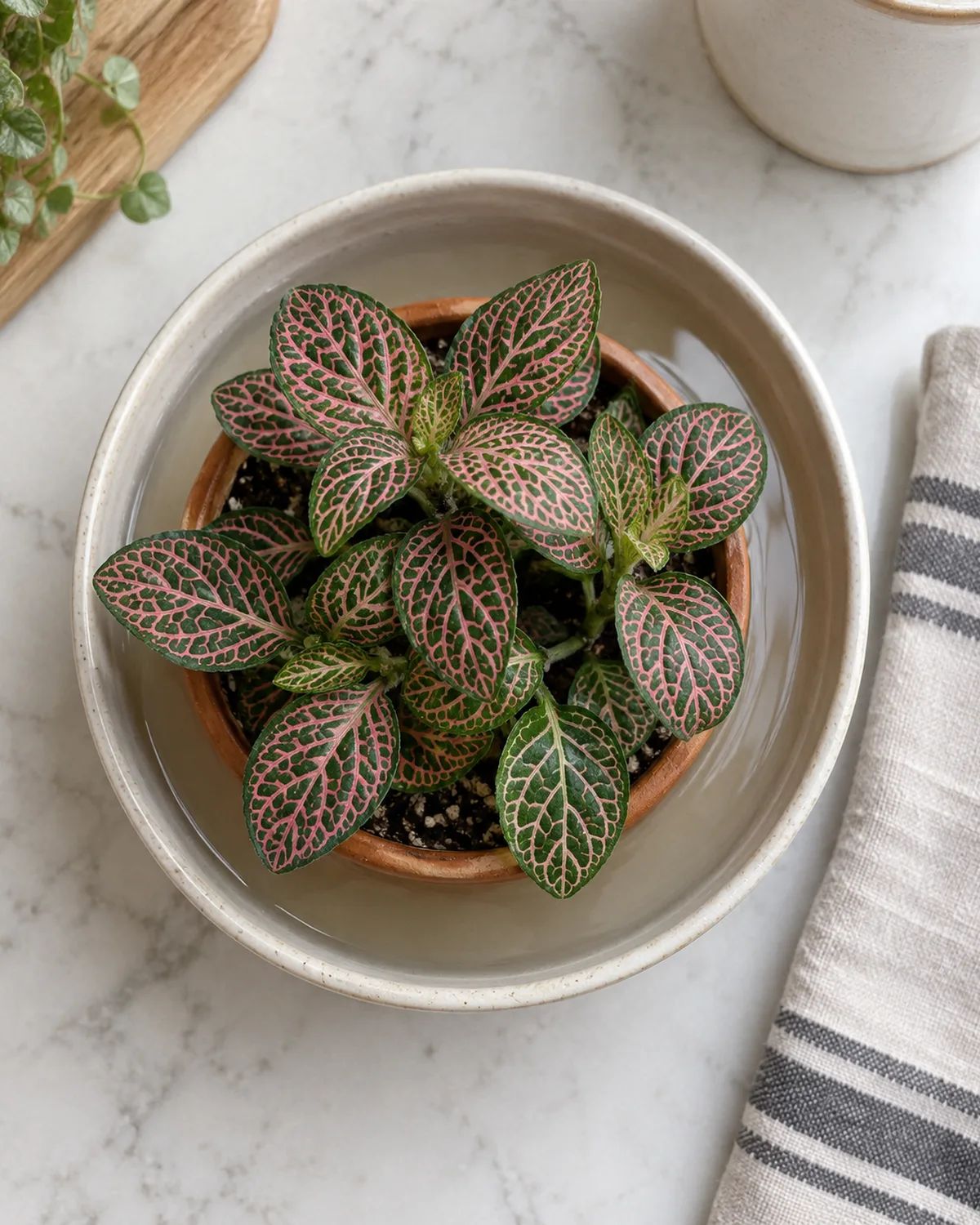
Consistently moist is the target — not wet, not dry, just the narrow band in between where the soil feels like a wrung-out sponge. Nerve plants have shallow root systems that sit in the top five to eight centimeters of soil, and those fine roots dry out fast in standard potting mix.
Check the soil every two to three days by pressing your fingertip half a centimeter into the surface. If it feels dry at that depth, water thoroughly. If it still feels moist, wait another day. The goal is to catch the soil right before it dries out — not after the plant has already fainted.
- Bottom watering reduces drama: set the pot in a tray of room-temperature water for ten to fifteen minutes, then remove — the soil wicks up exactly what it needs without oversaturating the surface
- Lukewarm water only: cold tap water shocks the tropical roots and can cause temporary leaf curl — let the water sit for an hour or use room-temperature filtered water
- Pot drainage is non-negotiable: a nerve plant sitting in standing water develops root rot within days — always use a pot with drainage holes
- Self-watering pots are ideal: the wicking reservoir delivers steady, even moisture that matches the nerve plant's constant but moderate thirst — set it and check the reservoir weekly
The frequency changes with seasons. In summer with active growth and higher evaporation, you may water every two to three days. In winter when growth slows and indoor heating dries the air, the soil surface dries faster but the roots use less — check more often but water the same way.
Humidity Is the One Thing You Cannot Fake
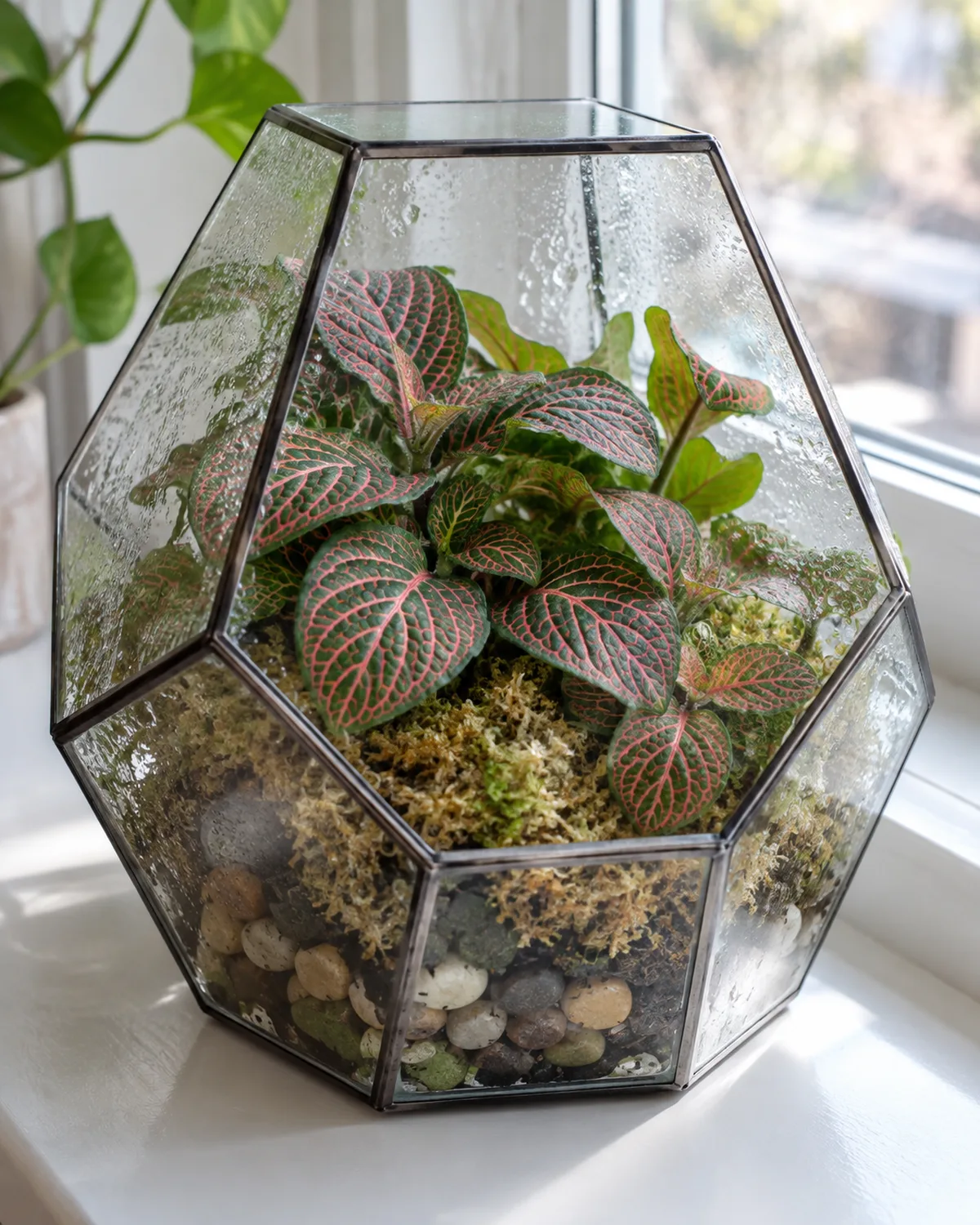
This is the make-or-break requirement. Nerve plants evolved on the tropical forest floor under near-constant eighty to ninety percent humidity, and they show it. Below fifty percent relative humidity, the thin leaf margins dry out, curl, and turn brown — crispy edges that no amount of watering fixes because the problem is atmospheric, not soil-based.
Most homes sit between thirty and fifty percent humidity, which is the danger zone for nerve plants. Air conditioning and central heating push it even lower in summer and winter respectively. The plant does not adapt to low humidity — it just slowly desiccates from the leaf edges inward.
- Terrarium is the gold standard: a closed or semi-closed glass terrarium traps moisture and maintains seventy to ninety percent humidity with zero effort — nerve plants are one of the most popular terrarium species for exactly this reason
- Humidifier within one meter: a cool-mist humidifier running near the plant is the most reliable open-air solution — aim for sixty percent or higher
- Pebble tray provides a modest boost: fill a shallow tray with pebbles and water, set the pot on top — evaporation raises local humidity by five to ten percent, which helps but may not be enough on its own
- Grouping plants raises humidity: clustering nerve plants with other tropicals like calathea, ferns, and prayer plants creates a microclimate of shared transpiration
Misting is almost useless. A mist bottle raises humidity for roughly ten to fifteen minutes before the droplets evaporate. Doing it three times a day is better than nothing, but it is a band-aid that many growers mistake for a real solution.
Persistent crispy edges despite regular misting is the telltale sign that ambient humidity needs a structural fix — terrarium, humidifier, or bathroom placement.
Fix the humidity problem before treating individual leaves.
Soil Mix That Stays Moist Without Staying Wet
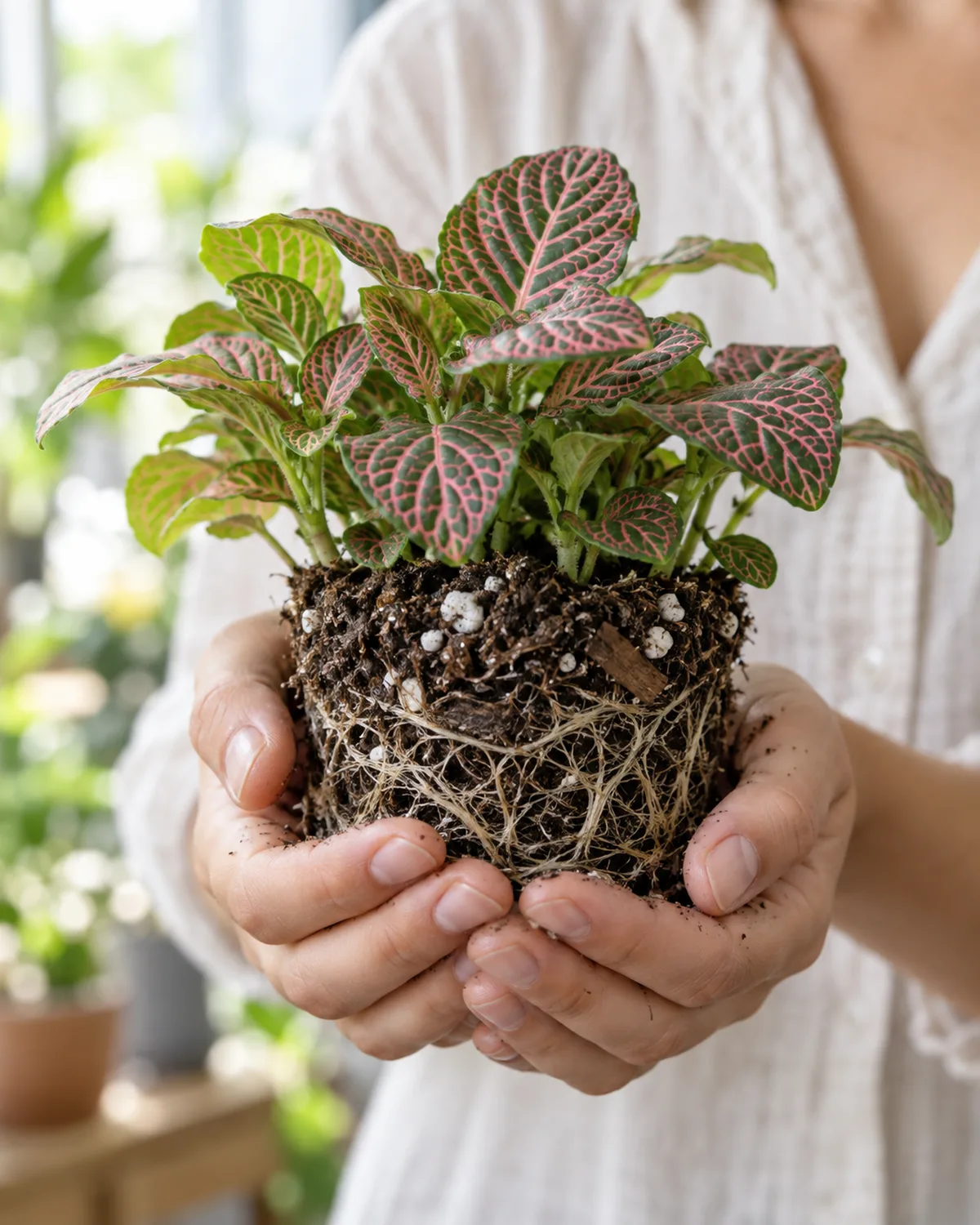
The root system of a nerve plant is shallow and fine — a mat of thin roots that spreads horizontally in the top five centimeters of soil rather than diving deep. This root architecture needs a mix that retains moisture in the upper layer but drains fast enough that the roots never sit in waterlogged soil.
A proven recipe: two parts peat moss or coco coir, one part perlite, and one part fine orchid bark. The peat holds moisture for the shallow roots, the perlite creates air pockets that prevent compaction, and the bark adds structure that keeps the mix from turning into a dense mud when wet.
- Avoid heavy garden soil: it compacts around the fine roots, holds too much water, and suffocates them — standard potting mix from a bag works as a base if you add perlite and bark
- Repot annually in spring: nerve plants are not fast growers, but the shallow root system benefits from fresh mix once a year — the old mix breaks down and loses its drainage structure
- Shallow pot over deep pot: a four to five inch pot is sufficient for most nerve plants — deep pots hold excess moisture below the root zone where it does nothing useful and creates a rot risk
- Drainage layer myth: gravel at the bottom of the pot does not improve drainage — it just raises the water table closer to the roots — use a pot with holes and a well-draining mix instead
Feeding a Light-Appetite Tropical
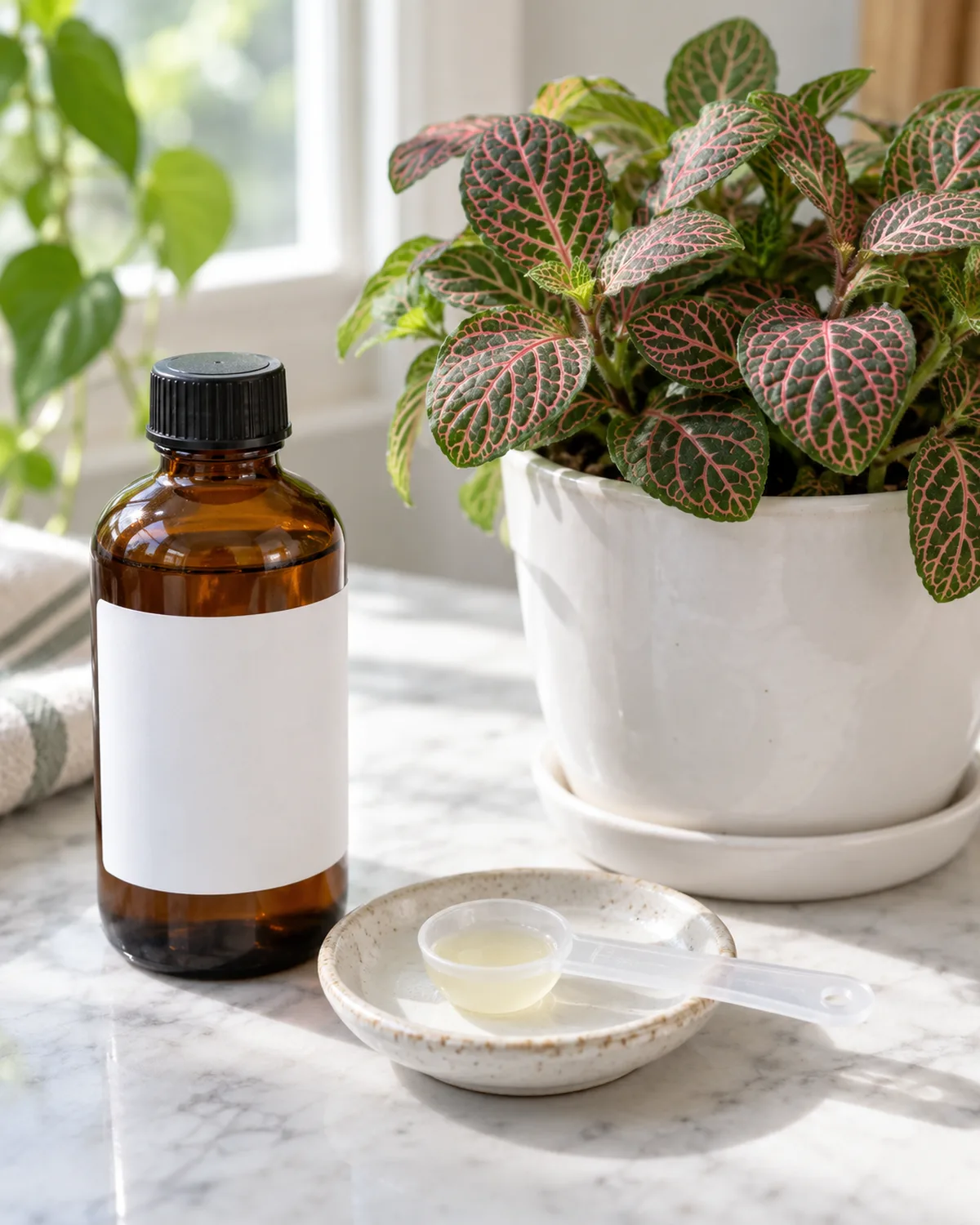
Nerve plants are light feeders that burn easily. A balanced liquid fertilizer — 10-10-10 or 20-20-20 — diluted to half the label's recommended strength, applied once a month during spring and summer, is all the plant needs. Stop feeding entirely from October through February when growth slows to a crawl.
Over-fertilizing shows up as brown leaf tips that look identical to low-humidity damage. If you see crispy margins and your humidity reads above fifty percent, excess fertilizer salt in the soil is the likely culprit. Flush the soil by running lukewarm water through the pot for several minutes, letting it drain completely, and then reducing your feeding frequency.
- Half strength, always: nerve plant roots are sensitive to salt buildup — full-strength fertilizer risks chemical burn on the fine root hairs
- Flush soil quarterly: run three to four pot volumes of plain water through the soil to wash out accumulated salts — this is especially important if you use tap water, which adds its own mineral content
- Signs of under-feeding: pale veins and slow growth during the active season — but this is rare because nerve plants genuinely do not need much
- Organic option: diluted worm castings tea applied monthly provides a gentler nutrient source with almost zero burn risk
Propagation by Stem Cuttings in Water or Soil
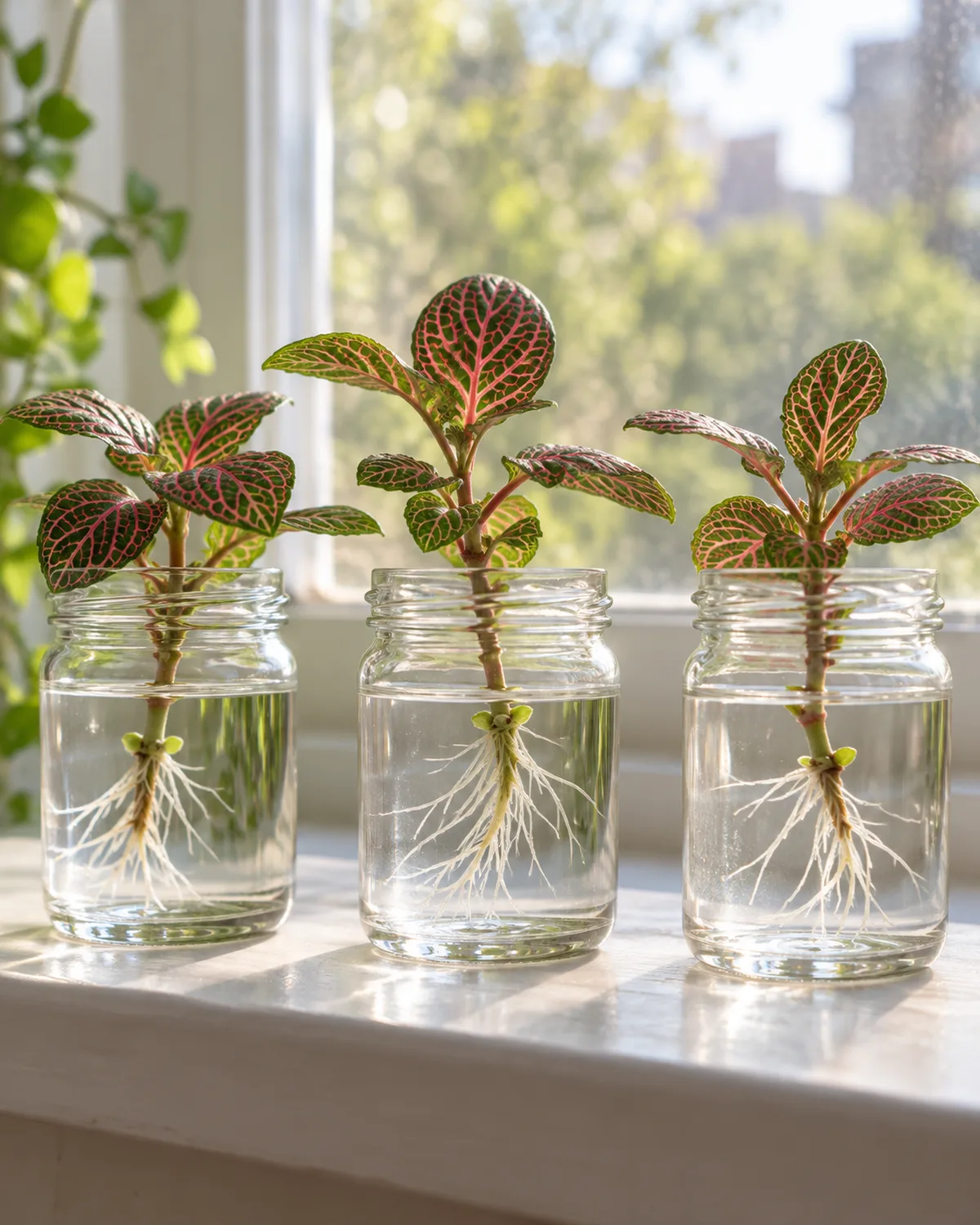
Nerve plants are one of the easiest houseplants to propagate, and stem cuttings in water are the simplest method. Cut a healthy stem three to four inches long with at least two nodes — the slightly swollen points where leaves attach.
Strip the lowest pair of leaves so the nodes are bare, and set the cutting in a jar of clean water with the nodes submerged and the remaining leaves above the surface.
Roots appear within one to two weeks in warm conditions. The white root tips are visible through the glass before they are long enough to anchor in soil — let them grow to two to three centimeters before transplanting into moist potting mix.
- Water propagation tips: change the water every five to seven days to prevent bacterial film, use room-temperature water, and keep the jar in bright indirect light — a windowsill is ideal
- Soil propagation alternative: dip the cut end in rooting hormone, insert into moist perlite-peat mix, and cover with a clear plastic bag or cloche to hold humidity — new growth from the tip confirms rooting in two to three weeks
- Division of mature clumps: a full pot of nerve plant is actually a tangle of individual stems — gently pull the root ball apart into two or three sections and pot each separately
- Best timing: spring and early summer give the fastest root development — avoid propagating in winter when the plant's metabolic rate drops
The division method produces instant full plants rather than small cuttings, and nerve plants tolerate being divided more gracefully than most houseplants. Water the mother plant thoroughly a day before dividing to make the root ball easier to separate without tearing too many roots.
Pests, Problems, and the Real Reasons Leaves Go Crispy
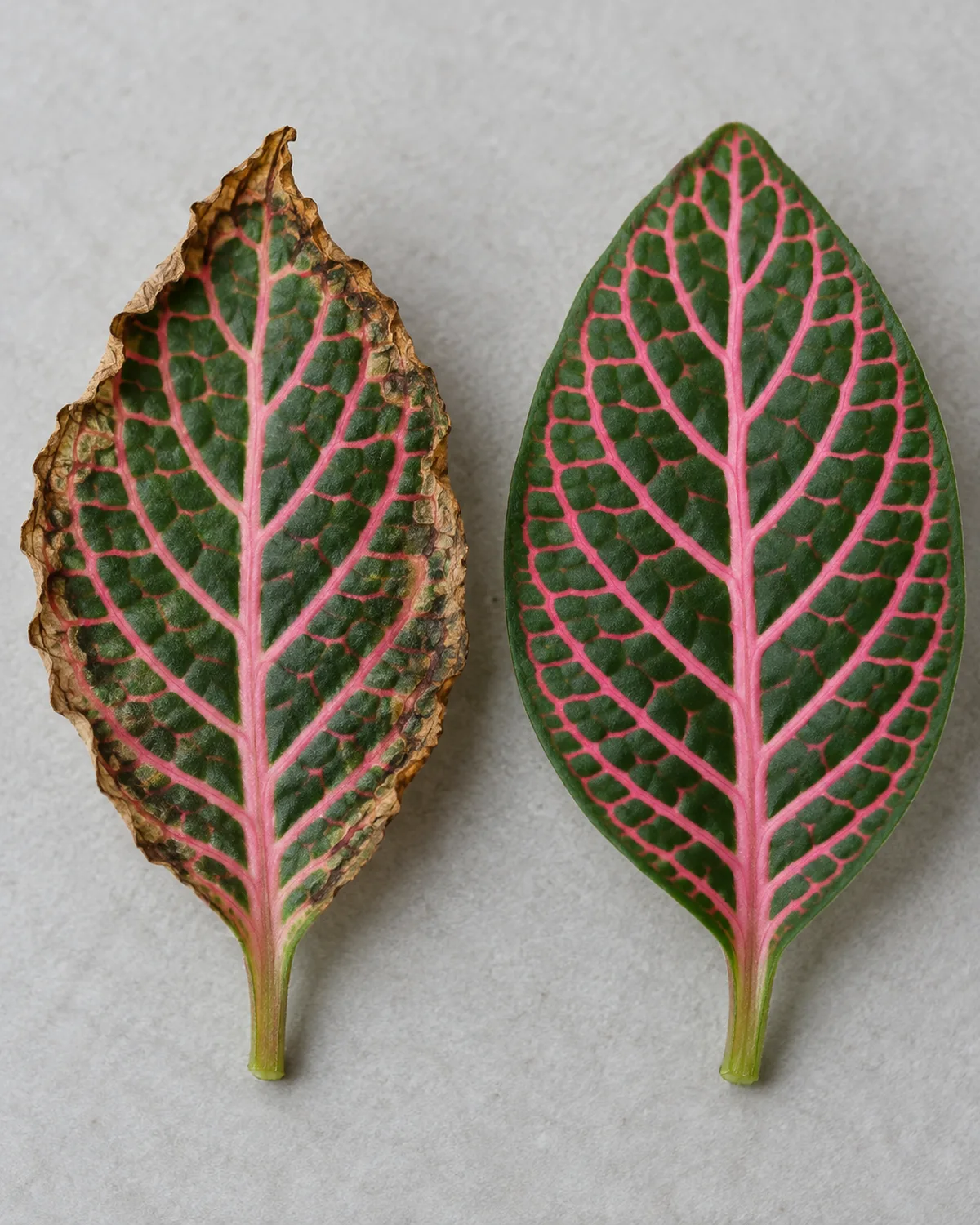
The single most common complaint about nerve plants is crispy brown leaf edges — and the single most common misdiagnosis is under-watering. In nine out of ten cases, the real cause is low humidity. The thin leaves lose moisture to the air faster than the roots can replace it, and the margins dry out first because they are the thinnest, most exposed tissue.
Before reaching for the watering can, check your humidity with a hygrometer. If it reads below fifty percent, no amount of soil moisture will fix the crispy edges. The solution is atmospheric: terrarium, humidifier, or a more humid room.
- Fungus gnats: the most common pest — they breed in the moist soil nerve plants need and their larvae feed on fine roots — yellow sticky traps catch adults, and a top layer of sand or perlite discourages egg-laying
- Mealybugs: white cottony clusters in leaf axils and under leaves — wipe off with a cotton swab dipped in rubbing alcohol, then spray with neem oil weekly for three weeks to break the lifecycle
- Aphids: soft-bodied clusters on new growth — blast off with a gentle stream of lukewarm water, follow up with insecticidal soap
- Yellow leaves: usually overwatering or cold drafts — check drainage and move the plant away from exterior doors and AC vents
- Leggy, stretched stems: insufficient light — move closer to a window or add a grow light
- Toxicity: nerve plants are non-toxic to cats and dogs according to the ASPCA — one of the safest choices for homes with pets
Nerve Plant Varieties Worth Collecting
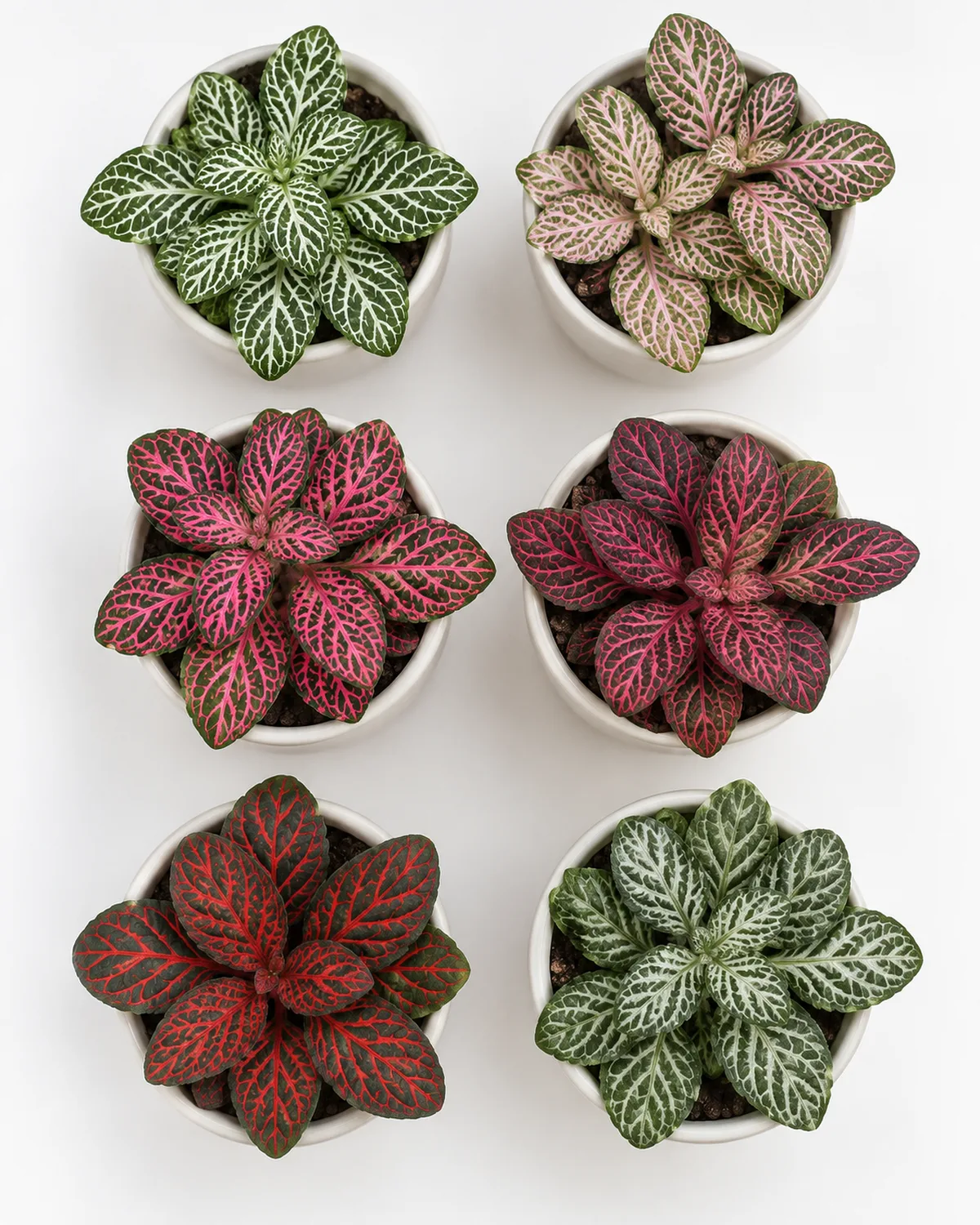
The species itself has just two basic forms — Fittonia albivenis with white veins and Fittonia verschaffeltii with red veins — but decades of hybridization have produced a spectrum of cultivars that makes collecting nerve plants a quiet obsession.
All share the same care requirements. The differences are purely aesthetic: vein color, leaf size, growth habit, and the ratio of vein to green on each leaf.
- 'White Anne': the classic — crisp silver-white veins on dark green, compact growth, the most widely available variety and a reliable starter
- 'Pink Angel': hot pink veins on a compact form — the most popular nerve plant in garden centers and the one most people picture when they hear the name
- 'Red Anne': deep rose-red veins that darken with age — slightly more vigid than the pink varieties and a good contrast piece in a collection
- 'Frankie': pink leaves with narrow green margins — the reversed color pattern where the pink dominates and the green is the accent, creating a dramatically different look from the standard forms
- 'Black Star': dark, nearly black-green leaves with deep red veins — the moodiest variety and a striking terrarium centerpiece
- 'Superba': larger leaves than the standard cultivars — a good choice for open-air growing because the bigger leaf surface area handles lower humidity slightly better
Mini cultivars — marketed as "mini" or "dwarf" nerve plants — stay under three centimeters tall and are purpose-built for terrariums. They have the same vein patterns as their full-sized counterparts but on a miniature scale that fits inside a jar.
Frequently Asked Questions
Can nerve plants grow in a terrarium?
Yes, and it is arguably the ideal environment. The enclosed glass traps humidity at seventy to ninety percent — exactly what nerve plants need — while the diffused light through the glass walls provides the gentle illumination they prefer.
Closed terrariums need almost no watering once the moisture cycle establishes itself. Nerve plants are one of the top five most commonly used terrarium plants for good reason.
- Best terrarium companions: ferns, mosses, peperomia, and miniature begonias share the same humidity and light needs
- Container style: geometric glass, wardian cases, or even large mason jars all work — the key is some degree of enclosure to trap moisture
Are nerve plants toxic to pets?
No. The ASPCA lists Fittonia as non-toxic to both cats and dogs. This makes nerve plants one of the safest houseplant choices for homes with curious pets, alongside spider plants, calathea, and prayer plants.
| Question | Short Answer |
|---|---|
| Yellow leaves? | Overwatering or cold drafts — check drainage first |
| How big? | Six to fifteen centimeters tall, spreading to thirty centimeters |
| Growth speed? | Slow — two to three years to reach mature spread |
Why are my nerve plant leaves turning yellow?
Yellow leaves on a nerve plant almost always point to overwatering or cold drafts. Check the soil — if it is saturated and the pot has been sitting in water, let it dry slightly and improve drainage. If the soil moisture is fine, check for cold air sources: exterior doors, single-pane windows in winter, or AC vents blowing directly on the plant.
How big do nerve plants get?
Most nerve plants stay between six and fifteen centimeters tall and spread up to thirty centimeters wide as a low ground cover. The mini cultivars bred for terrariums stay under three centimeters tall. Neither form grows fast — expect a mature spread in two to three years from a small nursery start.
Quick Reference
10 nerve plant care essentials to save
- 1Mosaic vein pattern is the signatureContrasting veins in white, pink, or red on dark green leaves — the more bright indirect light, the more vivid the color.
- 2The dramatic faint is a turgor crash, not deathWater thoroughly and the plant recovers within thirty to ninety minutes. Repeated fainting causes permanent crispy edges.
- 3Bright indirect light only — no direct sunNorth or east windows are ideal. Direct afternoon sun bleaches veins and scorches thin leaves within hours.
- 4Keep soil consistently moist, never soggyCheck every two to three days. Bottom watering is the most drama-free method for shallow nerve plant roots.
- 5Humidity above fifty percent is non-negotiableBelow fifty percent causes crispy brown leaf margins that watering cannot fix. Terrarium or humidifier is the real solution.
- 6Use a moisture-retentive but well-draining mixTwo parts peat or coco coir, one part perlite, one part orchid bark. Shallow pots suit the horizontal root system.
- 7Half-strength fertilizer monthly in growing seasonStop in winter. Over-fertilizing mimics humidity damage with brown tips — flush soil quarterly to remove salt buildup.
- 8Stem cuttings root in water in one to two weeksCut below a node, strip lower leaves, submerge nodes in clean water. Division of mature clumps produces instant full plants.
- 9Crispy edges are almost always low humidity, not thirstCheck hygrometer before watering. Non-toxic to cats and dogs. Watch for fungus gnats in the moist soil.
- 10Collect across the vein spectrumFrom classic White Anne to reversed-pattern Frankie to moody Black Star — all share the same care requirements.
kultivy.com — nerve plant care guide

Mara writes about indoor plants for people who want honest, practical care advice without the fluff. She covers everything from first-time plant parents to collectors chasing rare aroids — always with the science behind why something works. More at kultivy.com.