Air plants sit on a shelf with no pot, no soil, and no visible means of support. Most people buy one because it seems like the easiest possible houseplant. Then it slowly turns brown and dies.
The problem is not neglect. Air plants absorb water and nutrients through specialized scales on their leaves, not through roots. Get the soaking method right, keep air moving around them, and they thrive for years.
What makes air plants different from every other houseplant
Every other houseplant on this site grows in soil, sits in a pot, and drinks through its roots. Tillandsia — the genus that includes all air plants — does none of those things.
Air plants belong to the Bromeliaceae family, the same family as bromeliads and pineapples. But while bromeliads collect water in a central cup and grow roots into soil, Tillandsia evolved a completely different survival strategy.
They are true epiphytes: they attach to trees, rocks, cacti, fences, and even power lines in their native habitats across the southern United States, Central America, and South America.
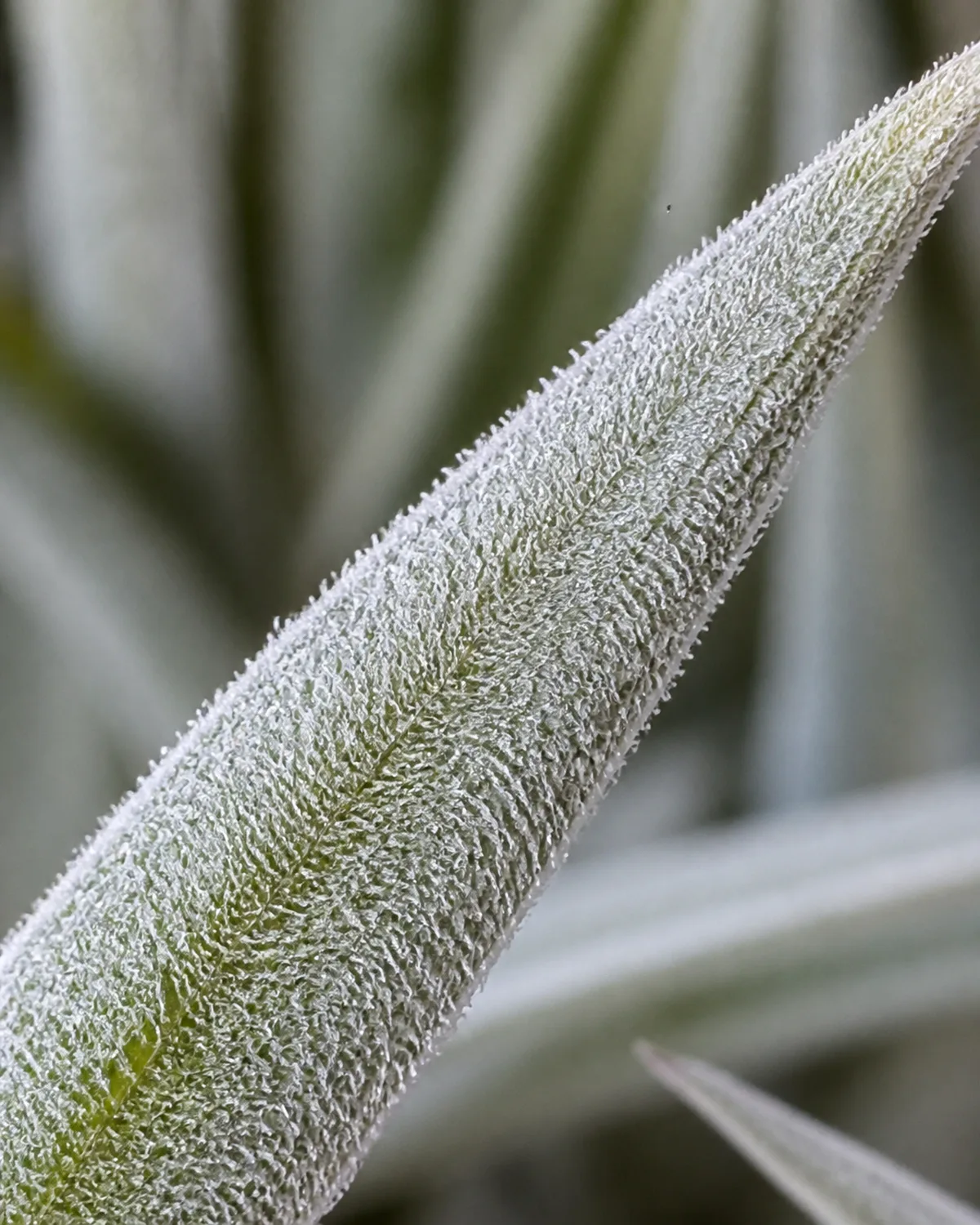
Their roots serve only as anchors. Some species barely produce roots at all. Every drop of water and every nutrient the plant needs is absorbed through trichomes — tiny specialized scales that cover the leaf surfaces.
- Trichomes open when wet to absorb moisture and dissolved minerals directly into leaf tissue
- Trichomes close when dry to seal the leaf surface and prevent water loss
- The silvery-white color of many air plants is the trichomes themselves — dense coverage creates that frosted, almost metallic appearance
- Trichomes also reflect sunlight, protecting the plant in the exposed, bright habitats where many species grow wild
The genus contains over 650 species, ranging from thumbnail-sized Tillandsia ionantha to the massive T. xerographica, which forms silvery rosettes over a foot across. This is not a single plant — it is a vast group with wildly different sizes, shapes, and care requirements.
Air plants are not parasites. They take nothing from the trees or surfaces they attach to. The host provides physical support and nothing more.
Four species that cover the most common indoor situations — pick the one that fits your light, your display vision, and your watering habits.
Xeric versus mesic: the two care tracks that matter
Before doing anything else with a new air plant, answer one question: is it xeric or mesic? This single distinction determines watering frequency, light needs, and humidity tolerance.
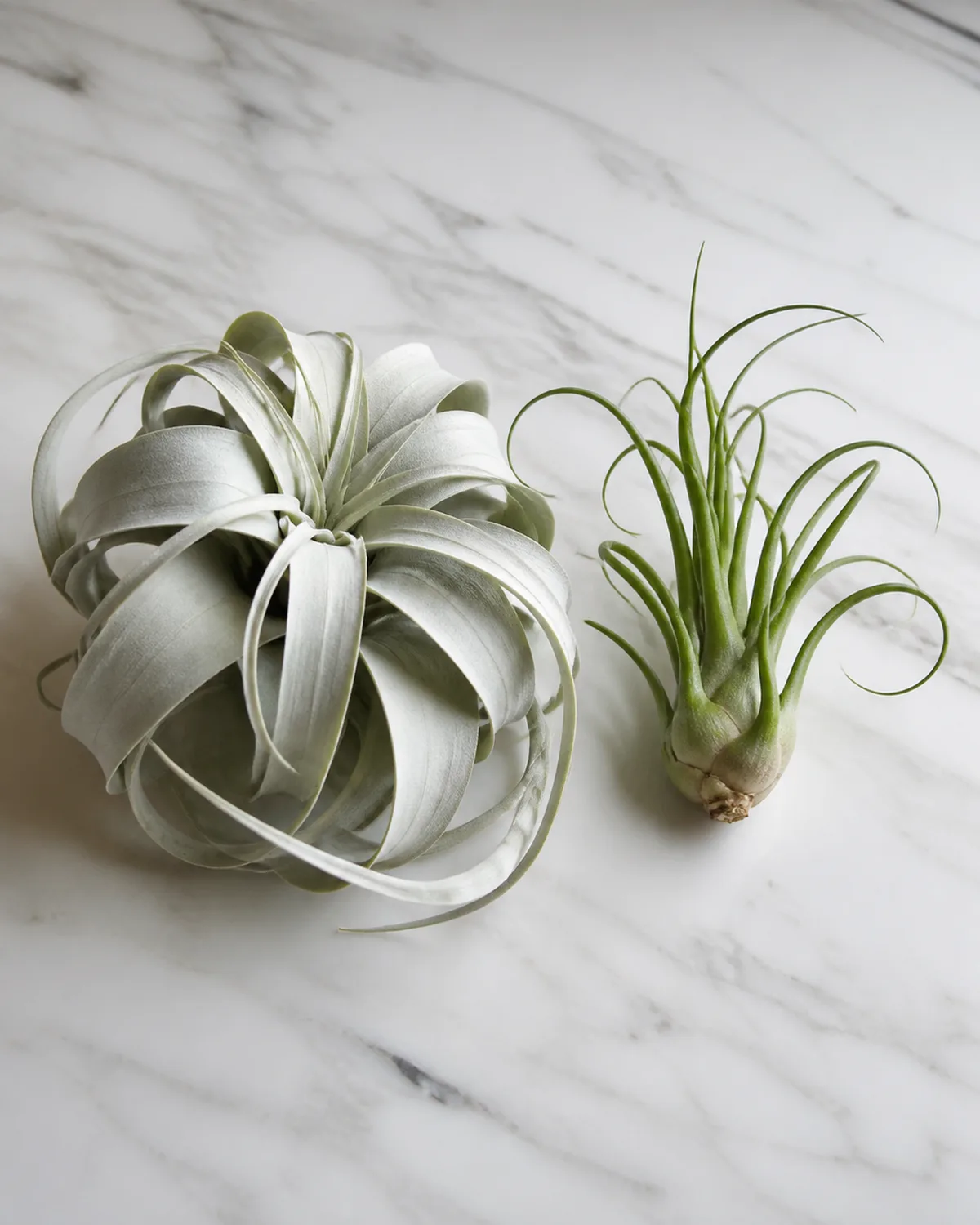
Xeric Tillandsia evolved in arid, exposed habitats — desert rocks, dry forests, and open scrublands with intense sun. They have:
- Thick, stiff leaves with heavy trichome coverage
- A silvery-white or gray appearance (the trichomes create that color)
- Higher drought tolerance and slower water absorption
- A preference for brighter light, including some direct sun
Common xeric species include T. xerographica (the massive silvery rosette), T. tectorum (fuzzy snowball texture), T. harrisii, and T. capitata.
Mesic Tillandsia evolved in humid, shaded environments — tree canopies in cloud forests, sheltered ravines, and tropical understories. They have:
- Thinner, smoother leaves with less trichome coverage
- A greener, shinier appearance
- Higher water needs and faster drying
- Better tolerance of lower light
Common mesic species include T. bulbosa (squid-like curling leaves), T. butzii (spotted), T. juncea (grass-like), and T. stricta (compact green rosette).
The practical consequence is straightforward. Treating a xeric air plant like a mesic — soaking too often — leads to rot. Treating a mesic like a xeric — soaking too rarely — leads to desiccation. When you buy an air plant, the first assessment is visual: silver and stiff means xeric care track, green and smooth means mesic care track.
Light: brighter than you think for a plant without soil
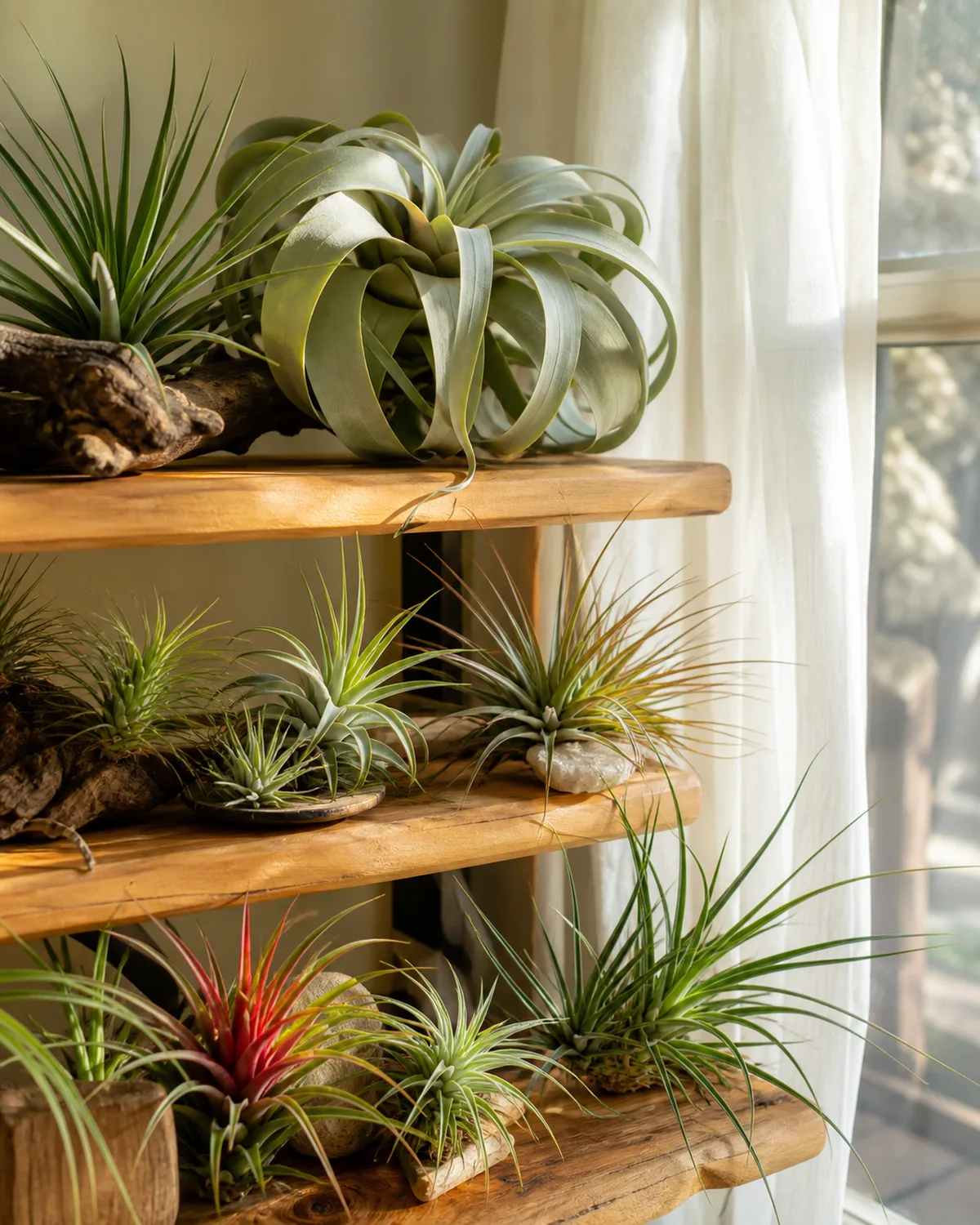
Air plants need more light than most people expect. Because they have no soil and look sculptural, they end up on dark bookshelves and windowless bathrooms — and they slowly decline.
Bright indirect light is the baseline for most Tillandsia. This is the same intensity range that works for succulents, not the lower light that ferns and calatheas tolerate. A south or west window with a sheer curtain is ideal for most collections.
- Xeric species tolerate and even prefer some direct morning sun — one to three hours of gentle east-window light
- Mesic species do better in filtered bright light without direct exposure
- Artificial grow lights work well: 12 hours of full-spectrum LED at moderate intensity, especially useful during winter when natural light drops
Insufficient light produces symptoms that are easy to misread as other problems:
- Leaves elongate and stretch toward the light source
- Trichome density decreases on xeric types, making silvery plants look greener
- The plant fails to bloom even after years of growth
- Slow, general decline that looks like underwatering but does not respond to more water
For a deeper look at matching any houseplant to your specific window direction and light intensity, see the light requirements guide. For supplemental lighting setups, the grow light guide covers LED options and timer configurations.
The soak-and-shake watering method
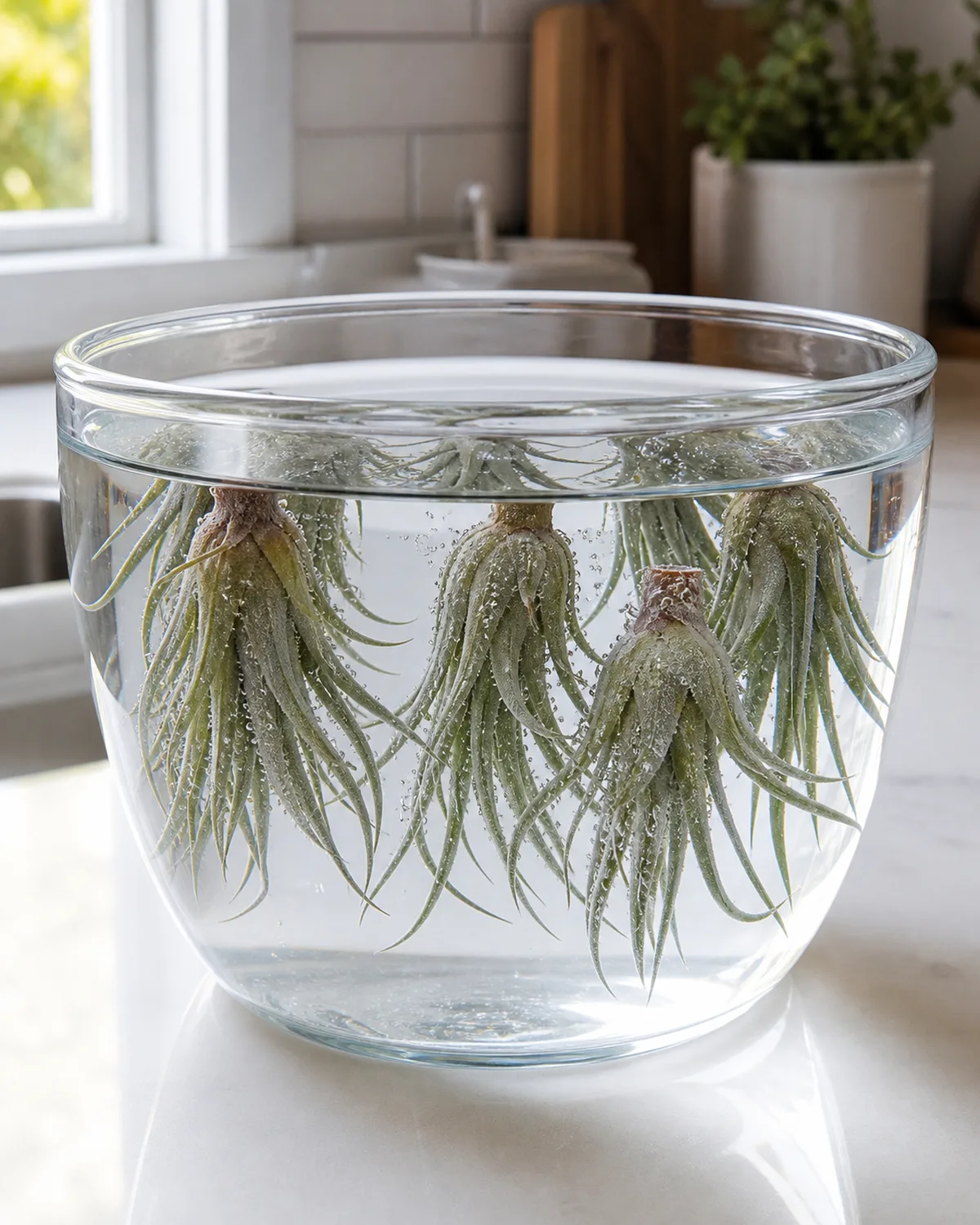
This is the single most important skill in air plant care. Get it right and nearly everything else falls into place.
The method has three steps:
- Soak — submerge the entire plant upside down in room-temperature water for 20 to 30 minutes. A quick dunk does not give trichomes enough contact time to fully open.
- Shake — lift the plant out and shake it gently but firmly to dislodge trapped water from between the leaves and the crown center.
- Dry upside down — place on a clean towel in a spot with air circulation for one to four hours until the base is completely dry. Water pooling in the crown causes crown rot, the number one killer of indoor air plants.
The frequency depends on the type:
- Xeric species: every 7 to 10 days
- Mesic species: every 5 to 7 days
- Dry heated homes in winter: increase frequency
- Humid summer conditions: decrease frequency
Water quality matters more than with soil-grown plants because trichomes absorb everything in the water directly into leaf tissue:
- Rainwater or spring water is ideal
- Tap water is fine if it is not heavily chlorinated or softened
- Water softeners add sodium that damages trichomes over time
- Letting tap water sit uncovered for 24 hours allows chlorine to evaporate
- Never use distilled water — it contains zero minerals and can draw nutrients out of the plant through osmosis
Misting between soaks helps in very dry conditions, but it cannot replace the deep soak. Trichomes need sustained contact — 20 minutes submerged — to fully open and absorb. A mist provides seconds of contact.
For the complete watering framework across all houseplant types, see the watering guide. Air plants represent the fourth distinct watering paradigm on this site, after the tropical top-inch-dry method, the succulent soak-and-dry cycle, and the bromeliad central cup technique.
Air circulation: the care factor nobody talks about
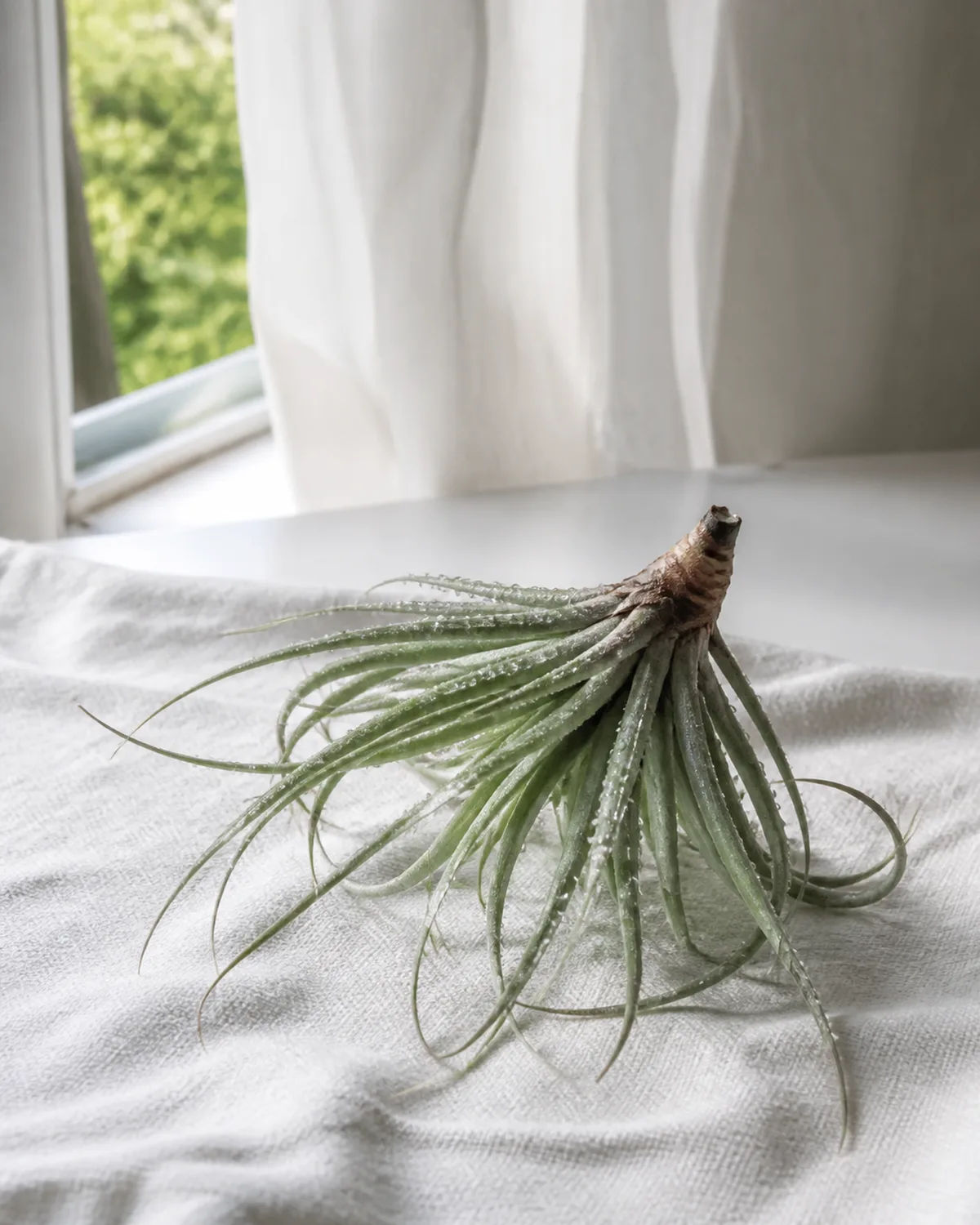
Most houseplant guides focus on light, water, and humidity. For air plants, add a fourth factor that outranks humidity: air circulation.
In the wild, Tillandsia grow in exposed positions — tree branches, cliff faces, open scrublands, the tops of cacti — where wind is constant. They evolved expecting air movement around them at all times. This is not a preference. It is a requirement.
Air circulation after soaking is especially critical. A wet air plant in stagnant air is a dead air plant. Without air flow, the water trapped in the crown and between the tightly layered leaves cannot evaporate. Rot begins within hours.
This is why air plants die in sealed terrariums — stagnant, humid, trapped air with no movement kills within weeks. The signs of poor circulation include:
- Persistent dampness at the base hours after soaking
- Dark softening at the crown (early rot)
- Musty or sour smell from the rosette center
Good circulation setups:
- Near an open window or in a room with cross-ventilation
- On an open shelf with natural room air flow
- Near a ceiling fan on low speed
- In an open-top terrarium or bowl — the opening must allow air flow
- Outdoors on a covered patio or porch
Poor circulation setups:
- Sealed glass globes (the worst offender)
- Enclosed terrariums without ventilation holes
- Crowded shelves pressed against walls with no space behind
- Inside cabinets, bookcases, or recessed shelving
The paradox that confuses people: air plants need moisture, but they need it to dry completely between waterings. Circulation is what makes this cycle work. A room at 40 percent humidity with good air flow will keep Tillandsia healthier than a room at 70 percent humidity with no air movement.
For guidelines on which terrarium setups work for air plants (open-top only) and which do not, the terrarium guide covers display options in detail.
Temperature: tropical survivors with a surprising cold limit
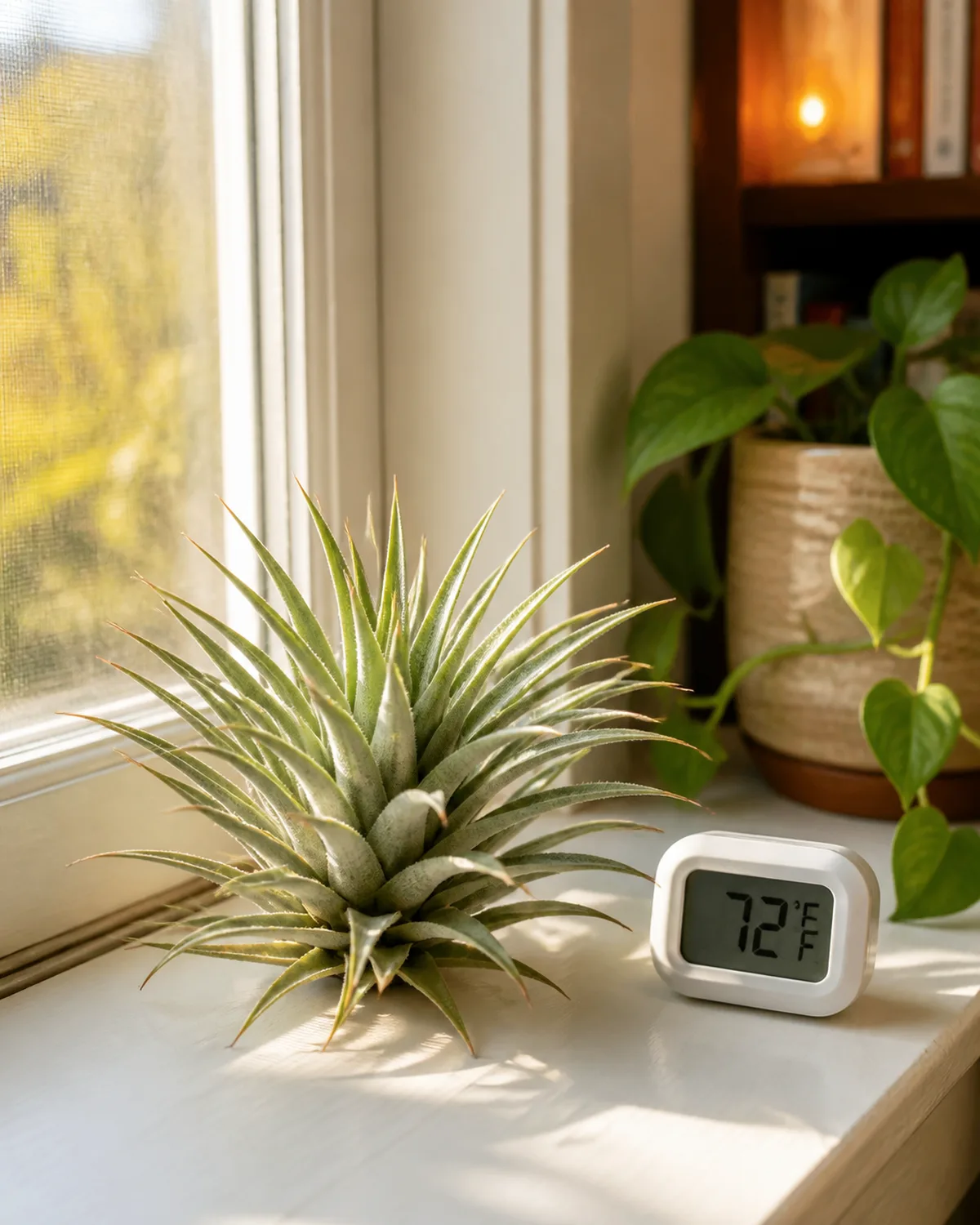
Air plants tolerate a wider temperature range than most tropical houseplants. The comfortable band runs from 50 to 90 degrees Fahrenheit, which covers normal indoor conditions in nearly every home.
Most species handle brief dips to 40 degrees without damage. Prolonged exposure below 45 degrees causes tissue damage — the leaves soften and darken at the tips. Any sub-freezing temperature kills the plant outright.
On the warm end, air plants handle heat up to 95 degrees as long as air circulation is adequate and the plant is hydrated. In stagnant hot air, they dry out rapidly. The combination of heat and no air flow is more dangerous than heat alone.
For outdoor display:
- Year-round outdoors in USDA zones 9 through 11 (southern Florida, coastal California, Hawaii)
- Seasonal outdoor display in cooler zones from late spring through early fall
- Bring indoors before nighttime lows consistently reach 50 degrees
In warm climates, mounted outdoor Tillandsia naturalize and grow wild. They are sold as ornamental landscape features, not just houseplants, and entire trees can end up decorated with air plants that propagated themselves over years.
Fertilizing: dilute, infrequent, and never on dry leaves
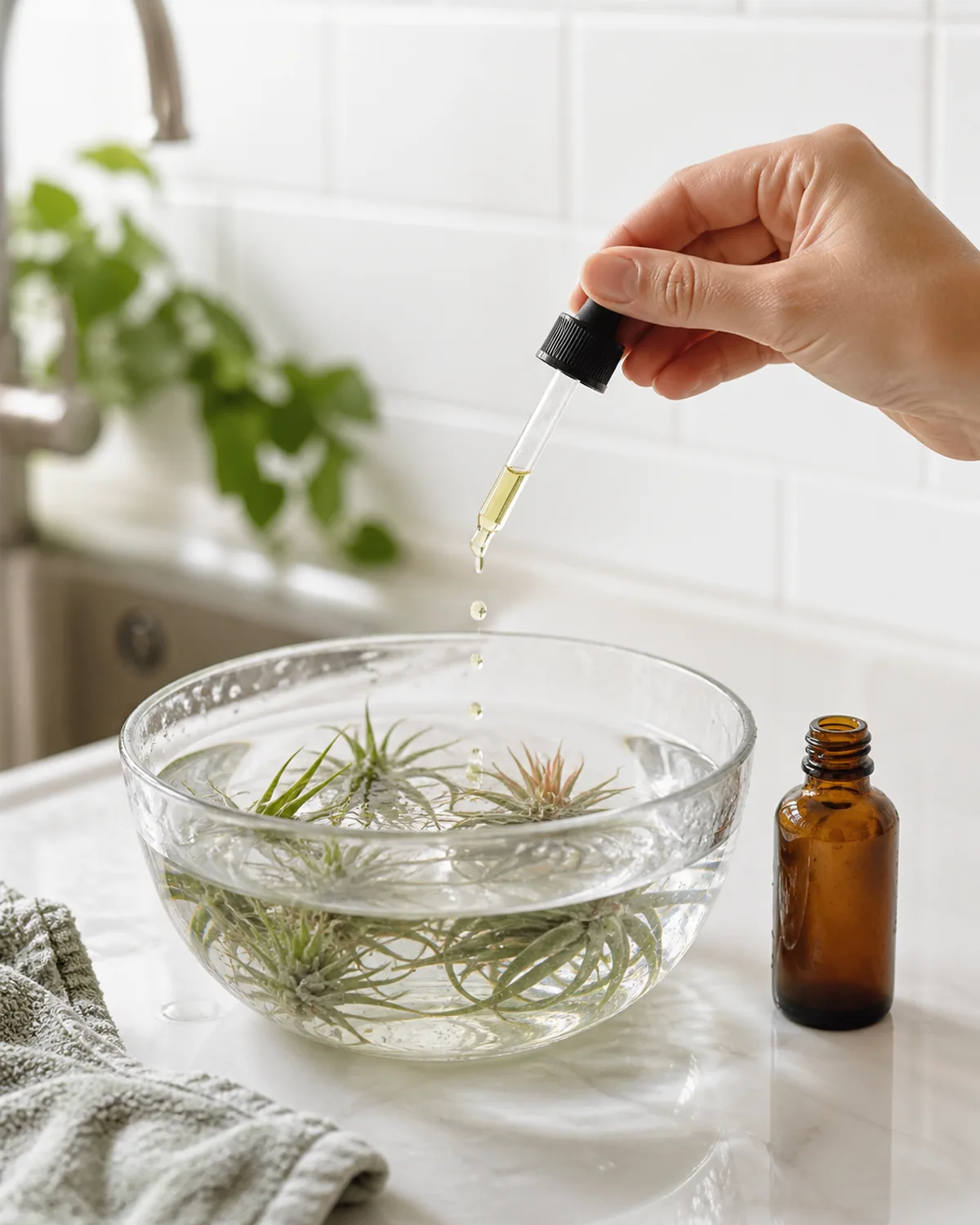
Air plants can survive without fertilizer. But blooming, pup production, and overall vigor improve noticeably with feeding.
The key differences from fertilizing soil-grown plants:
- Use a bromeliad or tillandsia-specific fertilizer — these are formulated with low nitrogen and critically, low copper. Copper is toxic to Tillandsia at concentrations that are harmless to other houseplants.
- Dilute to one-quarter strength if using a general-purpose houseplant fertilizer. One quarter of whatever the label recommends.
- Frequency: once a month during the growing season, spring through early fall. Skip winter entirely.
- Application method: add the fertilizer to the soak water. The plant absorbs nutrients through trichomes during the same soak that provides hydration. This is the most efficient delivery.
Two rules that prevent damage:
- Never apply fertilizer to a dry air plant. The concentrated salts damage trichomes on contact.
- Never mist fertilizer directly. The brief contact time means poor absorption and the residue left behind can clog trichomes.
Urea-nitrogen — the form found in most houseplant fertilizers — happens to be the preferred nitrogen form for Tillandsia. Soil-grown plants rely on soil bacteria to convert nitrogen into usable forms. Air plants, lacking soil entirely, absorb urea directly through trichomes without that bacterial intermediary.
Signs of nutrient deficiency include very slow growth, pale or washed-out color, and failure to bloom despite adequate light and plant maturity. Over-fertilization shows as leaf tip burn — brown tips similar to desiccation but appearing only at the very tips, not along the edges.
For the complete houseplant fertilization framework, including the weakly-weekly dilution method, see the fertilizing guide.
Mounting and display: no pot required
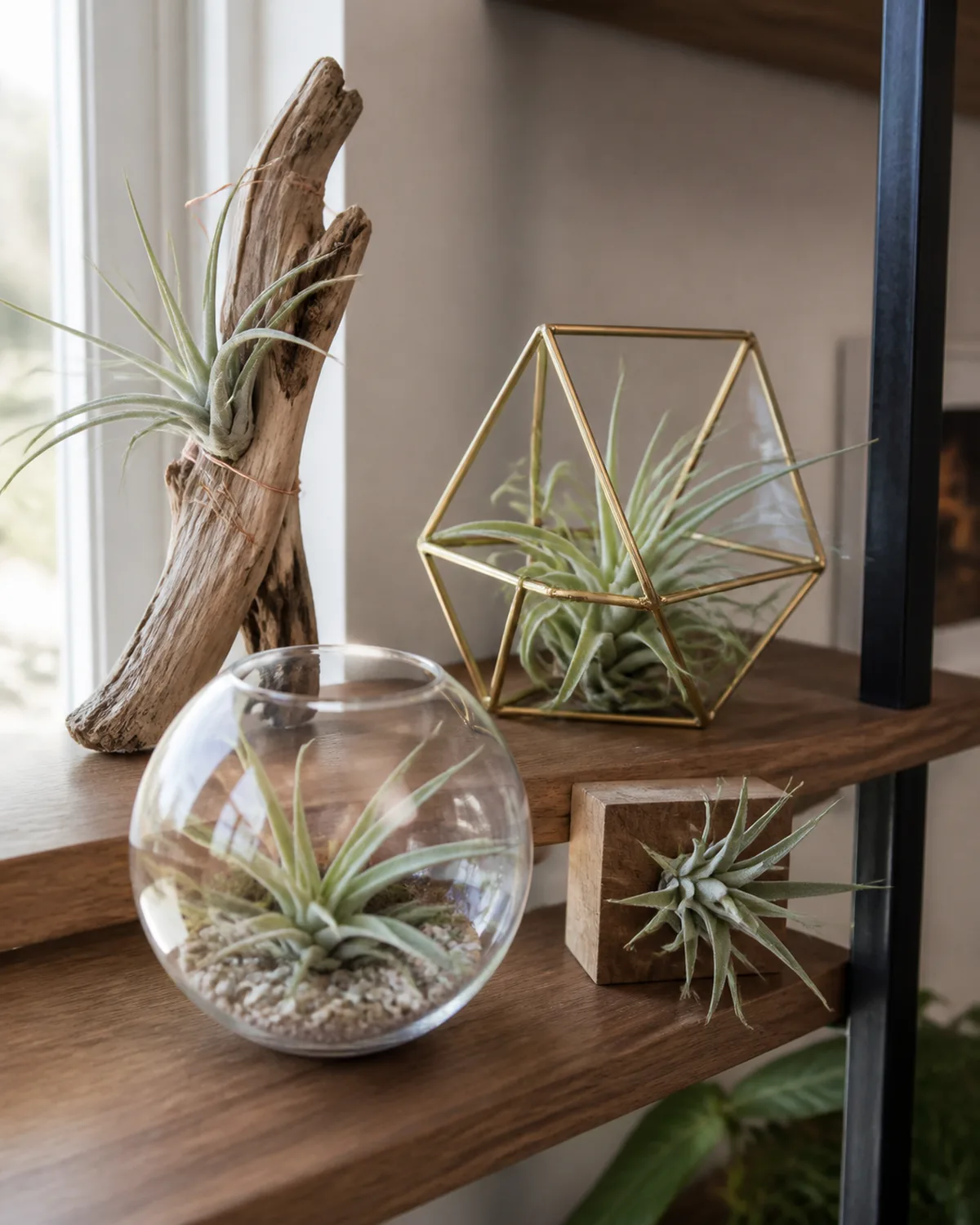
No pot. No soil. No drainage hole to worry about. The display versatility of air plants is unmatched by any other houseplant — they attach to almost anything.
The most popular mounting methods:
- Driftwood — attach with a small dot of E6000 adhesive, floral wire, or fishing line at the base. Never use superglue — it kills the tissue it contacts.
- Wire frames and holders — geometric brass and copper holders cradle the plant with air circulating around it. The plant sits loosely for easy removal at soak time.
- Glass globes — only open-top designs work. Sealed globes kill air plants within weeks from stagnant humidity.
- Magnets — a small Tillandsia on a magnetic base turns a refrigerator door into a display surface.
- Shells, stones, and crystals — nestle the plant into natural concavities. A dab of adhesive secures it if needed.
- Living walls — a grid of mounted air plants creates a living wall with the simplest maintenance: remove all plants for the weekly soak, dry, and replace.
Three display rules that prevent common failures:
- Every mounted position must allow removal for soaking — permanently glued plants die because they cannot be submerged
- The display spot must have adequate light, not just visual appeal
- Air must circulate around the plant — enclosed or cramped positions kill
Air plants live on a desk, a bookshelf, a bathroom ledge, a kitchen windowsill, a fridge door — anywhere that has light and air flow. For hanging display options, the dedicated guide covers additional mounting and suspension methods.
Blooming: the once-in-a-lifetime flower show
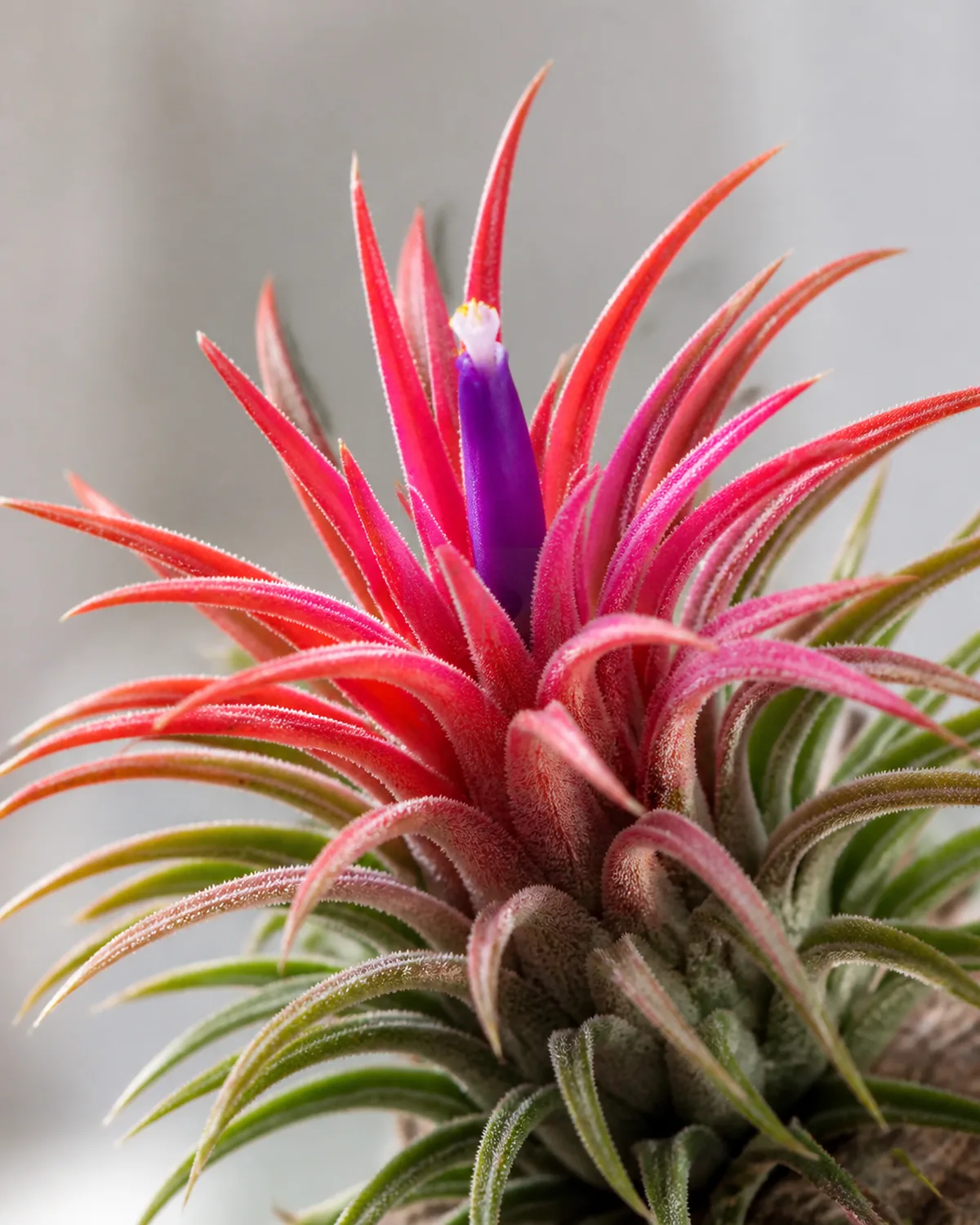
Every air plant blooms exactly once in its lifetime. This is not a care failure or a sign that something went wrong. It is the fundamental biology of the genus.
The bloom signals that the plant has reached sexual maturity and is beginning its reproductive phase. Timing varies wildly by species — some bloom within two to three years from pup, others take five to ten years or longer.
The flowers themselves range from simple and small to spectacular:
- T. ionantha produces a single small purple tubular flower from a rosette that turns brilliant red at the leaf tips
- T. brachycaulos turns entirely red or pink before blooming
- T. xerographica sends up a multi-branched inflorescence with bright red and purple bracts that lasts for weeks to months
- The bract — the modified leaf structure holding the flower — often outlasts the actual flower petals by weeks, providing color long after blooming finishes
Triggering bloom requires adequate bright light plus plant maturity. A slight stress — a brief dry period or a cool nighttime temperature drop — can nudge a mature plant into its bloom cycle.
The ethylene trick works on air plants just as it does on bromeliads: seal the plant in a clear bag with a ripe apple for one to two weeks. The ethylene gas released by the apple signals the plant to initiate flowering. This only works on mature plants that are already physiologically ready.
After blooming, the mother plant slowly declines over months while channeling energy into producing pups — the next generation. This decline is normal, expected, and not a sign of bad care. It is the lifecycle completing.
Growing pups: the next generation
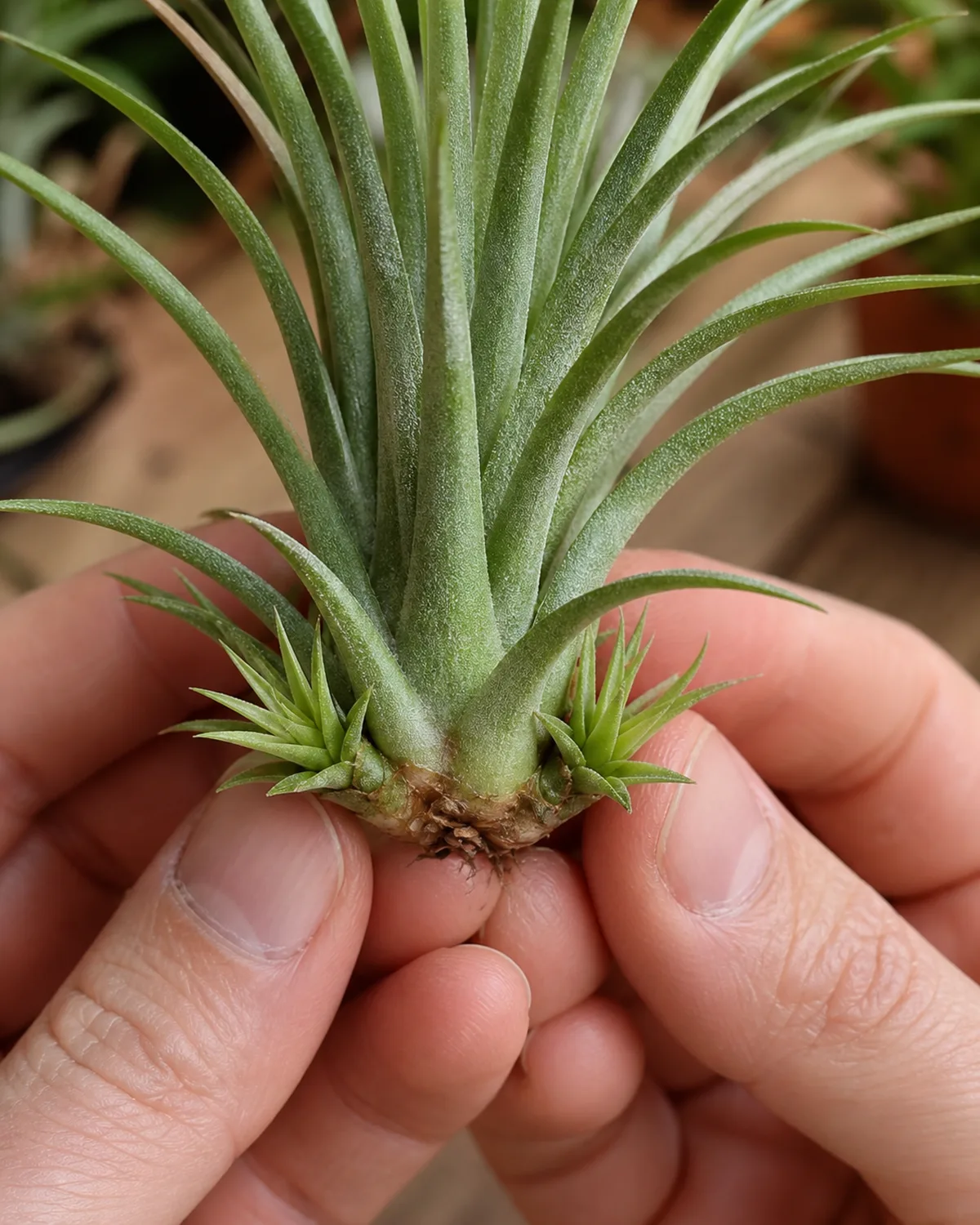
Pups are baby air plants that emerge from the base or leaf axils of the mother plant during or after blooming. Most species produce one to four pups, though some prolific varieties generate more.
The separation process:
- When to separate — allow pups to grow to at least one-third the size of the mother plant. They need the mother's resources to establish trichome coverage. Premature separation stunts or kills the pup.
- How to separate — gently twist or pull the pup away at its base. If it resists gentle pressure, it is not ready. Forcing separation tears tissue and damages both plants.
- The clump alternative — many growers skip separation entirely. Left attached, the mother and pups form a multi-headed specimen over generations. Clumps of T. ionantha or T. xerographica are highly prized.
Caring for separated pups follows the same watering and light requirements as adults, but soak slightly more frequently. Smaller plants have less water storage capacity and dry out faster. Separated pups take two to five years to reach blooming size depending on species, light, and nutrition.
The mother plant continues living for months to over a year after producing pups, slowly browning from the leaf tips inward. Remove the mother only after she is completely brown and dry. The lifecycle loop — pup grows to maturity, blooms once, produces pups, declines while pups grow — repeats indefinitely. A single purchase provides plants for decades.
For the complete propagation framework across all houseplant types, see the propagation guide.
Four air plant mistakes that cause slow death
- 1Keeping them in a sealed terrariumStagnant air plus trapped moisture equals rot within weeks. Only open-top displays work for air plants. If there is no opening for air to flow through, the plant cannot dry after soaking and the crown rots from the inside out.
- 2Misting instead of soakingMisting provides seconds of moisture contact. Trichomes need a sustained 20-minute soak to fully open and absorb water into the leaf tissue. A plant that only gets misted is chronically dehydrated no matter how often you spray.
- 3Using distilled or softened waterDistilled water lacks all minerals and can leach nutrients from the plant through osmosis. Water softeners add sodium that accumulates on trichomes and blocks absorption. Use filtered, spring, or aged tap water instead.
- 4Gluing them permanently to a displaySuperglue kills tissue on contact. Any permanent mount that prevents removal means the plant can never be soaked — and soaking is not optional. Use wire, fishing line, or removable adhesive dots that allow the plant to be lifted off for its weekly bath.
kultivy.com
Common problems and how to fix them
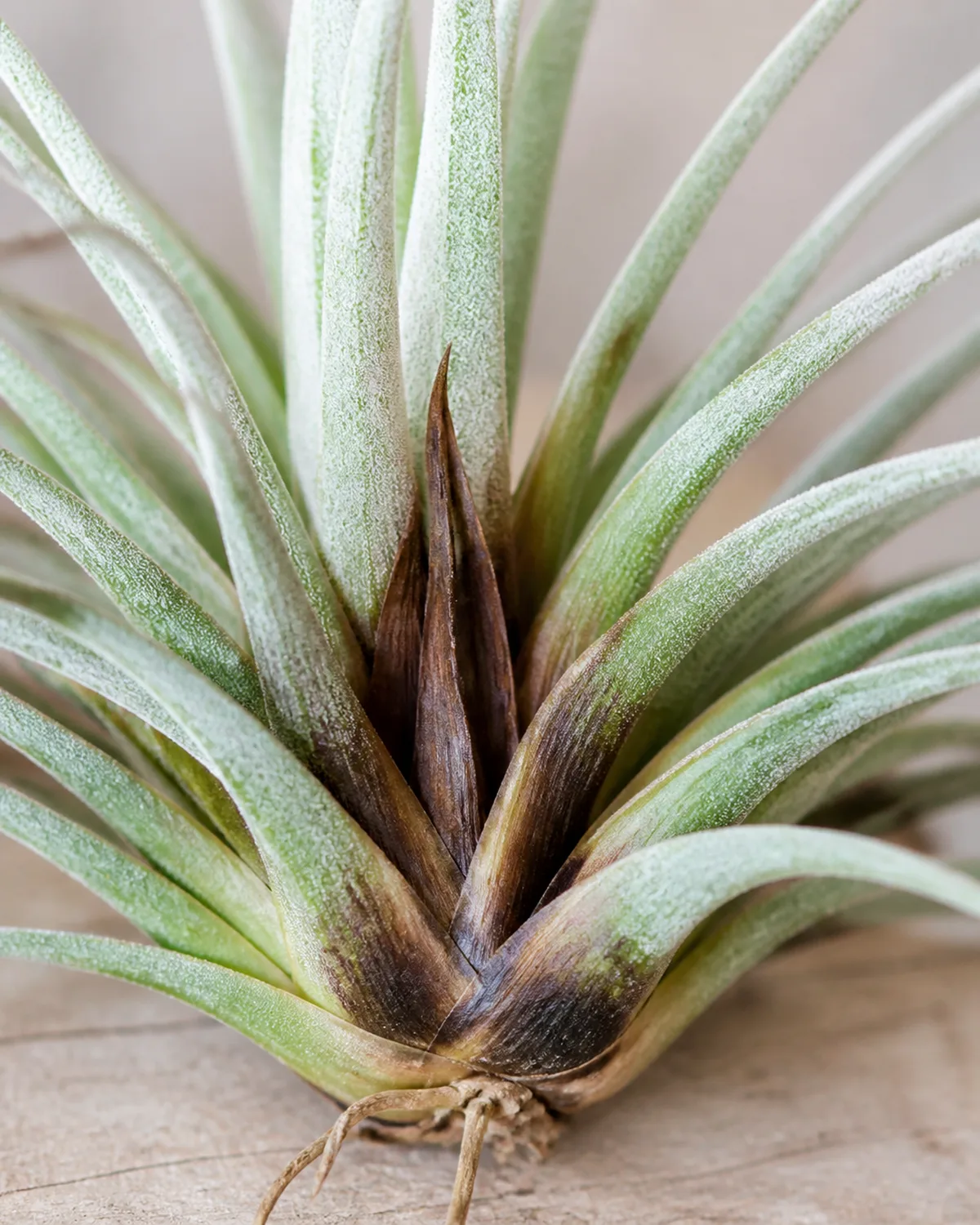
Crown rot is the number one killer of indoor air plants. The center of the rosette turns dark brown, soft, and mushy. Leaves pull away from the base with almost no resistance. If the core is rotten, the plant cannot be saved — discard it and improve the post-soak drying routine for the rest of your collection.
Prevention is the only cure: shake thoroughly after every soak, dry upside down with air circulation, and never place a still-wet plant back in an enclosed display.
Desiccation produces the opposite symptoms:
- Leaf tips turn brown and crispy, progressing inward
- Leaves curl dramatically beyond their natural shape
- The plant feels paper-thin, rigid, and noticeably lighter than normal
Fix desiccation with an emergency extended soak — four to eight hours submerged. Then return to more frequent regular soaking and evaluate whether the display location is too hot, too dry, or both.
Other common issues and their fixes:
- Sunburn — white or bleached patches from sudden direct sun exposure. Move to bright indirect light and acclimate slowly. The cosmetic damage is permanent but the plant survives.
- Leaf tip browning — underwatering, low humidity, or chlorinated/softened water. Trim tips at an angle and increase soak frequency or switch water source.
- Scale insects — small brown bumps on leaf surfaces. Scrape off with a fingernail and treat with rubbing alcohol on a cotton swab.
- Mealybugs — white cottony clusters at leaf bases. Same treatment as scale.
For the complete pest identification and treatment protocol, see the houseplant pests guide.
Seasonal care adjustments through the year
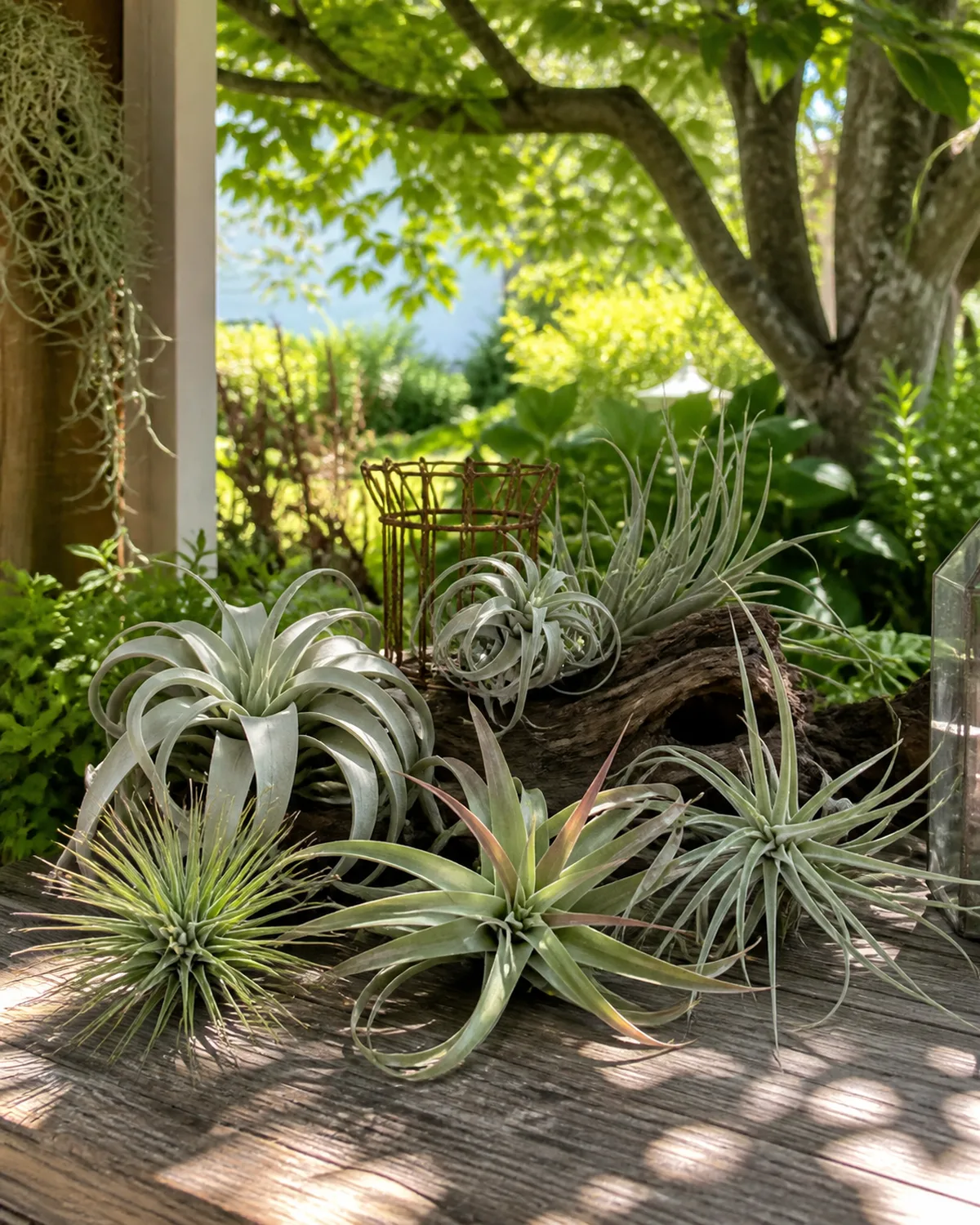
Spring marks the start of active growth. Resume monthly fertilizing in the soak water. Increase soak frequency as temperatures rise and the plant's metabolism accelerates. This is when pups are most likely to appear and bloom cycles most likely to initiate.
Summer is peak season. Growth is fastest, colors are brightest, and outdoor placement becomes ideal. A covered patio or the dappled shade under a tree approximates the natural habitat better than any indoor arrangement.
- Soak every five to seven days or more frequently in hot, dry conditions
- Air circulation is naturally better outdoors
- Acclimate gradually if moving plants outside for the first time — start in deeper shade for one to two weeks before moving to brighter positions
Fall is transition time. Bring outdoor plants inside before nighttime temperatures drop consistently below 50 degrees. Reduce fertilizer. Taper soak frequency slightly. Check every plant for hitchhiker pests from outdoor time — scale and mealybugs are the usual suspects.
Winter is survival mode:
- Growth slows significantly
- Reduce soaking to every 10 to 14 days for xeric types and every 7 to 10 for mesic types
- Stop fertilizing entirely
- Supplement with artificial light if natural light drops significantly
- Misting between soaks helps counter dry heated indoor air
The winter danger zone is the combination of low light, dry heated air, and infrequent soaking. This triple threat kills more air plants during their first indoor winter than any other seasonal factor. A small tabletop humidifier and a clip-on grow light during the darkest months make a measurable difference.
Toxicity and pet safety
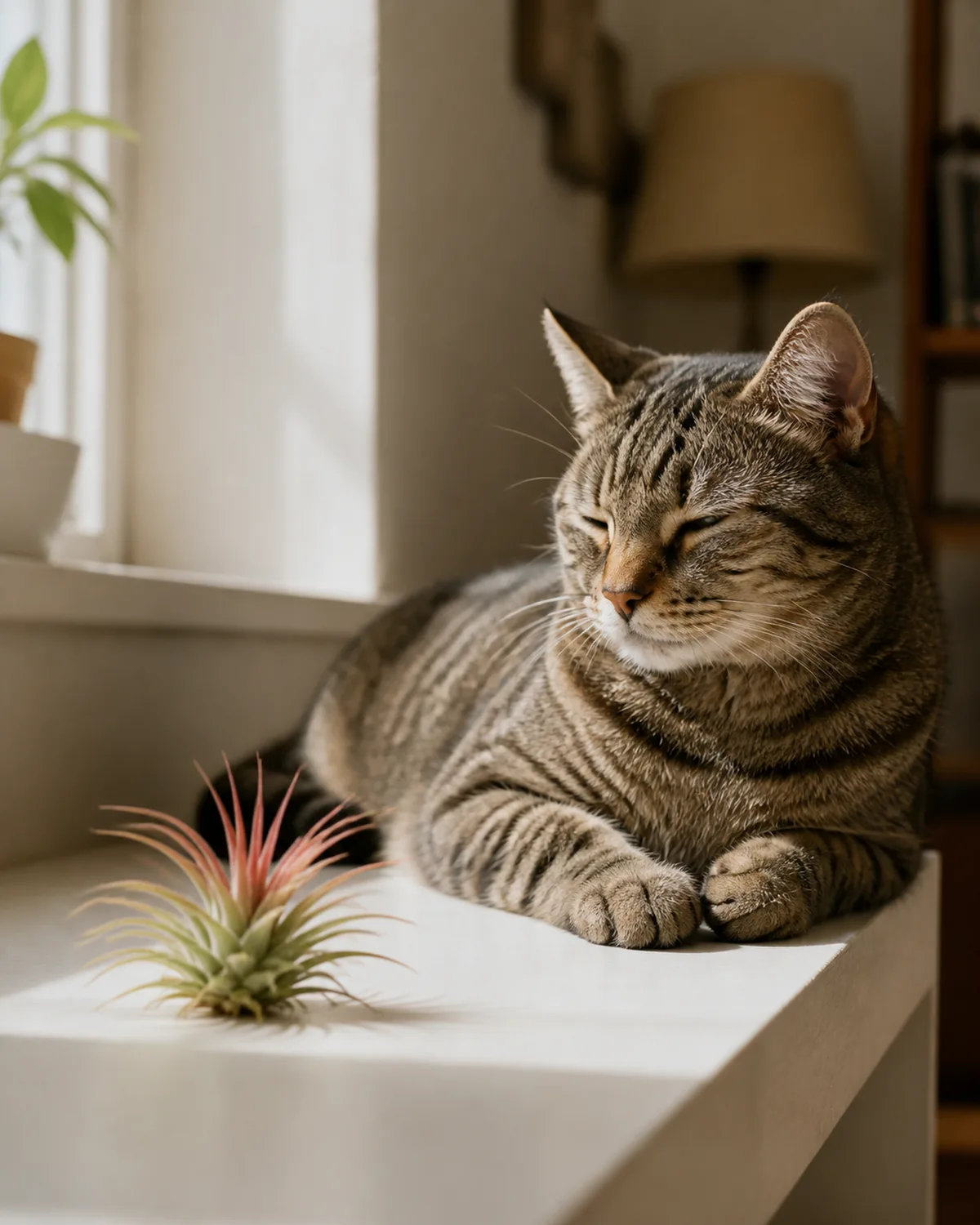
Tillandsia are non-toxic to cats, dogs, and humans. The ASPCA and veterinary databases confirm that no part of any Tillandsia species is harmful when ingested or handled.
The trichome-covered leaves are not appealing to most cats. The texture is rough and dry, there is no sap, and there is no scent. Compared to grassy plants like spider plants — which cats actively seek out — air plants generate almost zero feline interest.
Why air plants are among the safest houseplants for pet households:
- No toxic sap, latex, or calcium oxalate crystals
- No contact dermatitis from handling
- Mounted displays are naturally out of reach of most pets
- Adhesives (E6000, wire) should be fully cured before pet exposure — the wet adhesive is the only hazard, not the plant
This is one of the cleanest toxicity profiles on this site, alongside Boston ferns, parlor palms, and peperomia.
For the complete list of verified pet-safe houseplants, see the plants safe for cats guide.
Your first air plant: starting with the three most forgiving species
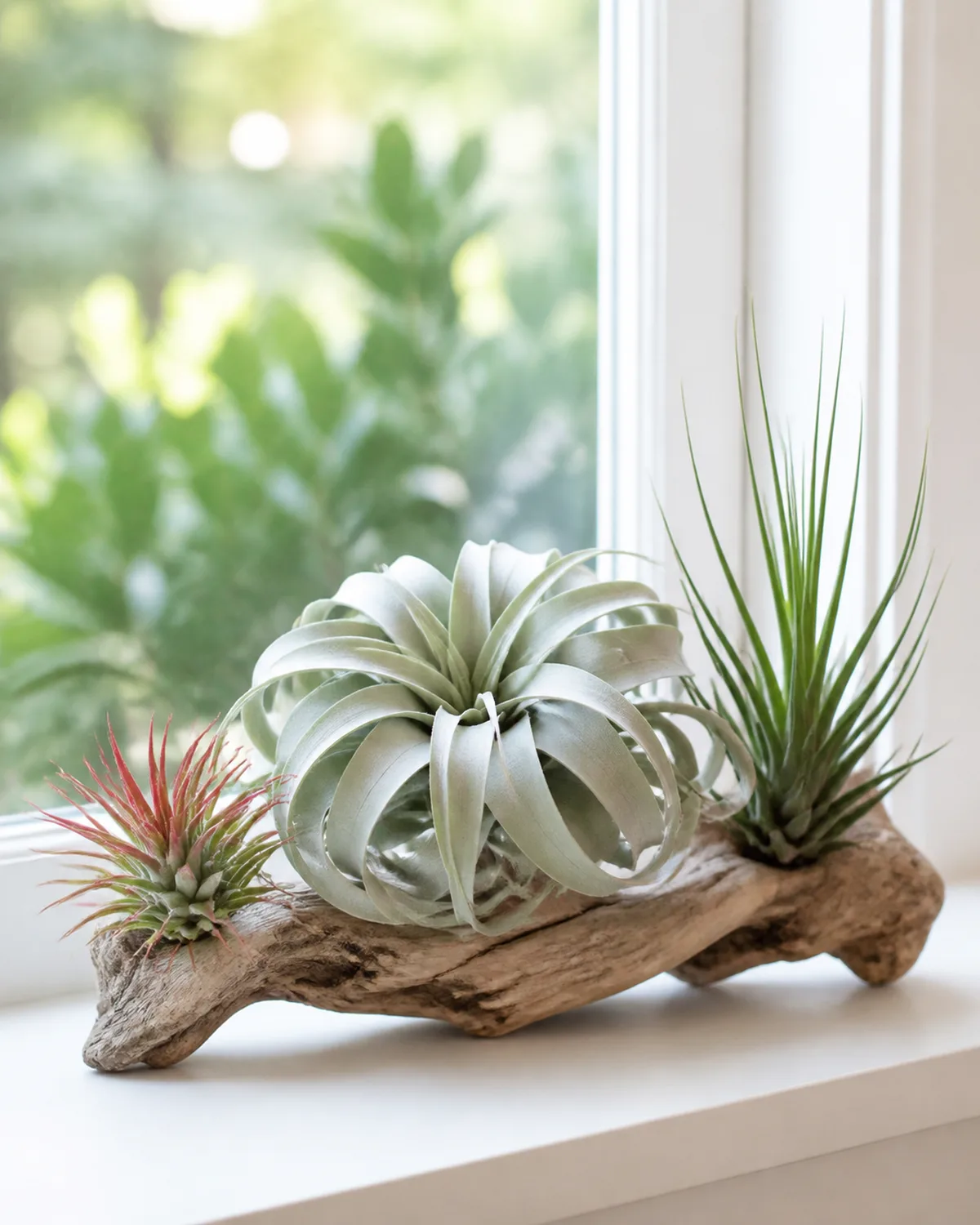
The three most forgiving species for beginners:
- T. ionantha — a compact rosette the size of a golf ball. Tolerates a wide range of conditions. Before blooming, the leaf tips turn brilliant red. Produces pups freely. Widely available for three to five dollars.
- T. xerographica — the statement piece. A large silvery rosette up to 12 inches across with elegantly curling leaves. Xeric and drought tolerant — soak every 10 to 14 days. More expensive at 15 to 30 dollars but worth it as a centerpiece.
- T. stricta — the easy bloomer. A compact green rosette that produces vivid pink and purple flowers readily, often within a year or two. Mesic type, so slightly more frequent watering, but forgiving of mistakes.
The starter trio strategy: Buy one of each for under 25 dollars total. You get a xeric species, a mesic species, and a showy bloomer — three different care tracks to learn simultaneously while the collection stays small.
Where to buy: local nurseries, garden centers, and specialty online shops. Avoid spray-painted or dyed air plants — the paint blocks trichomes and kills the plant slowly. If the color is an unnatural bright blue or neon green, it has been dyed.
Mount the trio three different ways — driftwood, open glass globe, and freely on a bright shelf — to discover which display you prefer. Once they are thriving and producing pups, every new species is a variation on the same theme. For more beginner-friendly recommendations, see the easy houseplants guide.

Mara Quinn edits Kultivy, where she shares houseplant care, propagation, beginner-friendly plant picks, and plant-styling ideas for anyone who wants their indoor plants to actually thrive. Every guide is image-led and reviewed for clarity, usefulness, image accuracy, and Pinterest-to-page alignment before it goes live. Visit the About page.