Calathea is the genus hobbyists buy for the leaves. Every species folds its foliage upward at dusk and opens it flat at dawn, a movement called nyctinasty.
Taxonomists moved most calatheas into Goeppertia in 2012, but the nursery tag still says calathea, so that is what this guide uses. The varieties below run from forgiving to demanding.
Calathea Medallion — the classic starter calathea
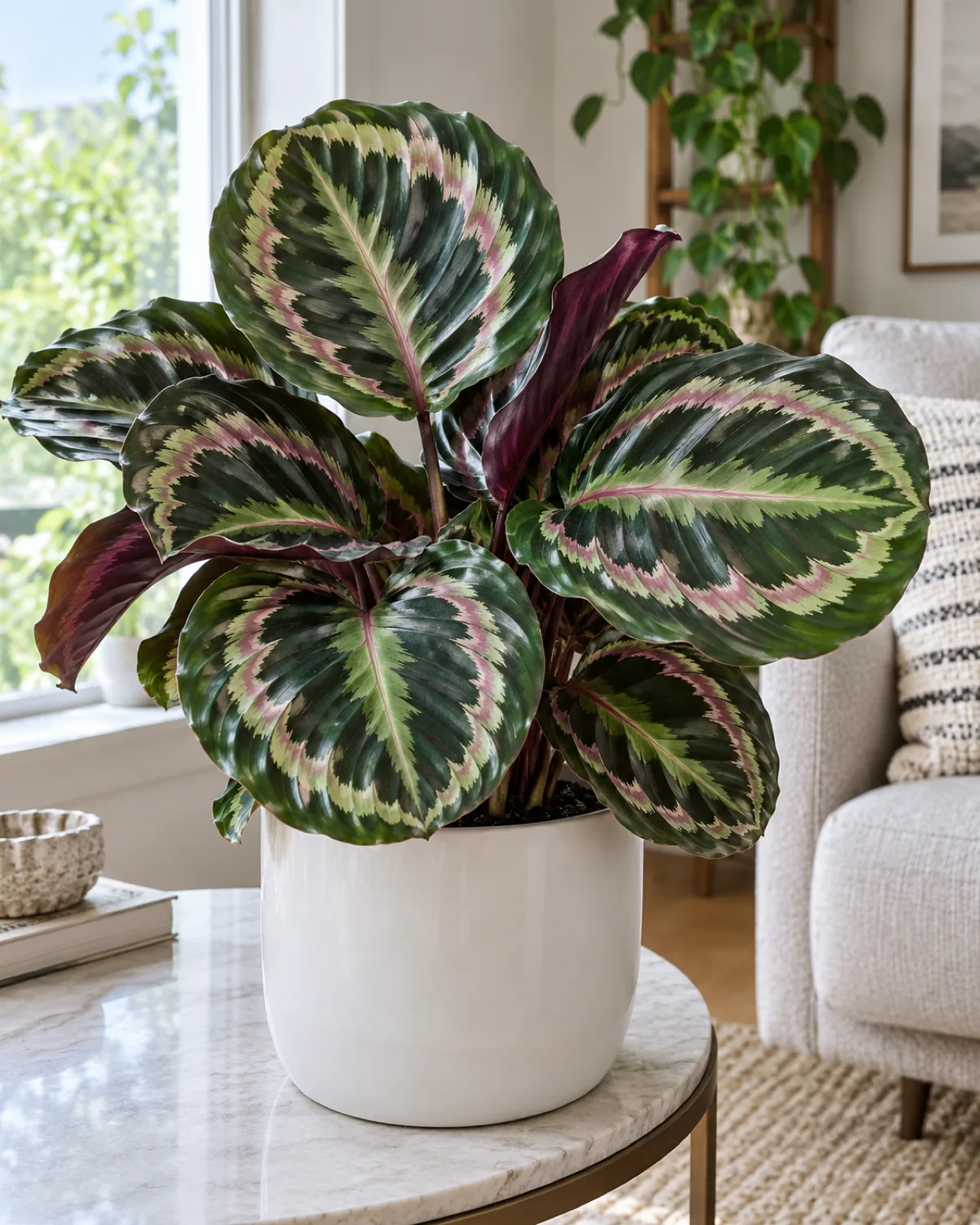
Calathea roseopicta 'Medallion' is the variety most people meet first. The round leaves carry concentric rings of cream, pink, and forest green — a painted-target pattern that gives the plant its name.
Medallion tolerates average household humidity better than almost any other calathea, which is why every beginner list starts here. Forty to fifty percent humidity is enough to keep the leaf edges clean. Most other calatheas start throwing brown edges at that level.
- Leaf pattern: Concentric cream-and-green rings with a dark green outer border and pink blush along the midrib
- Undersides: Deep burgundy-purple, visible when the leaves curl at night or in response to dry soil
- Difficulty: Low for a calathea, the highest margin for watering error in the genus
- Common mistake: Letting the soil dry out completely between waterings, which causes the leaves to curl inward and the edges to crisp
If you can keep a medallion alive and attractive through one full winter, you can handle most calathea varieties on this list. The skills transfer directly: filtered water, consistent moisture, no cold drafts.
Calathea Lancifolia — the rattlesnake calathea
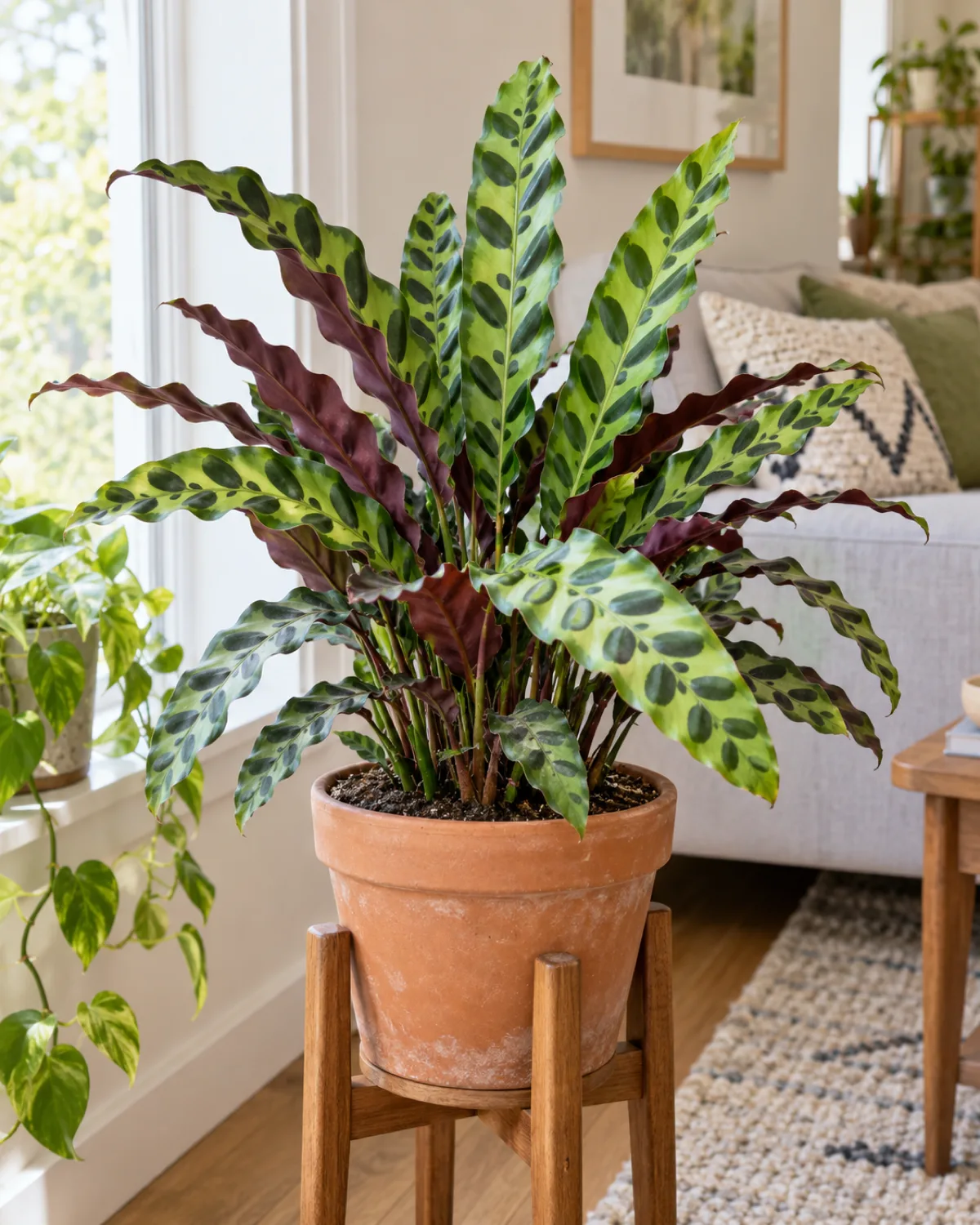
Calathea lancifolia looks nothing like the round-leafed roseopictas. The leaves are narrow, lance-shaped, and edged with a gentle wave. Dark green ovals alternate down each side of the midrib on a chartreuse background — the pattern that earned the common name rattlesnake.
The leaves are thicker than most calatheas, which means they lose moisture more slowly and tolerate minor lapses in humidity. That thickness also makes rattlesnake one of the more forgiving varieties for beginners who forget to water on schedule.
- Leaf length: Up to forty-five centimeters on a mature plant, far longer than wide
- Undersides: Deep purple-maroon, visible when you flip a leaf to confirm identification
- Drought tolerance: Better than average for a calathea because the thicker leaves store more moisture
- Light: Bright indirect preferred, but handles medium light without stretching or fading
Rattlesnake and medallion together cover both leaf shapes in the genus: round and lance. If you want one of each, start with these two.
Calathea Orbifolia — the one with the largest leaves
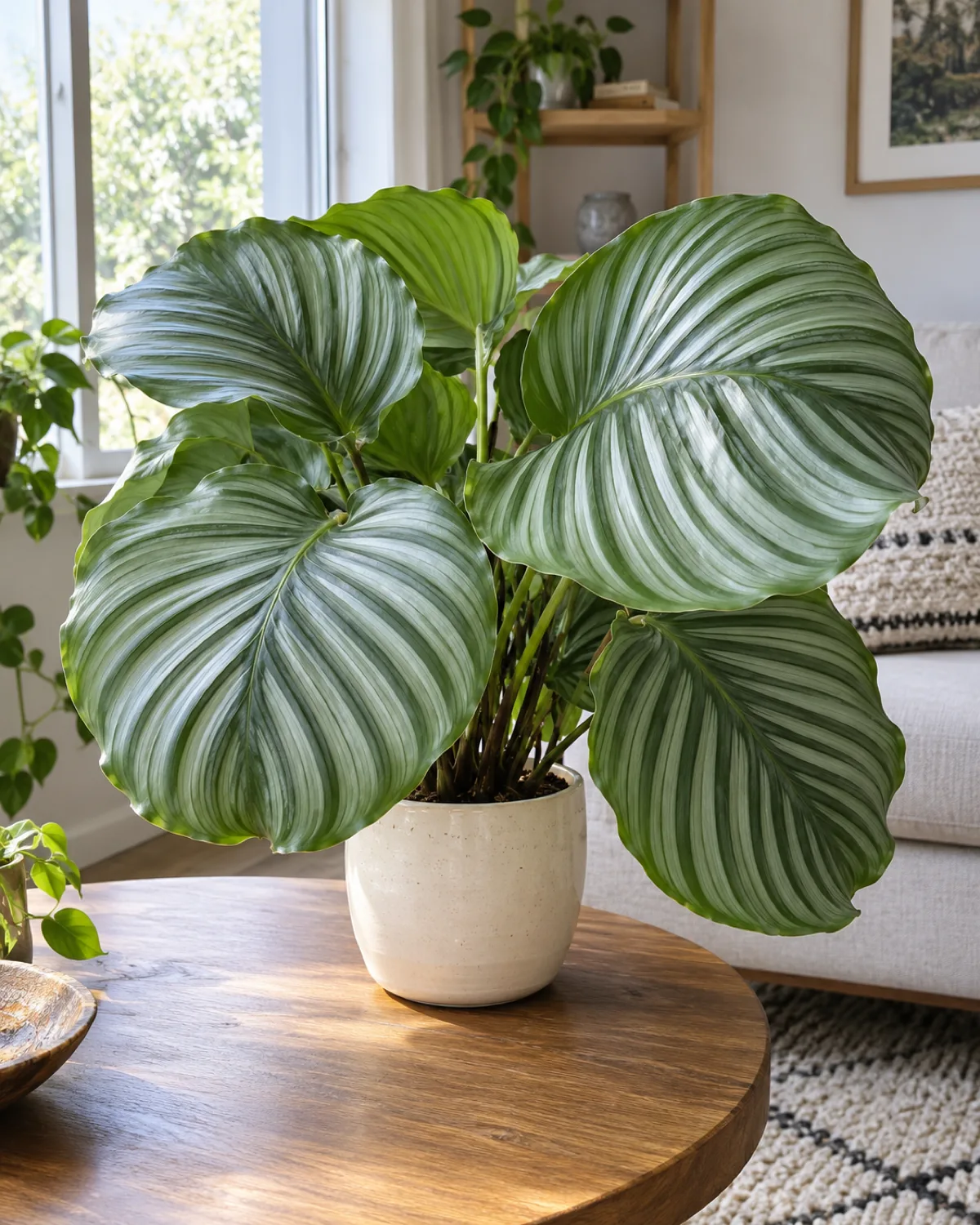
Calathea orbifolia is the variety people photograph from across the room. The leaves grow up to thirty centimeters across — enormous for an indoor calathea — with broad alternating stripes of silver-green and deeper green that catch light like brushed metal.
The size is the attraction and the complication. Leaves that large transpire fast, so orbifolia demands consistently moist soil without standing water. Let it dry out and the edges brown within days. Overwater and the shallow root system rots before you notice the droop.
- Leaf size: Twenty to thirty centimeters wide on a mature plant, roughly the size of a dinner plate
- Pattern: Broad parallel silver-and-green stripes, less intricate than medallion but more dramatic at scale
- Humidity: Fifty to sixty percent minimum. Brown leaf edges appear quickly below that
- Soil: Well-draining but moisture-retentive, such as peat or coco coir base with perlite for drainage
Orbifolia is the calathea you put in a bright corner where it can spread. It looks best as a solo specimen rather than grouped, because the leaves need room to display their full span.
Calathea Ornata — the pinstripe calathea
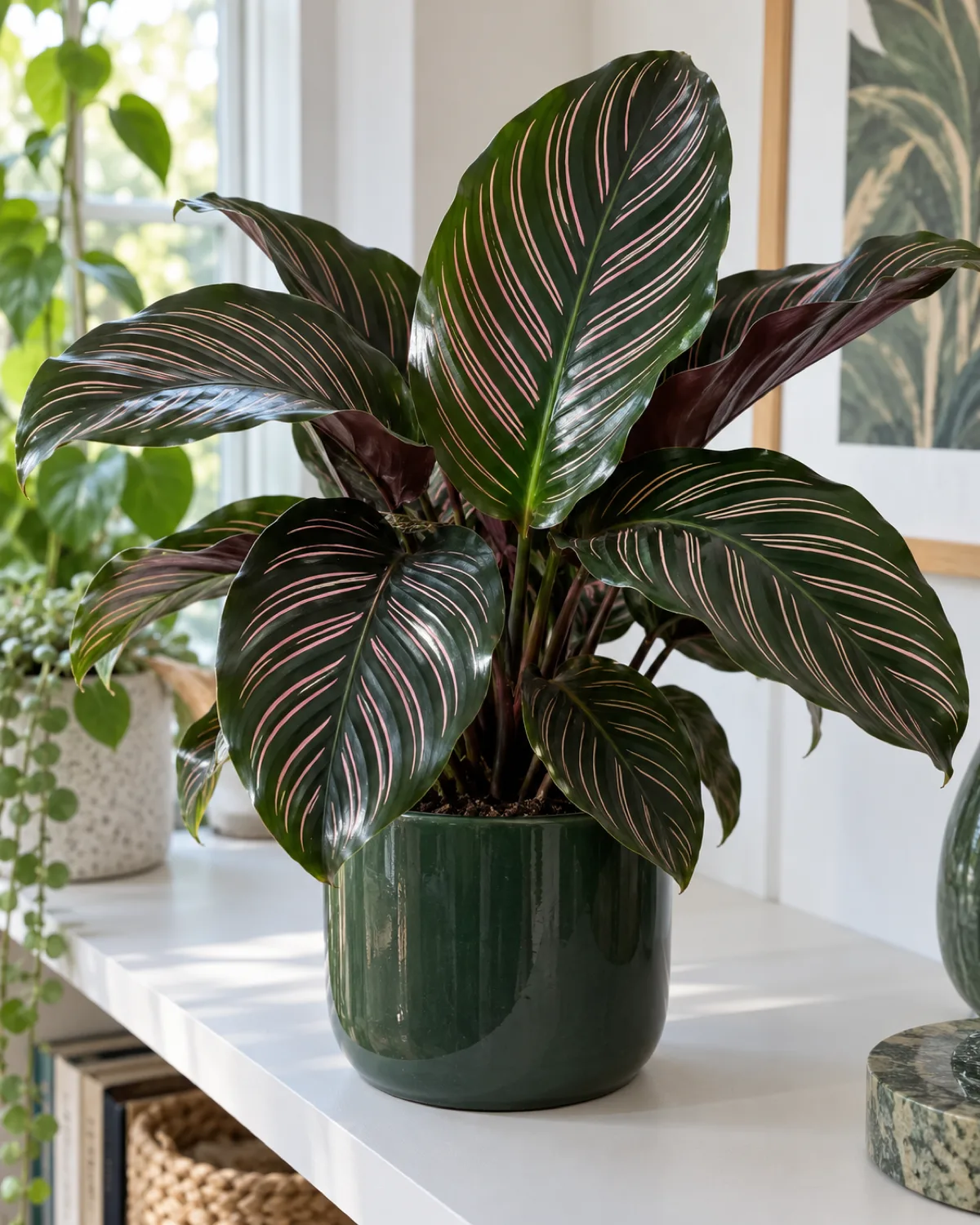
Calathea ornata draws thin parallel lines from the midrib to the leaf edge — pink on young leaves, fading to cream as the leaf matures. The lines are so precise they look painted with a single-hair brush.
Ornata is the calathea most sensitive to water quality. Tap water with chlorine or fluoride causes brown tips faster than on any other variety in the genus. Filtered water, rainwater, or water left sitting overnight to off-gas chlorine makes the difference between clean leaf tips and chronic crisping.
- Stripe color: Bright pink on new growth, fading to cream-white over months as the leaf hardens
- Leaf surface: Glossy and dark, the darkest green of any common calathea, which makes the stripes pop
- Water sensitivity: High. Use filtered or rain water to avoid mineral buildup that burns the tips
- Difficulty: Medium. Straightforward humidity and light needs, but punishes tap water harder than others
The color shift from pink to cream means a healthy ornata always carries both colors. New growth shows the pink; older leaves carry the cream. If all the stripes are cream and no new pink is emerging, the plant is not producing enough new leaves — usually a light or feeding issue.
Calathea Makoyana — the peacock calathea
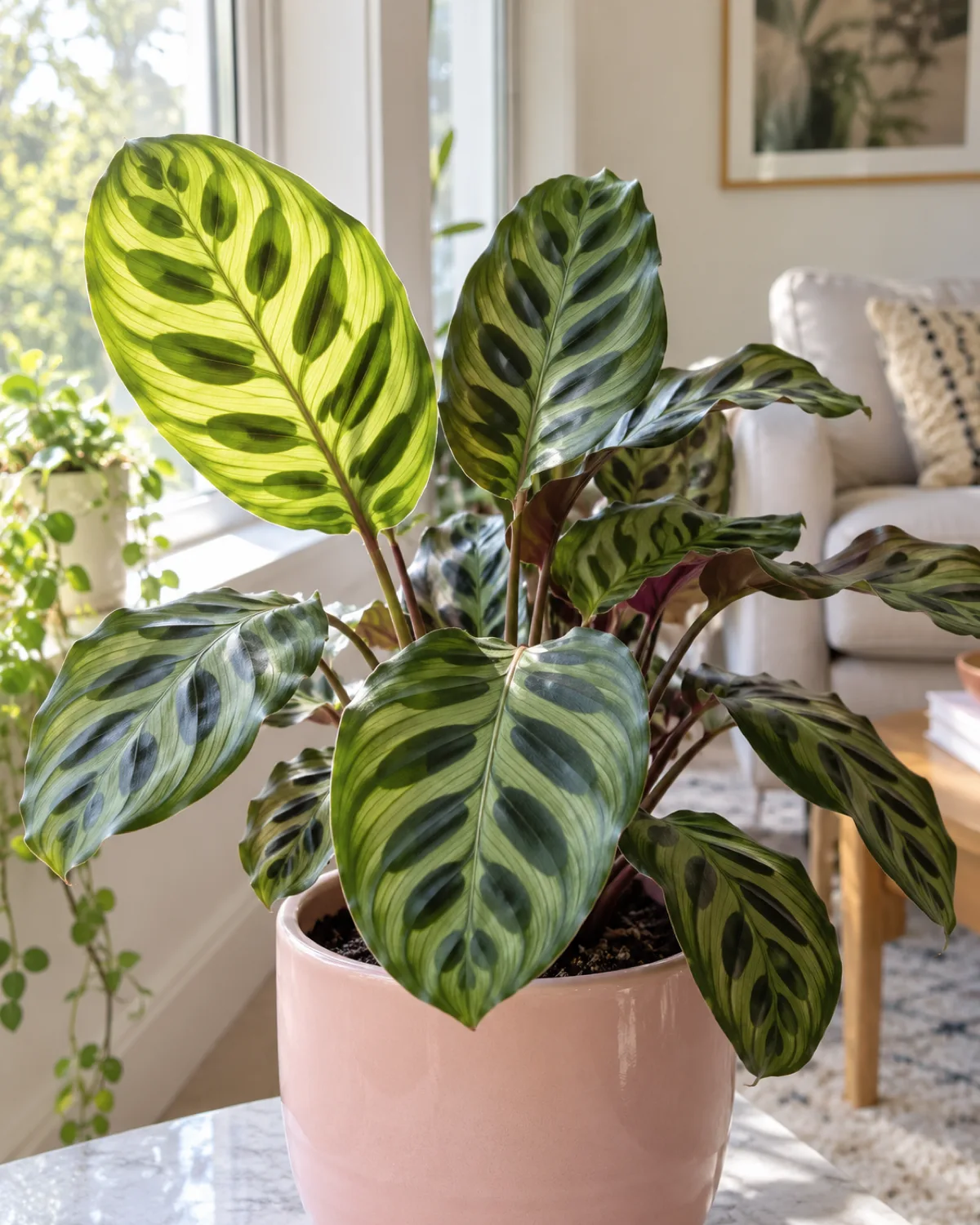
Calathea makoyana earns the name peacock because the leaf pattern mimics a peacock tail feather — dark oval spots and fine lines radiate outward from the midrib on a semi-translucent pale green blade. Hold a leaf up to window light and the pattern glows from behind, visible on both sides.
That translucency is the identification key and the care clue. Makoyana leaves are thinner than most calatheas, which means they lose moisture faster and show humidity stress sooner. Where a medallion might tolerate forty-five percent humidity with no damage, makoyana starts showing brown edges at fifty.
- Leaf texture: Thin and papery compared to the thicker rattlesnake or the waxy medallion
- Backlit effect: The semi-transparent blade lets light through, making the pattern glow. Position near a window for the best display
- Humidity demand: Sixty percent or higher for clean edges. A pebble tray or humidifier is not optional
- Growth habit: Clumping and relatively compact, staying under sixty centimeters in most indoor conditions
Makoyana is the variety that convinces plant owners to buy a hygrometer and a humidifier. If your home already runs humid — a bathroom or kitchen, for example — makoyana rewards you with some of the most photogenic leaves in the genus.
Calathea Zebrina — the zebra calathea
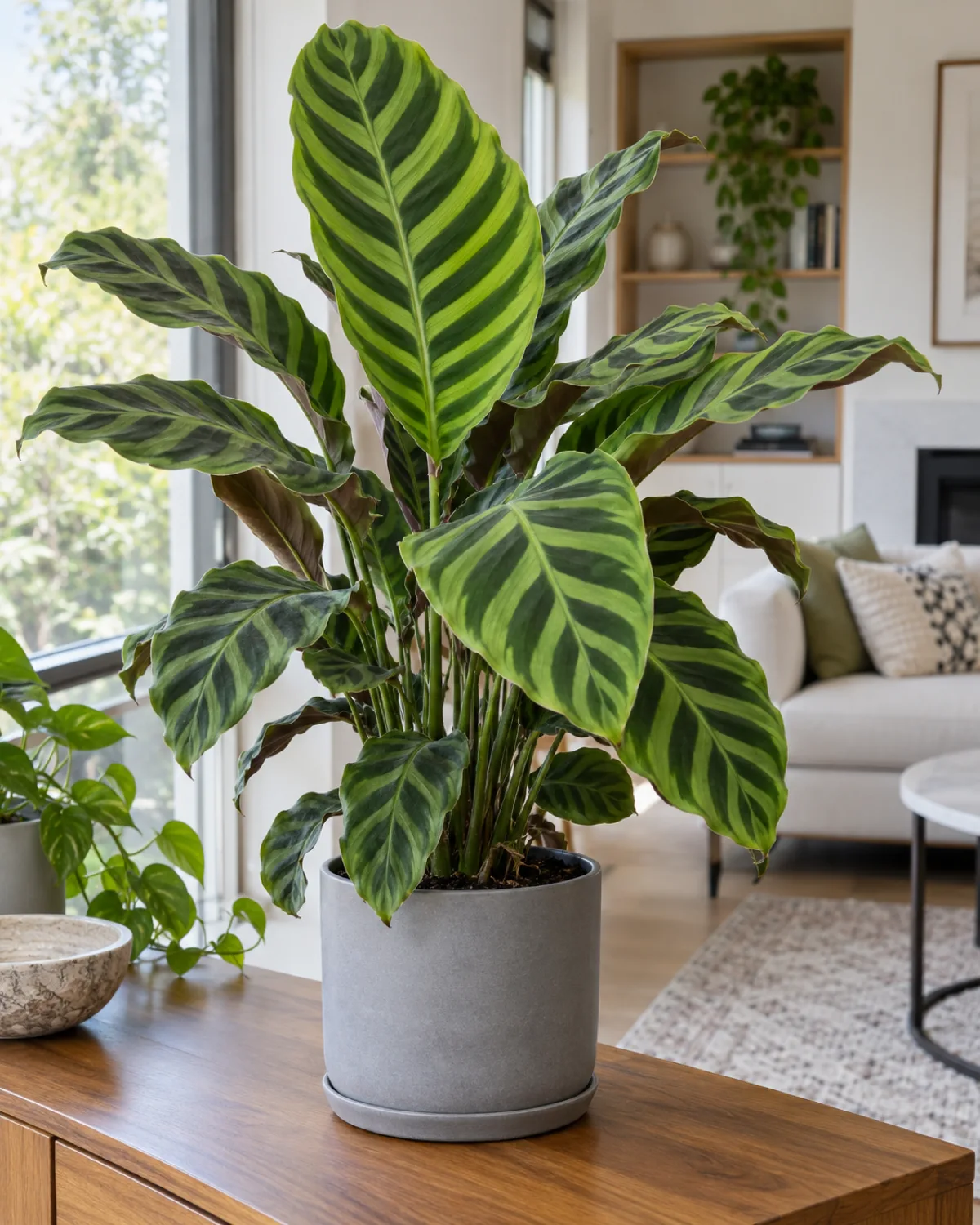
Calathea zebrina grows taller than most calatheas in the collection — up to ninety centimeters in ideal conditions. The oval leaves carry bold alternating bands of lime green and dark green in a pattern that reads as stripes from any distance.
The standout feature is the texture. Zebrina leaves have a velvety surface that gives them a matte finish instead of the gloss you see on ornata or medallion. That velvet traps dust, and dusty leaves photosynthesize less efficiently.
- Height: Up to ninety centimeters, significantly taller than the compact roseopictas
- Texture: Velvety matte surface that feels soft to the touch, unlike the glossy surface of most calatheas
- Maintenance: Wipe leaves monthly with a damp cloth to clear trapped dust and restore photosynthesis
- Undersides: Solid deep purple, consistent across the entire leaf
Zebrina works as a mid-height background plant in a group. The tall upright stems give vertical structure behind shorter, rounder calatheas like medallion and orbifolia.
Calathea Rufibarba — the furry feather calathea
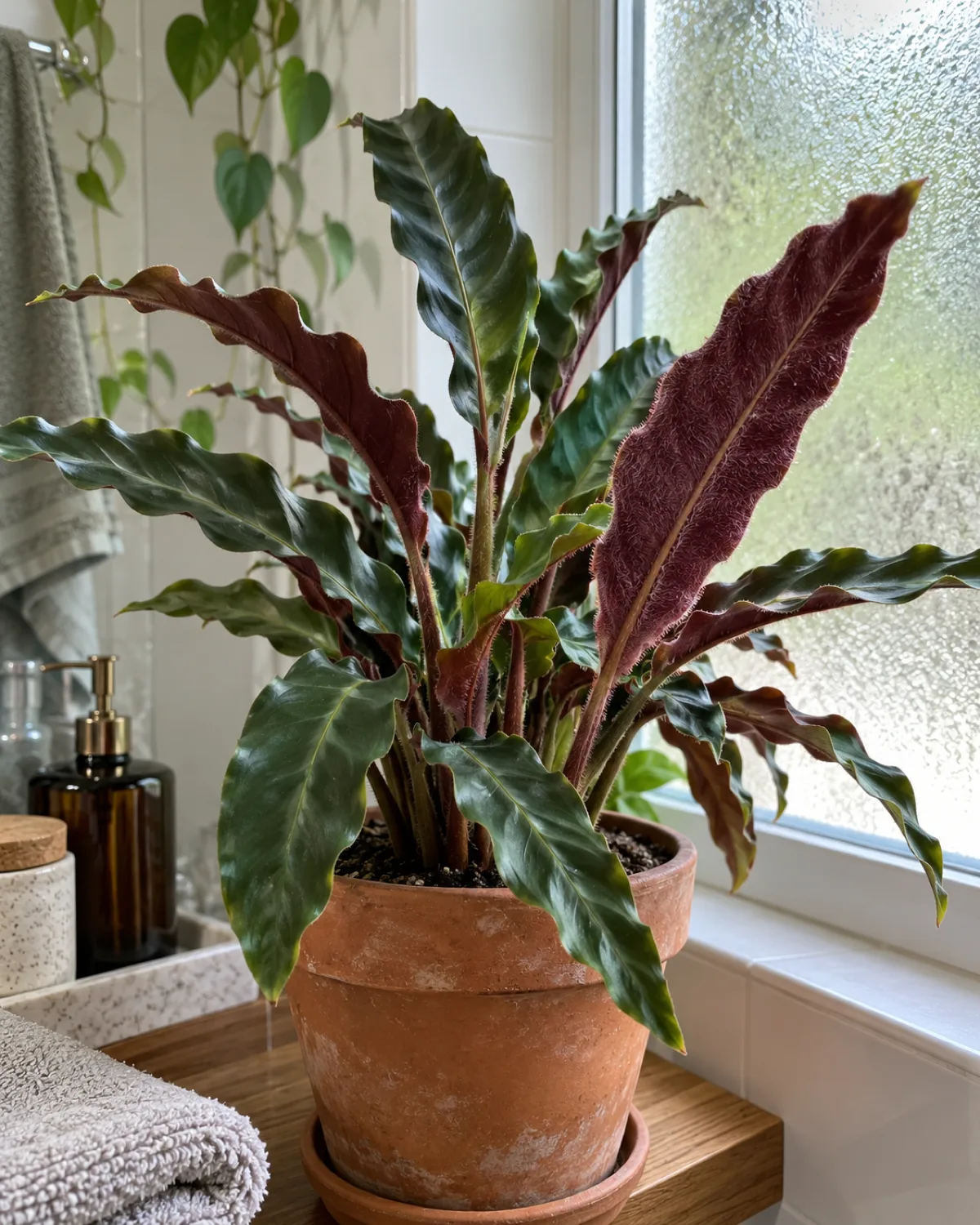
Calathea rufibarba is the variety people touch and then look surprised. The undersides of the narrow, wavy leaves are covered in fine maroon fuzz — trichomes that give the plant its common name and serve a real purpose.
Those trichomes slow moisture loss from the leaf surface. The practical result is that rufibarba tolerates slightly lower humidity than the thin-leafed varieties like makoyana and peacock. It is one of the easier calatheas to maintain in a standard room without a humidifier, though it still does better with one.
- Trichomes: Fine hair-like fuzz on the leaf undersides, maroon-burgundy colored
- Leaf shape: Narrow and elongated with wavy edges, similar to rattlesnake but darker
- Humidity tolerance: Better than average for a calathea because the trichomes reduce transpiration
- Common confusion: Sometimes mislabeled as calathea elgergrass or calathea wavestar in the trade
Rufibarba works well in a bathroom where the ambient humidity keeps the trichomes from drying out. The narrow leaves and upright habit fit tight spaces better than the spreading orbifolia.
Calathea Vittata — the subtle pinstripe
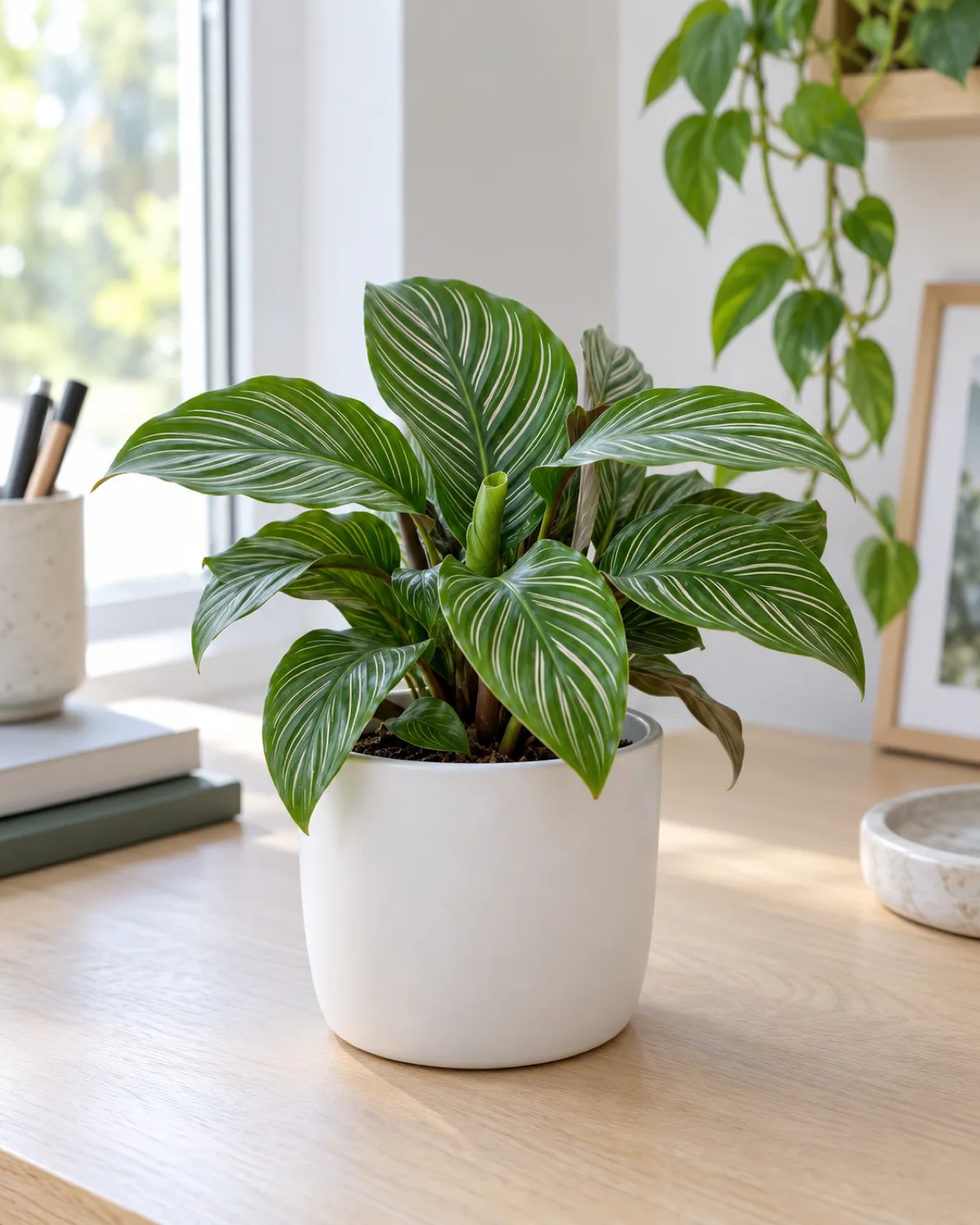
Calathea vittata draws the same pinstripe pattern as ornata but with a lighter hand. The stripes are thinner, whiter, and set against a brighter grass-green leaf instead of the dark emerald background of ornata. The overall effect is quieter and more delicate.
Vittata also stays smaller. Where ornata can reach seventy centimeters, vittata typically tops out under fifty — compact enough for a desk or a narrow shelf where a larger calathea would crowd its neighbors.
- Stripe pattern: Thin white lines on bright green — a softer, more delicate version of ornata's bold pink-to-cream stripes
- Size: Compact, rarely exceeding fifty centimeters — suitable for small spaces
- Water sensitivity: Less demanding about water quality than ornata, though filtered water still produces the best results
- Availability: Less common than ornata in garden centers, more often found through specialty growers
If you like the pinstripe look but want a plant that fits a desk, vittata is the compact alternative. It pairs well with round-leafed varieties like medallion for a contrast of leaf shapes and pattern scales.
Calathea Roseopicta 'Dottie' — the near-black calathea
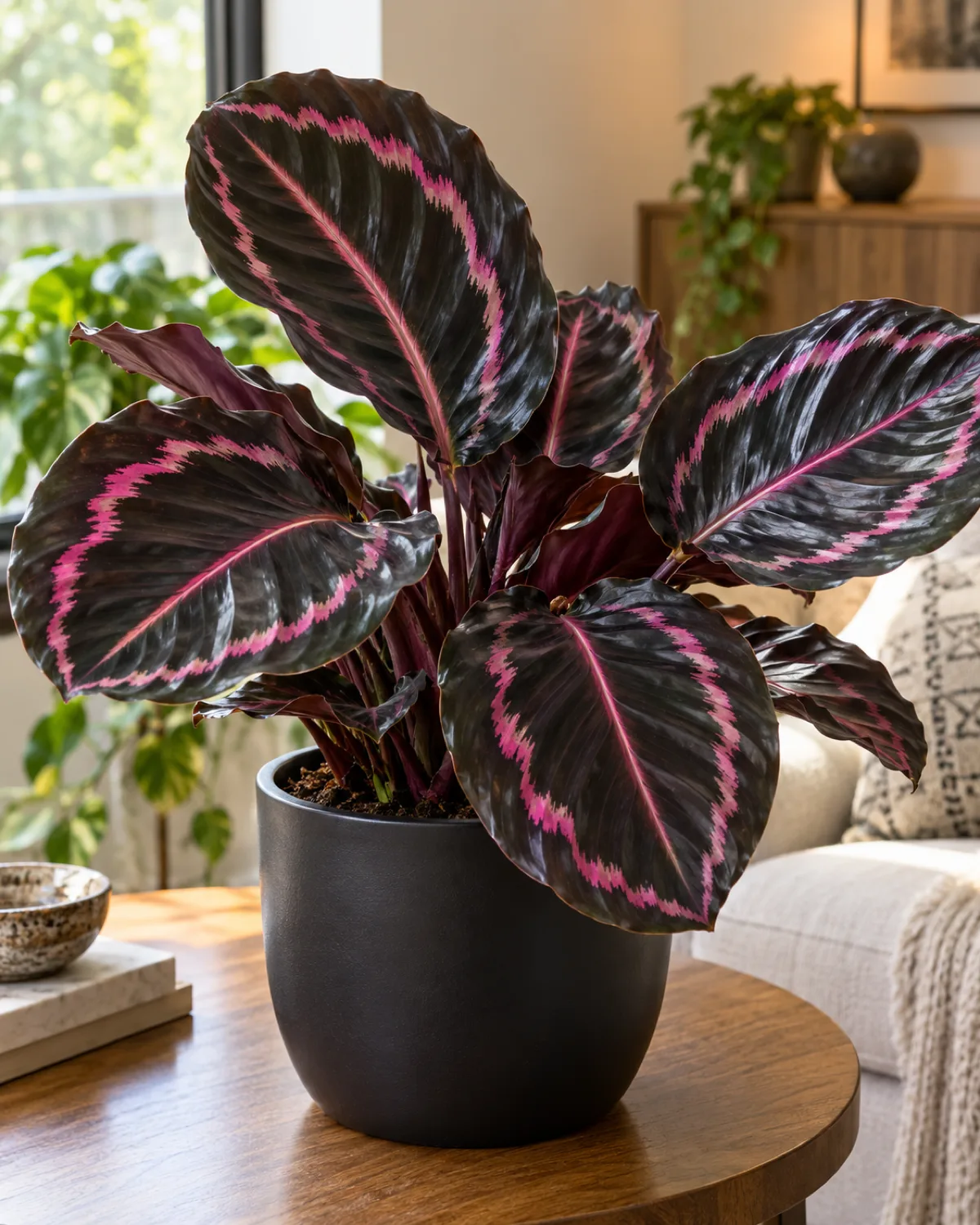
Calathea roseopicta 'Dottie' is the darkest calathea you can buy. The leaves are so deeply pigmented they read as near-black, with a single hot-pink ring traced just inside the leaf margin and a matching pink midrib running down the center.
The dark pigmentation means Dottie needs brighter light than you might expect. In low light the leaves lose contrast — the pink border fades and the dark background turns muddy green. Bright indirect light keeps the near-black depth and the pink border vivid.
- Leaf color: Near-black with hot-pink border ring and pink midrib — the highest contrast of any calathea
- Light need: Brighter indirect than most calatheas — the dark pigment needs light to maintain its depth
- Growth rate: Moderate — slower than medallion, faster than white fusion
- Pot pairing: Looks striking in a white or light-colored pot that frames the dark leaves
Dottie is the calathea people buy for the visual drama. The near-black-and-pink combination reads as deliberately styled in a way that even non-plant-people notice.
Calathea Musaica — the network calathea
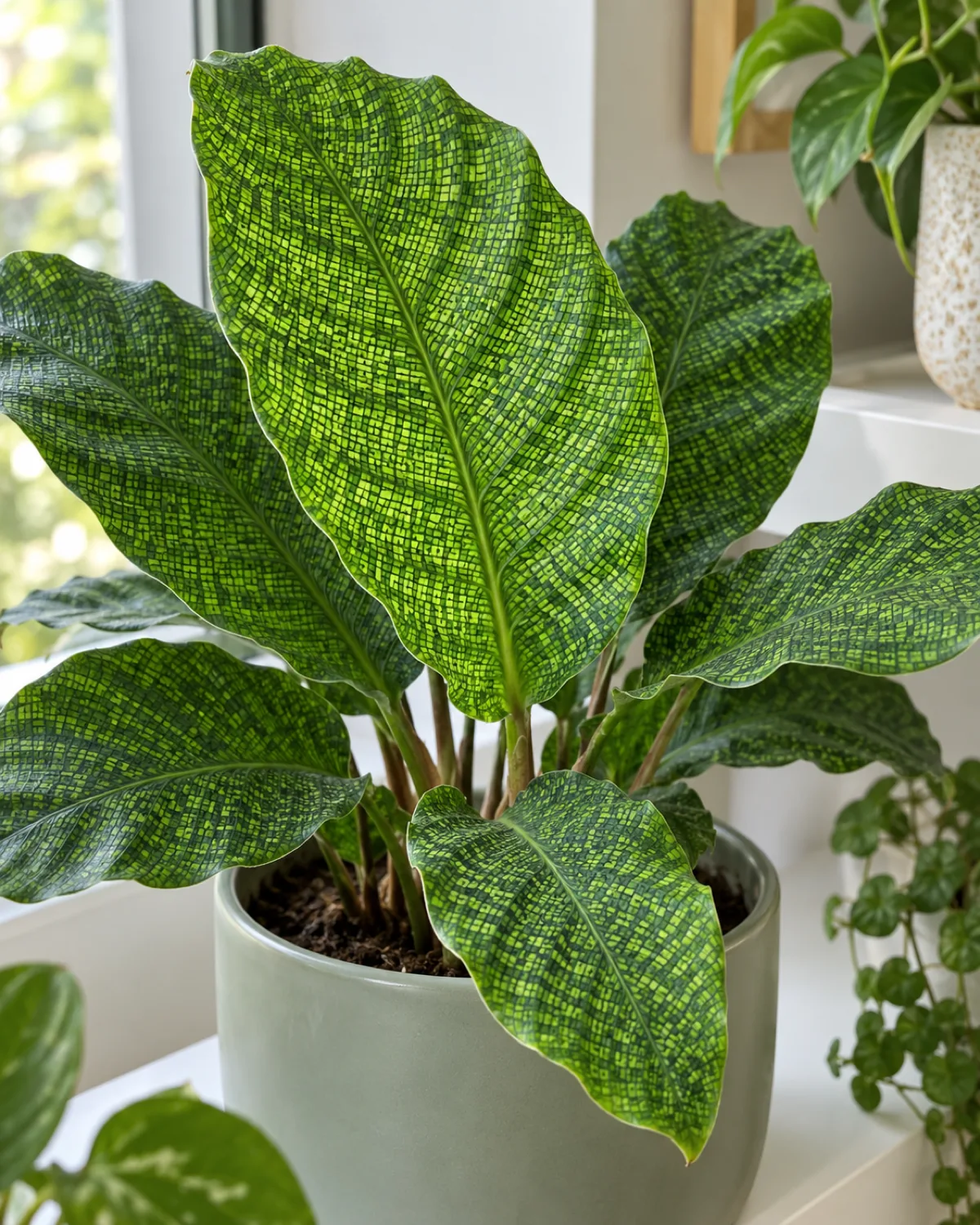
Calathea musaica — officially Goeppertia kegeljanii — carries a pattern unlike anything else in the genus. The leaf surface is covered in a fine mosaic of tiny rectangular cells, like a digital grid or stained glass viewed from a distance. You have to get close to see it. From across the room the plant just looks green.
That close-range reward is the point. Musaica rewards the grower who stops to look, and the intricate pattern photographs beautifully in macro shots.
- Pattern: Micro-mosaic tessellation — hundreds of tiny cells per leaf, visible only up close
- Humidity tolerance: Better than most calatheas — handles forty-five to fifty percent without crispy edges
- Growth rate: Slower than rattlesnake or medallion, producing fewer but longer-lasting leaves
- Leaf size: Medium, roughly ten to fifteen centimeters — the pattern works best on leaves this size
Musaica is one of the easier calatheas for rooms without a humidifier. The thicker leaf tissue and moderate humidity needs make it a practical choice for offices and living rooms where you cannot control the air.
Calathea Warscewiczii — the jungle velvet
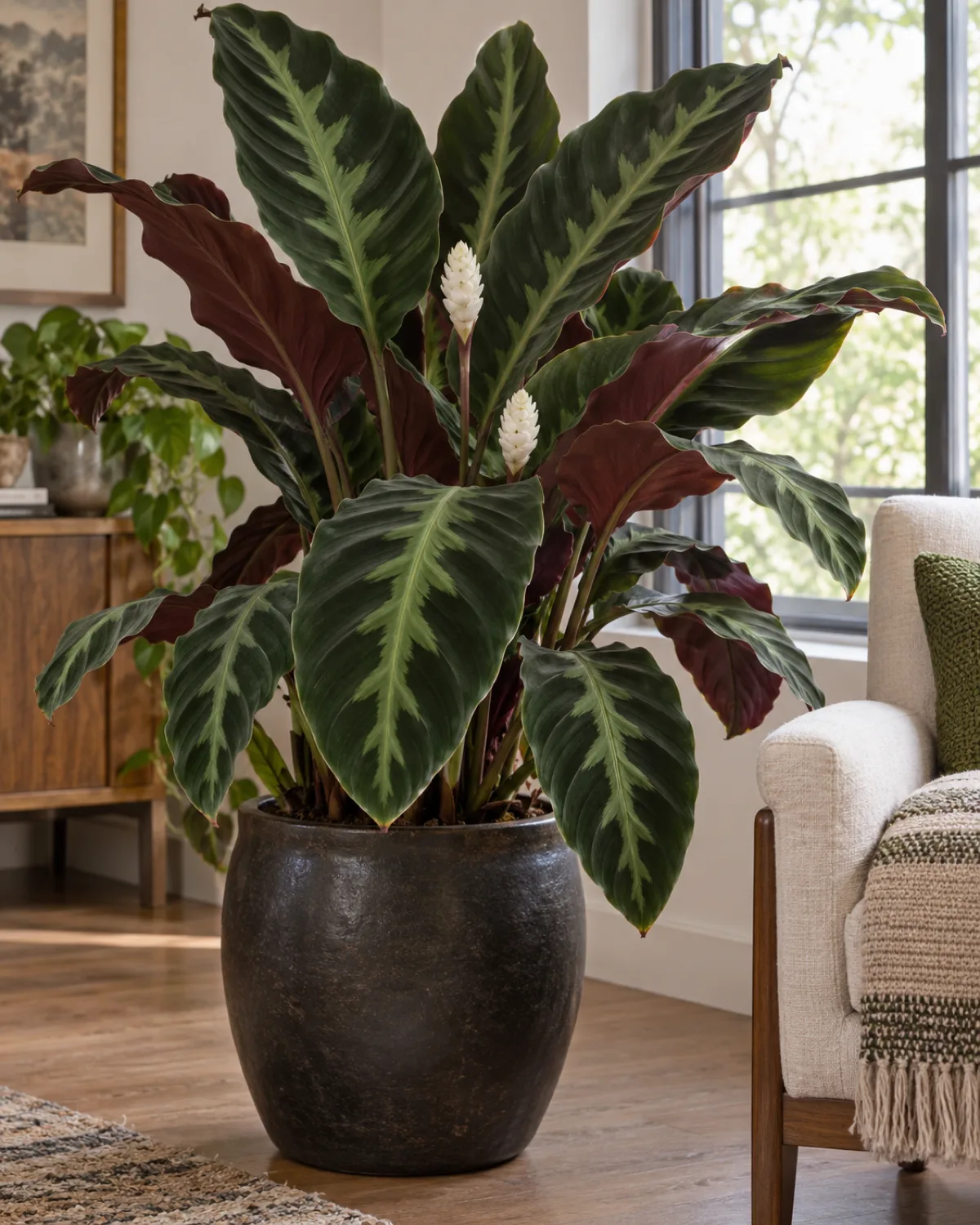
Calathea warscewiczii is the largest calathea most growers will encounter. The velvety dark leaves can reach thirty centimeters and the plant itself approaches a meter tall in good conditions. The lighter green herringbone pattern across the dark velvet surface gives it the jungle velvet name.
Warscewiczii is also one of the few calatheas that reliably flowers indoors. The cone-shaped white bracts emerge from the foliage and last several weeks — not dramatic in the way a bromeliad or anthurium flowers, but a genuine bloom from a genus better known for leaves.
- Size: The largest common calathea — up to one meter tall and wide
- Texture: Velvety matte surface similar to zebrina but darker
- Flowers: Cone-shaped white bracts, produced in growing season, lasting two to three weeks
- Undersides: Rich maroon-burgundy, deeper than most calatheas
This is a floor plant, not a shelf plant. Give it a corner where it can spread without crowding other plants. The velvety leaves show dust easily, so wipe them down every two to three weeks.
Calathea White Fusion — variegation that punishes every mistake
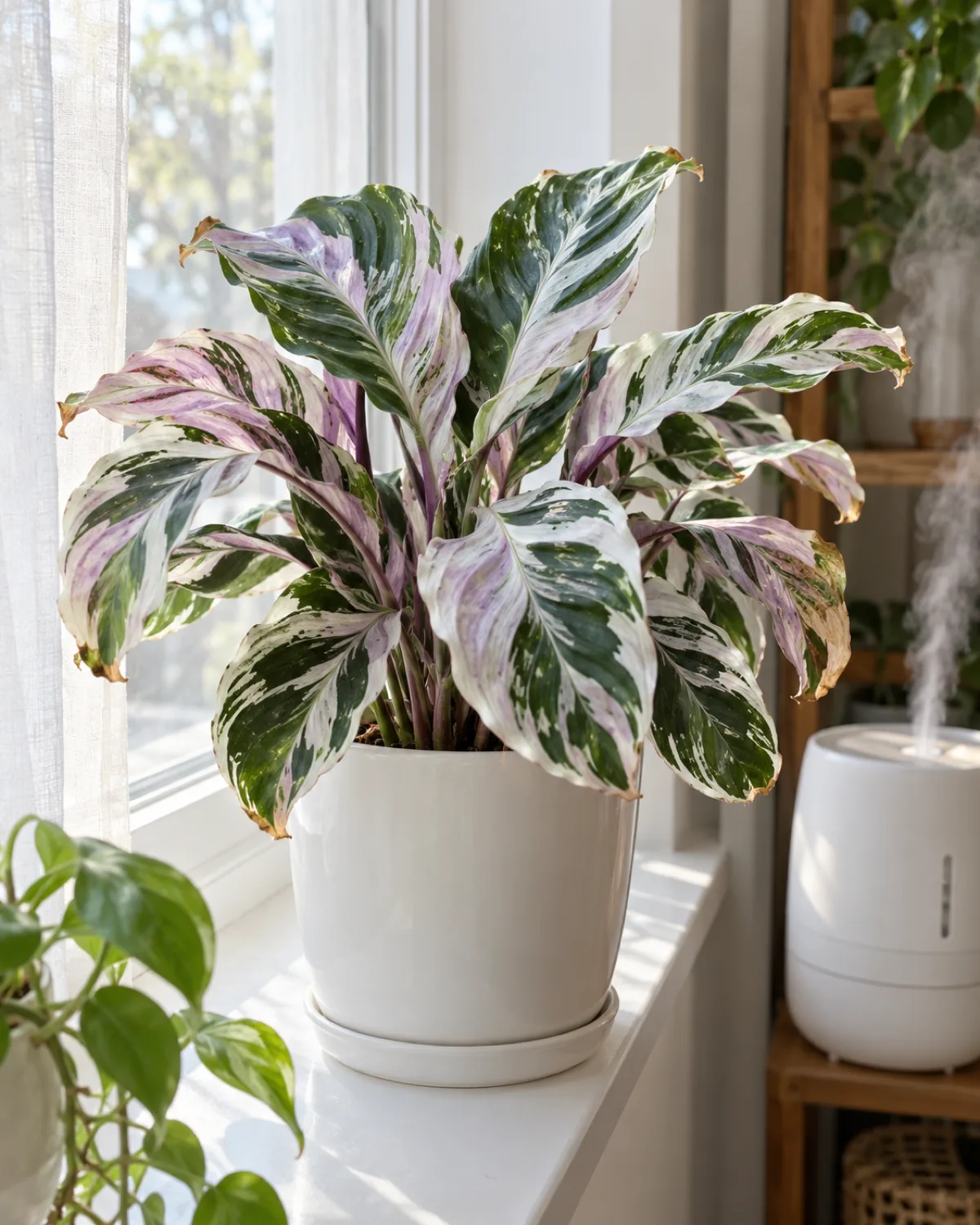
Calathea 'White Fusion' is the variety that tests whether you have actually mastered calathea care or just gotten lucky with a tolerant medallion. Every leaf carries a three-color swirl of white, green, and soft lilac that no other calathea produces — and every one of those white patches has zero chlorophyll.
That white tissue cannot photosynthesize. It browns within hours of humidity dropping below sixty percent, scorches faster than the green tissue in the same light, and cannot recover once damaged. You are not just watering the soil — you are watering the air around the plant simultaneously.
- Variegation: Unstable swirl of white, green, and lilac — no two leaves look the same
- Humidity: Sixty percent minimum, seventy preferred — a humidifier is mandatory, not optional
- Water: Filtered only — the white tissue reacts to mineral deposits even faster than the green
- Light: Bright indirect but absolutely no direct sun — the white tissue scorches in minutes where green tissue would last hours
White Fusion is not a beginner plant. It is the variety you grow after you have kept orbifolia and makoyana alive for a year and understand what your home's humidity and light actually do across seasons. The reward is leaves that look hand-painted.
Calathea Roseopicta 'Rosy' — the pink-centered calathea
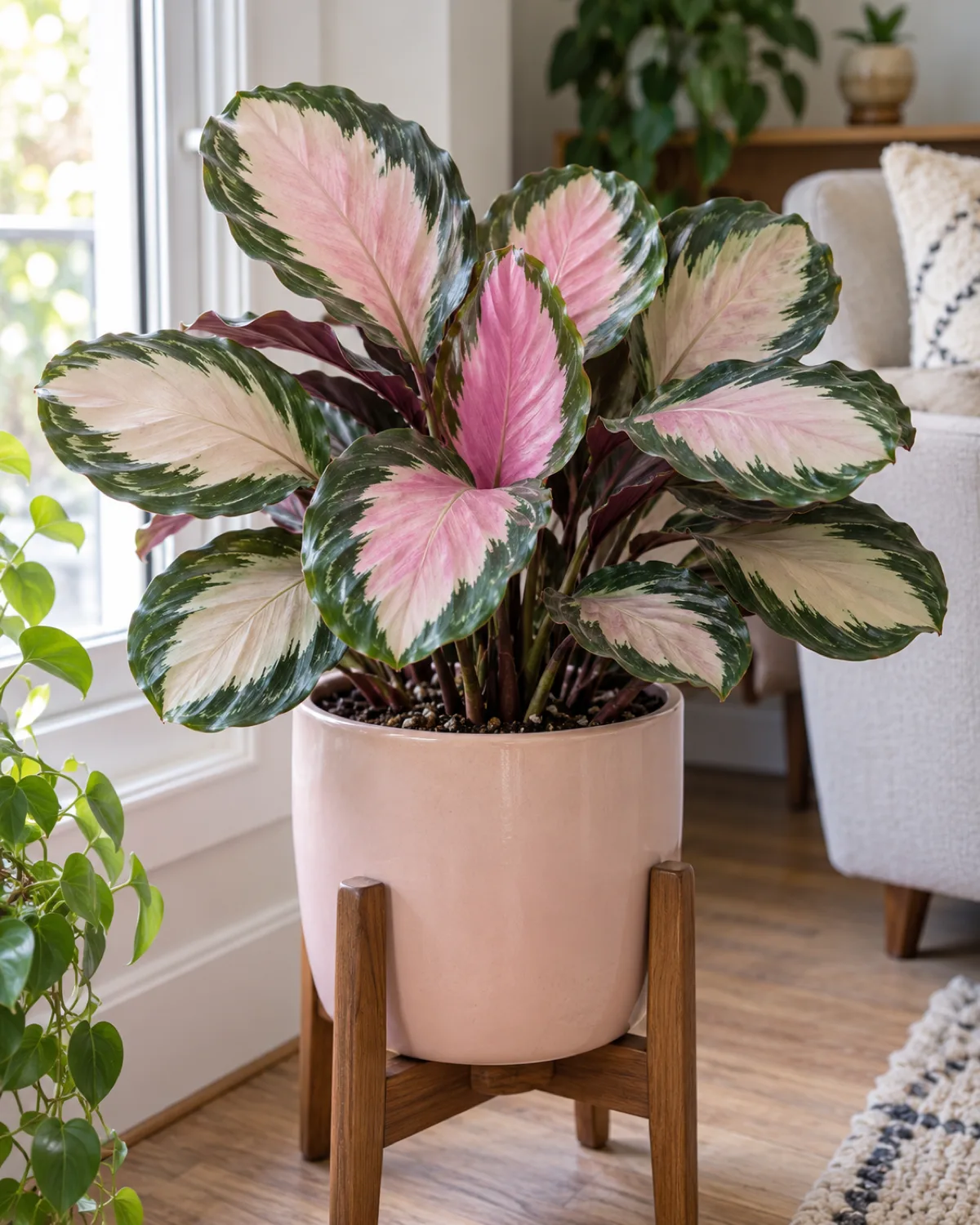
Calathea roseopicta 'Rosy' carries a broad pink center that occupies most of the leaf blade, bordered by a ring of dark green at the margins. The pink is brightest on new growth and fades to cream-white as the leaf matures — so a healthy Rosy always shows both fresh pink and faded cream at the same time.
The color progression means more light and more frequent new leaves translate directly into more visible pink. This is one of the few calatheas where brighter conditions create a noticeably different-looking plant.
- Pink intensity: Brightest on new unfurling leaves, fading to cream-white over three to four months
- Light response: Brighter indirect light produces more new leaves with more vivid pink centers
- Difficulty: Medium — similar care profile to medallion but less tolerant of dry soil
- Leaf shape: Broad and oval, similar in shape to other roseopicta cultivars like Medallion and Dottie
Rosy sits between medallion and white fusion in difficulty. It wants the same humidity and water quality as medallion but punishes dry soil faster because the pink tissue dehydrates before the green margins do.
Calathea Crocata — the eternal flame
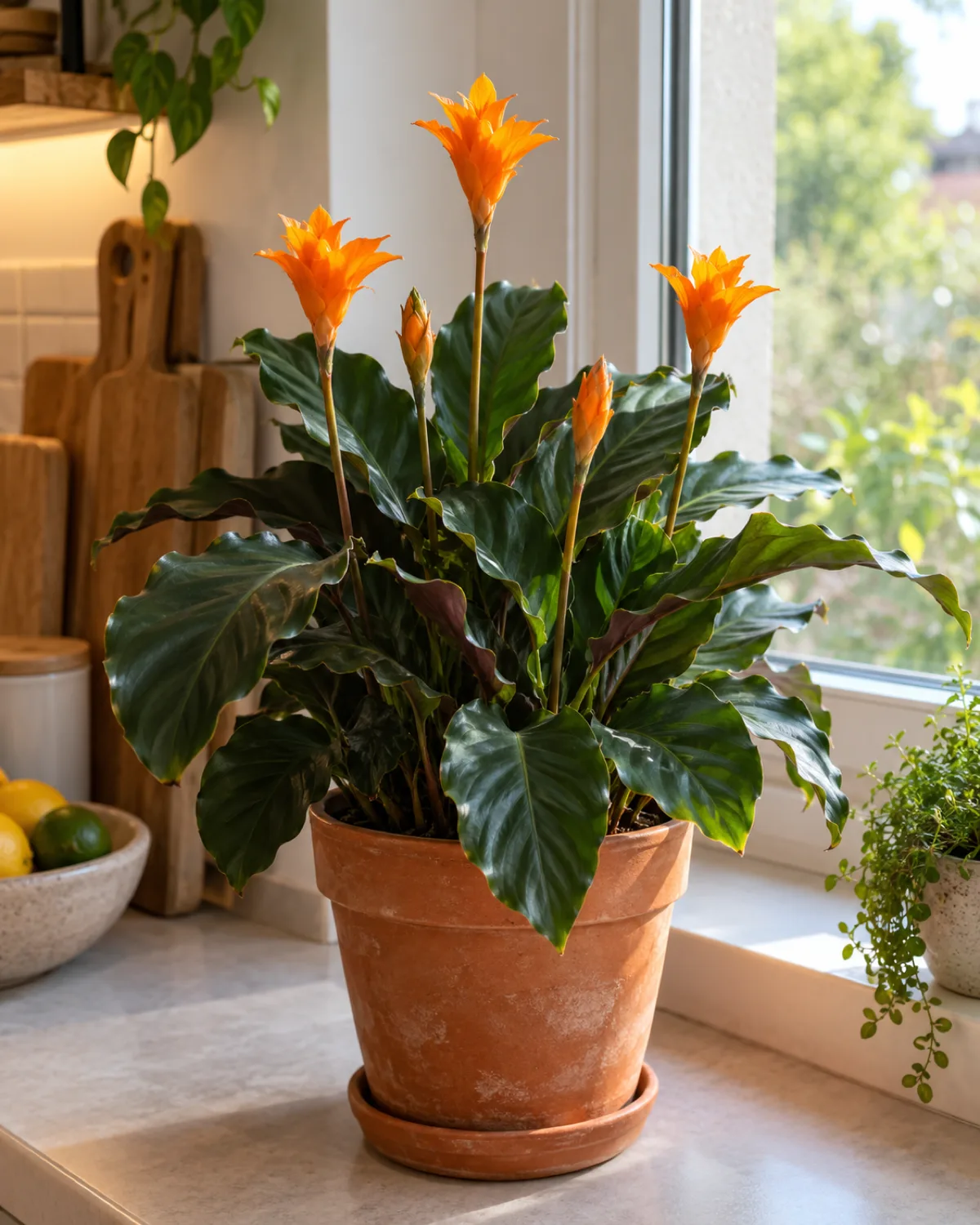
Calathea crocata is the odd one in the genus. Where every other variety on this list is grown for the leaf pattern, crocata is grown for its flowers — upright bright orange bracts that rise above the plain dark green foliage like small flames. The bracts last two to three months, which is longer than most houseplant blooms.
The trade-off is the foliage. Crocata leaves are solid dark green with a slightly ruffled texture and no pattern. If the plant is not blooming it looks ordinary, which is why most growers treat it as a seasonal display rather than a permanent collection piece.
- Bloom trigger: A two-month cool period with nighttime temperatures around sixteen degrees Celsius — without it the plant rarely re-blooms
- Bract color: Bright orange-yellow, upright, lasting eight to twelve weeks per spike
- Foliage: Plain dark green, slightly ruffled — no pattern, no stripes, no variegation
- Repeat blooming: Possible with the cool period, but many growers discard the plant after the first bloom and buy fresh
If you want a calathea that flowers, crocata is the only realistic option. Give it the cool nights in autumn and it rewards you with color that no leaf pattern can match.
Calathea Freddie — the leopard calathea
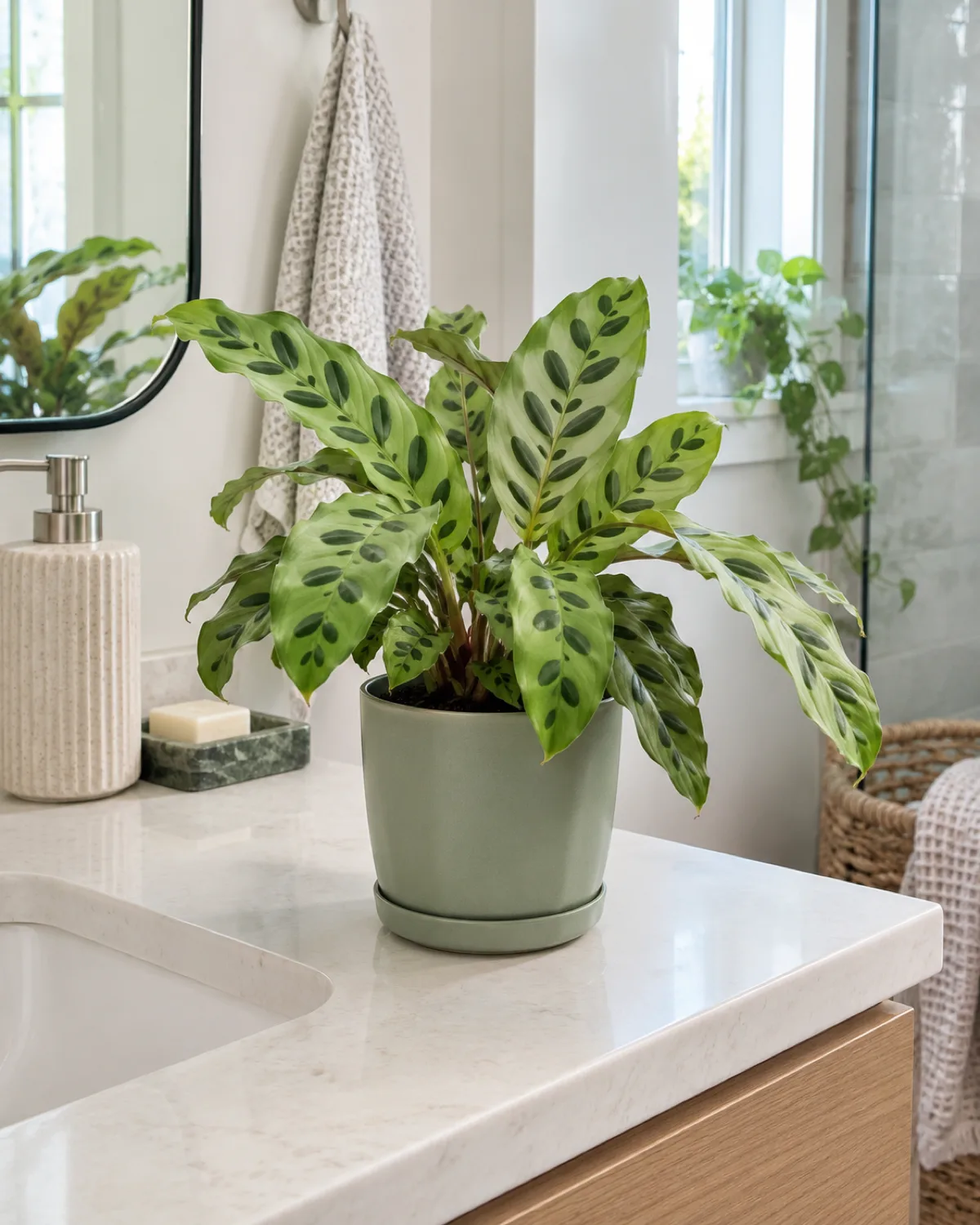
Calathea freddie — also sold as Calathea leopardina — carries rows of dark green oval spots on a light green background. The spots are arranged symmetrically along each side of the midrib, creating a leopard-print effect that is subtle enough to blend into a neutral room.
Freddie is one of the more resilient calatheas. It tolerates average humidity, recovers quickly from underwatering, and stays compact — under forty-five centimeters — which makes it a strong second calathea for someone who started with a medallion and wants to expand without escalating the care demands.
- Pattern: Dark green oval spots on light green — a lighter palette than most calatheas
- Size: Compact, under forty-five centimeters — suitable for desks, shelves, and small tables
- Recovery speed: Bounces back from underwatering faster than most calatheas
- Difficulty: Low — one of the easiest calatheas alongside medallion and rattlesnake
Freddie closes this list the way medallion opened it — with a variety that works for growers who want calathea pattern without calathea drama. Between the two, a beginner who keeps one on each side of a room has the genus covered from forgiving to resilient.
15 Calathea Varieties Worth Adding to Your Collection
- 1Medallion — the forgiving starterConcentric cream-and-green rings. Handles average humidity better than any other calathea.
- 2Lancifolia — the rattlesnakeNarrow spotted leaves with purple undersides. Thick leaves tolerate missed waterings.
- 3Orbifolia — the dinner-plate calatheaHuge silver-and-green striped rounds up to thirty centimeters across.
- 4Ornata — the pinstripePink-to-cream parallel lines on dark green. Sensitive to tap water minerals.
- 5Makoyana — the peacockTranslucent feather pattern that glows when backlit. Needs sixty percent humidity.
- 6Zebrina — the zebraTall velvety plant with bold lime-and-dark-green bands. Grows up to ninety centimeters.
- 7Rufibarba — the furry featherMaroon fuzzy undersides that slow moisture loss. Easier than it looks.
- 8Vittata — the subtle pinstripeThin white stripes on bright green. Compact enough for a desk.
- 9Dottie — the near-black calatheaNear-black leaves with hot-pink border ring. Needs bright light to keep the contrast.
- 10Musaica — the network calatheaMicro-mosaic tessellation visible only up close. Better humidity tolerance than most.
- 11Warscewiczii — the jungle velvetThe largest calathea. Velvety dark leaves and rare indoor cone-shaped flowers.
- 12White Fusion — the challenge varietyThree-color variegation of white, green, and lilac. Humidifier mandatory.
- 13Rosy — the pink-centered calatheaBroad pink center that fades to cream. More light means more pink new growth.
- 14Crocata — the eternal flameThe only calathea grown for flowers. Orange bracts lasting two to three months.
- 15Freddie — the leopard calatheaLight green with dark spots. Compact, resilient, and recovers fast from neglect.
Save this list · Kultivy
FAQ
Why are my calathea leaves curling?
Leaf curling is almost always dehydration. The plant rolls its leaves inward to reduce the surface area exposed to dry air. Check these two things in order:
- Soil moisture: if the top two centimeters are dry, water thoroughly and wait an hour
- Ambient humidity: if the soil is moist but the leaves still curl, humidity is too low
- Still stumped? A drooping and curling guide walks through every cause
Is calathea toxic to cats and dogs?
No. Calathea (Goeppertia) is non-toxic to cats and dogs according to the ASPCA, one of the safest genera for homes with pets. Should I mist my calathea? A humidifier or a pebble tray is the real solution. Misting raises humidity for minutes at most and does not change the ambient level around the plant.

Mara Quinn edits Kultivy, where she shares houseplant care, propagation, beginner-friendly plant picks, and plant-styling ideas for anyone who wants their indoor plants to actually thrive. Every guide is image-led and reviewed for clarity, usefulness, image accuracy, and Pinterest-to-page alignment before it goes live. Visit the About page.