Philodendron is not one plant. It is a genus of over 500 species spanning five-dollar trailing vines to velvet-leaved climbers that cost more than your grocery bill.
Some trail, some climb, some sit in a tidy mound on your desk. Care differs more than most people expect — a heartleaf thrives in conditions that would kill a gloriosum.
Here are the types worth growing, what makes each one different, and the care adjustments that actually matter.
- 1Heartleaf philodendron
- 2Brasil philodendron
- 3Birkin philodendron
- 4Pink Princess philodendron
- 5Velvet-leaf (micans)
- 6Prince of Orange
- 7Xanadu philodendron
- 8Gloriosum philodendron
- 9Melanochrysum
- 10Silver Sword
- 11White Knight
- 12Florida Ghost
- 13Lemon Lime
- 14Ring of Fire
- 15Pedatum
- 16Choosing your philodendron
Heartleaf philodendron — the one that forgives everything
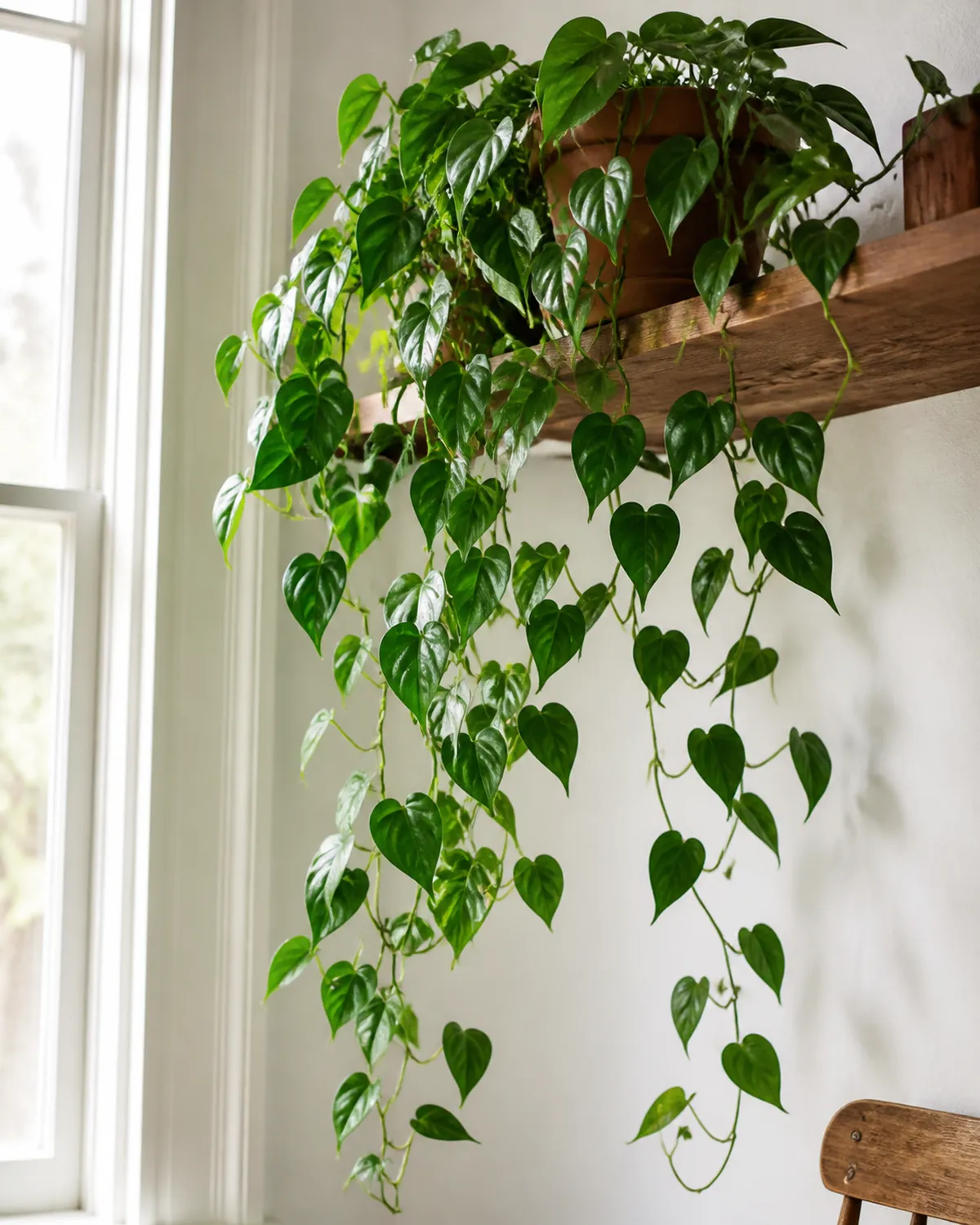
Philodendron hederaceum is the plant you buy when you are not sure you can keep anything alive. It is the most common philodendron species and the most forgiving one in the entire genus.
The leaves are small glossy hearts, dark green and slightly waxy. The vines trail effortlessly from shelves and hanging baskets without any training, and a single plant can reach ten feet or more in one growing season with decent light.
What sets heartleaf apart from every other philodendron on this list is tolerance:
- It grows in low light — not just medium, but genuinely dim rooms where most plants would stretch and suffer
- It survives inconsistent watering better than any other variety, bouncing back from a slight wilt within hours
- It grows in water indefinitely, making it one of the few philodendrons you can keep as a permanent water display
- It handles average household humidity without complaint
The Brasil cultivar adds a lime-green center stripe to the same bombproof chassis. If you want color without adding difficulty, Brasil is the first step up. For the fundamentals of caring for any philodendron including heartleaf, see our complete philodendron care guide.
Brasil philodendron — heartleaf with a paint stroke
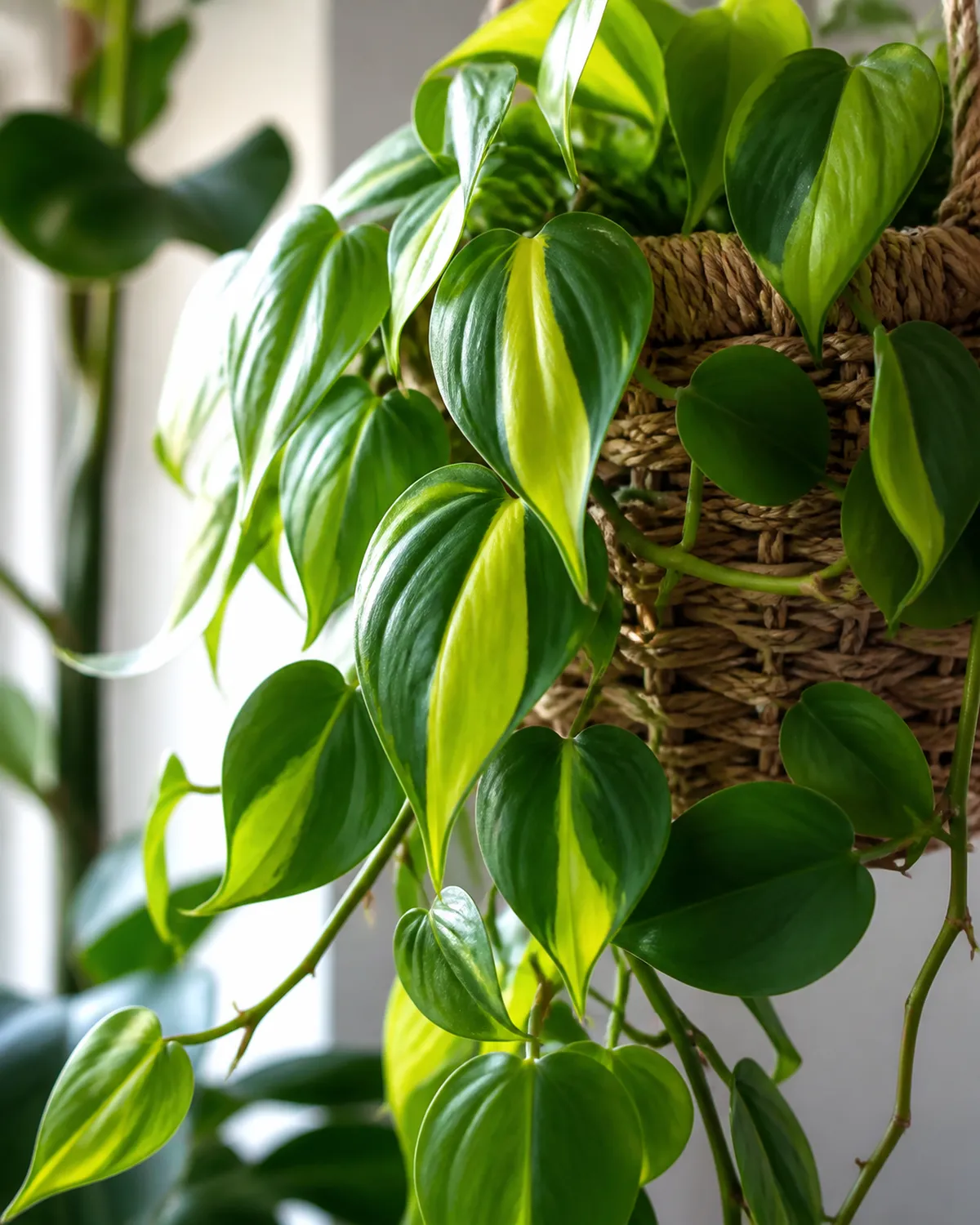
Philodendron hederaceum 'Brasil' is a heartleaf cultivar with a vivid lime-green and yellow stripe running down the center of each leaf. No two leaves have the same stripe width — some are mostly green with a thin line, others are half chartreuse.
The single care difference from plain heartleaf is light. Brasil needs bright indirect light to maintain vivid variegation. In low light conditions, the plant defaults to survival mode and produces all-green leaves. The variegation does not come back once a leaf goes green.
- Reversion management: If stems start producing only solid green leaves, prune those stems back to the last variegated node — this redirects energy toward variegated growth
- Propagation: Cuttings maintain variegation only if the cutting includes a variegated node
- Growth rate: Slightly slower than plain heartleaf because the yellow sections produce less chlorophyll
Everything else — water, soil, temperature, humidity tolerance — is identical to standard heartleaf. Same bombproof plant, better colors.
Birkin philodendron — pinstripe precision on every leaf
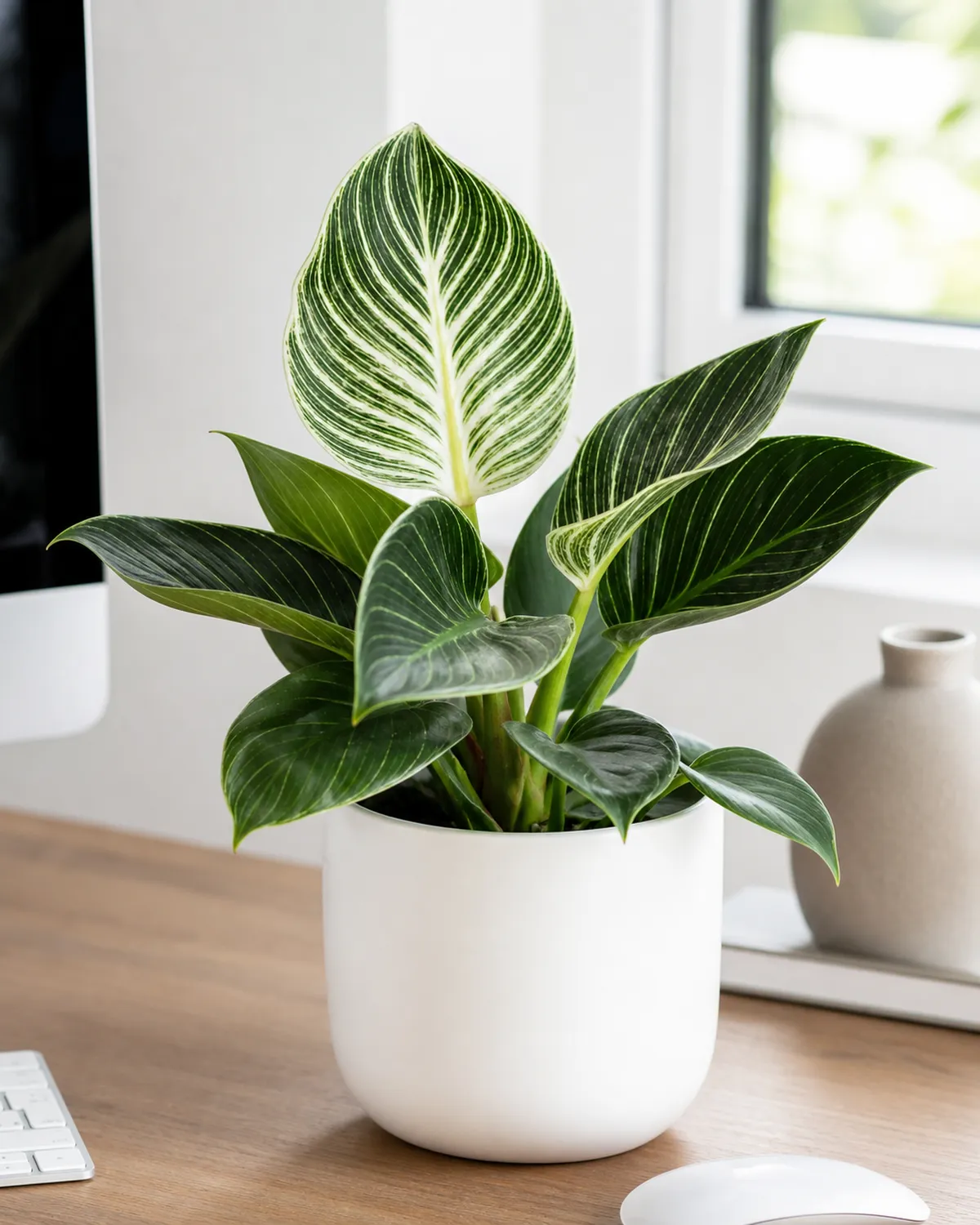
Philodendron 'Birkin' is a self-heading variety — it grows upright in a compact mound rather than trailing or climbing. That makes it perfect for desks, nightstands, and office spaces where a trailing vine would be impractical.
The signature look is crisp white-to-cream pinstripes radiating from the center midrib of each dark green leaf. Every new leaf unfurls with a slightly different stripe pattern, so the plant evolves visually as it grows.
Birkin has a few care differences from the trailing heartleaf types:
- Light: Needs bright indirect light to produce defined stripes — dim light reduces or eliminates the variegation entirely
- Sport leaves: Occasionally produces a half-moon leaf that is half white and half green, or reverts to solid dark green — both are normal genetic instability from its hybrid origin
- Size: Stays compact, topping out around three feet — never needs a moss pole
- Root rot sensitivity: Let the top inch dry completely between waterings — slightly drier than trailing types prefer
The combination of compact form and striking variegation makes Birkin one of the best philodendrons for small spaces.
Pink Princess philodendron — the variegation everyone wants
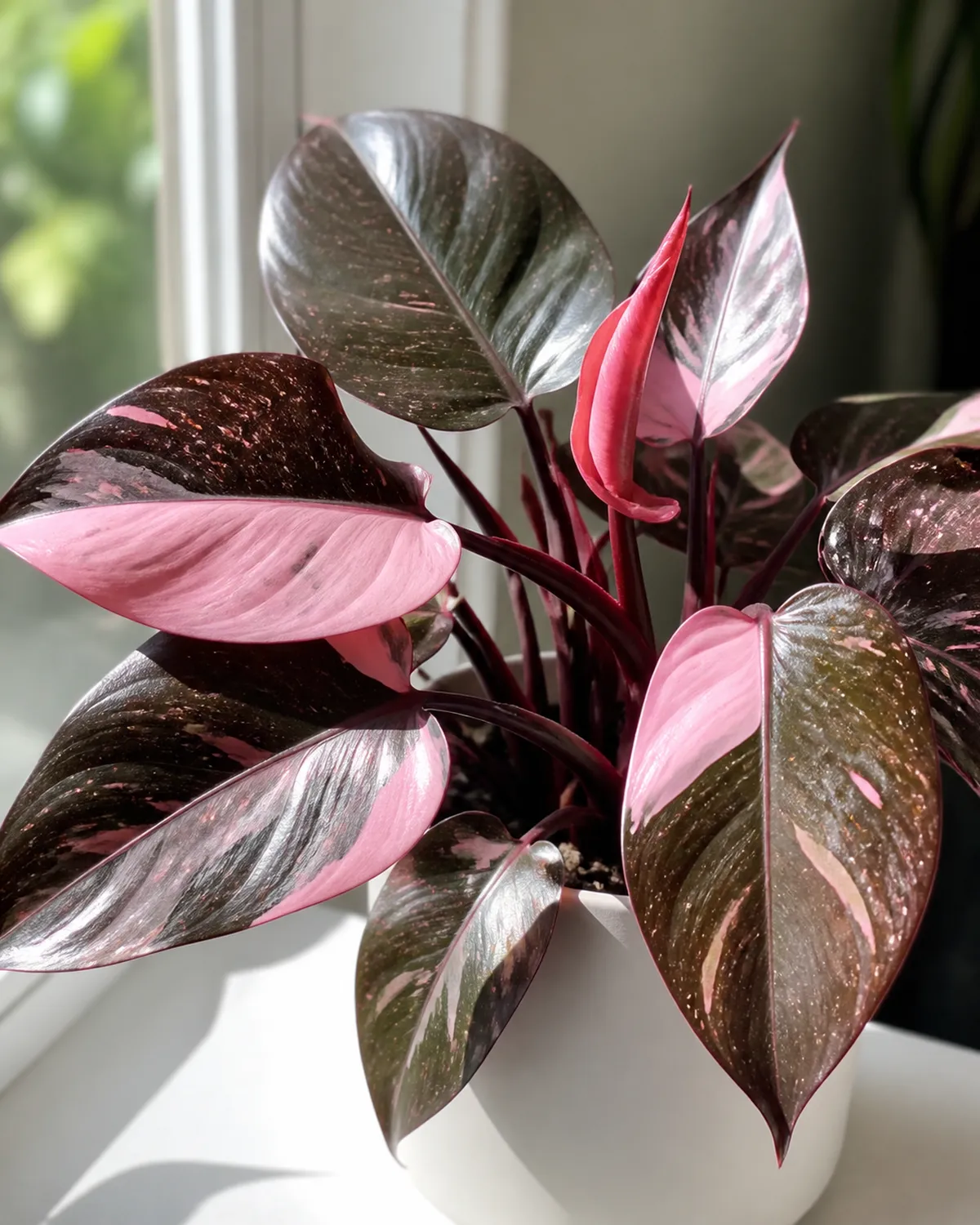
Philodendron erubescens 'Pink Princess' is the variety that launched a thousand Instagram accounts. The bubblegum-pink variegation on dark burgundy-green leaves is unlike anything else in the houseplant world.
Each leaf is unique — some mostly pink, some mostly green, some a perfect half-and-half split. The plant decides, and you cannot control which leaves come out pink. What you can control is the one lever that matters.
Light is the single most important factor. Bright indirect light to direct morning sun maximizes pink expression. Low light produces all-green leaves that will never turn pink regardless of fertilizer tricks or prayer.
What collectors need to know:
- Price reality: Once two hundred dollars per cutting, now thirty to sixty dollars for established plants as tissue culture increased supply dramatically
- The dark side: Too much pink means the leaf has too little chlorophyll to photosynthesize — entirely pink leaves eventually die back, and a healthy pink princess has mixed leaves, not all-pink ones
- Fakes exist: Real variegation is in the leaf tissue, not painted on the surface — rub a leaf to check
- Propagation: Stem cuttings with at least one variegated node are required, but there is no guarantee the new plant maintains the same variegation level
For the light conditions that maximize variegation in any philodendron, give it the brightest spot you have that does not include harsh afternoon sun.
Velvet-leaf philodendron (micans) — the texture you can't stop touching
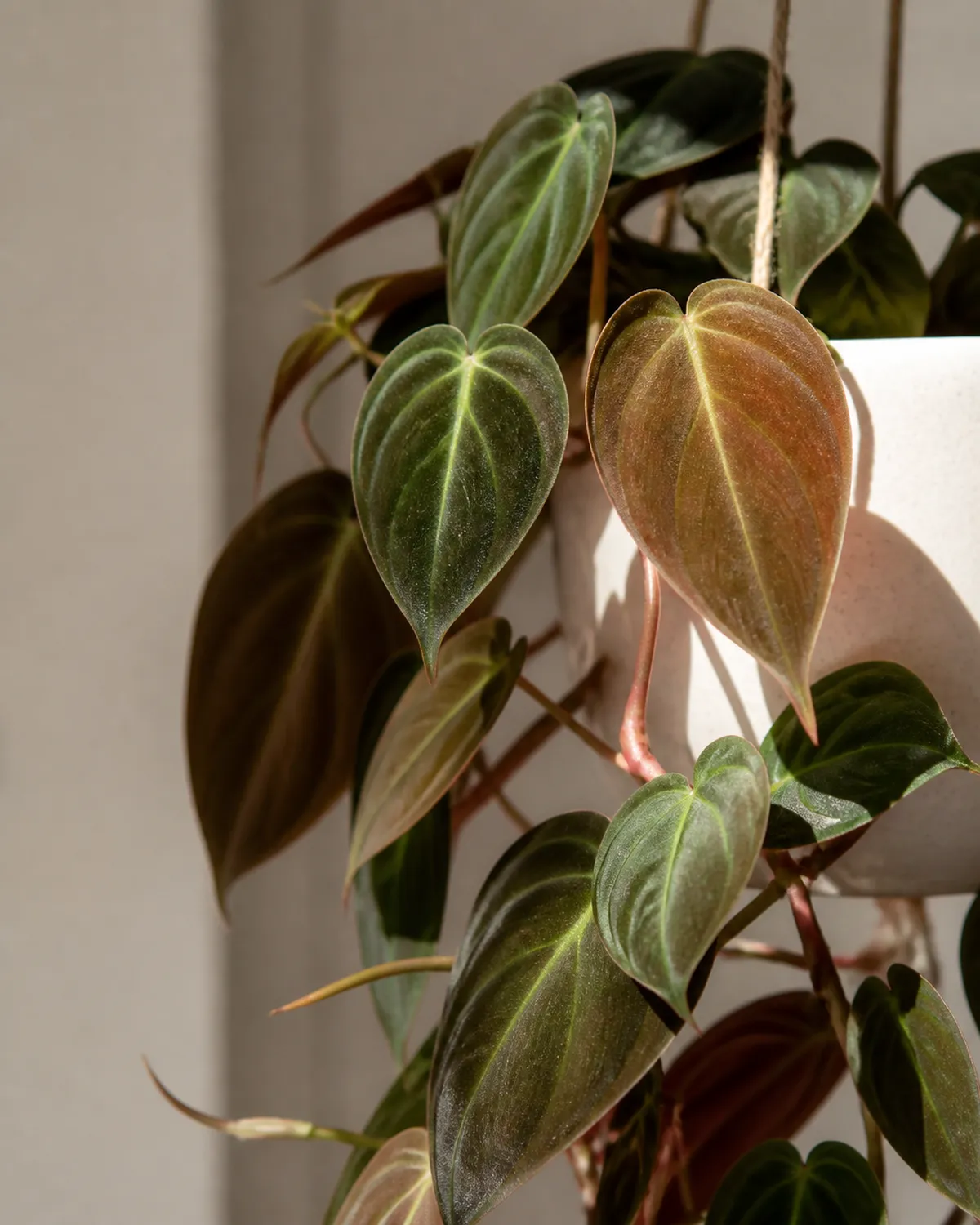
Philodendron hederaceum var. micans has a surface you need to experience in person. Each leaf is covered in fine trichomes — plant hairs — that create an iridescent sheen. The leaves literally shift from bronze to deep green as you change your viewing angle.
The trailing habit is identical to heartleaf, but micans has shorter internodes, which means denser foliage along the vine. The leaves are also smaller — one to three inches versus heartleaf's three to five — creating a more delicate cascading effect from shelves and hanging planters.
- Light: Medium to bright indirect — the leaves appear darker and more bronze in lower light, greener in brighter conditions
- Humidity: The one added need — below forty percent humidity, the velvet texture loses its plushness and leaf edges crisp
- Care: Everything else is identical to heartleaf — same water, soil, temperature tolerance
- Price: One of the more affordable fancy philodendrons, widely available at big box stores for under fifteen dollars
If heartleaf is the reliable sedan, micans is the same engine in a velvet interior.
Prince of Orange philodendron — leaves that cycle through sunrise colors
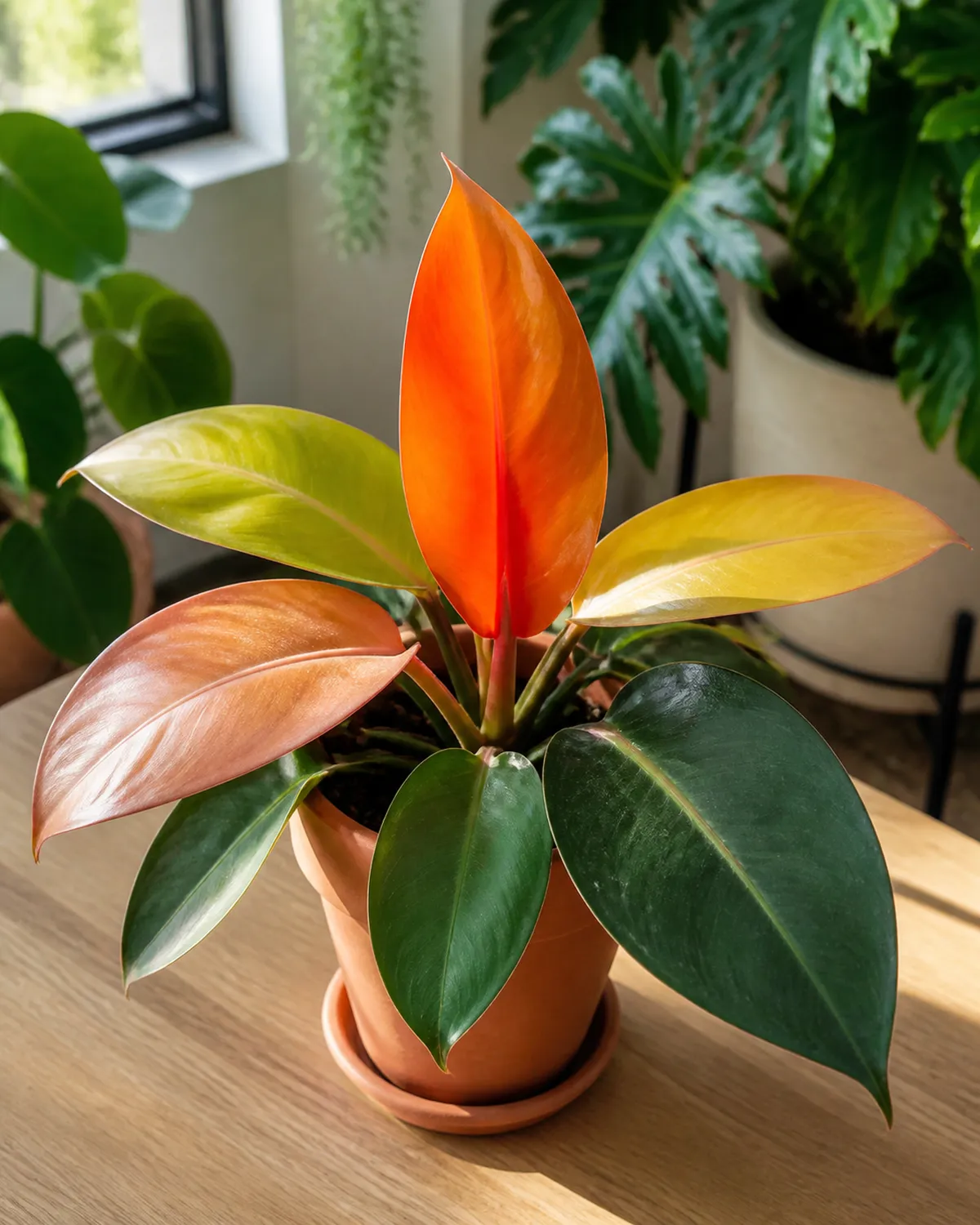
Philodendron 'Prince of Orange' is a self-heading hybrid that delivers color without the unpredictability of variegation. Each new leaf emerges bright orange-copper and then matures through peach, yellow-green, and finally dark green over several weeks.
The result: at any given time, the plant displays four or five different colored leaves simultaneously. The oldest leaves are dark green at the bottom, the newest are vivid orange at the top — a living gradient.
This is not variegation. It is sequential pigment change — anthocyanin fading as chlorophyll increases. Every leaf goes through the full cycle, every time.
- Light for color: Bright indirect light produces the most vivid orange in new leaves — low light mutes it to yellowish-green
- Growth habit: Compact self-heading form similar to Birkin, staying under two feet — never climbs, never needs a pole
- Difficulty: Low — tolerates average humidity and standard watering with the top inch drying between drinks
- Price: Fifteen to twenty-five dollars — one of the most affordable unusual philodendrons
An excellent second philodendron after heartleaf. Same compact convenience, dramatically more visual interest.
Xanadu philodendron — the structured one that stays put
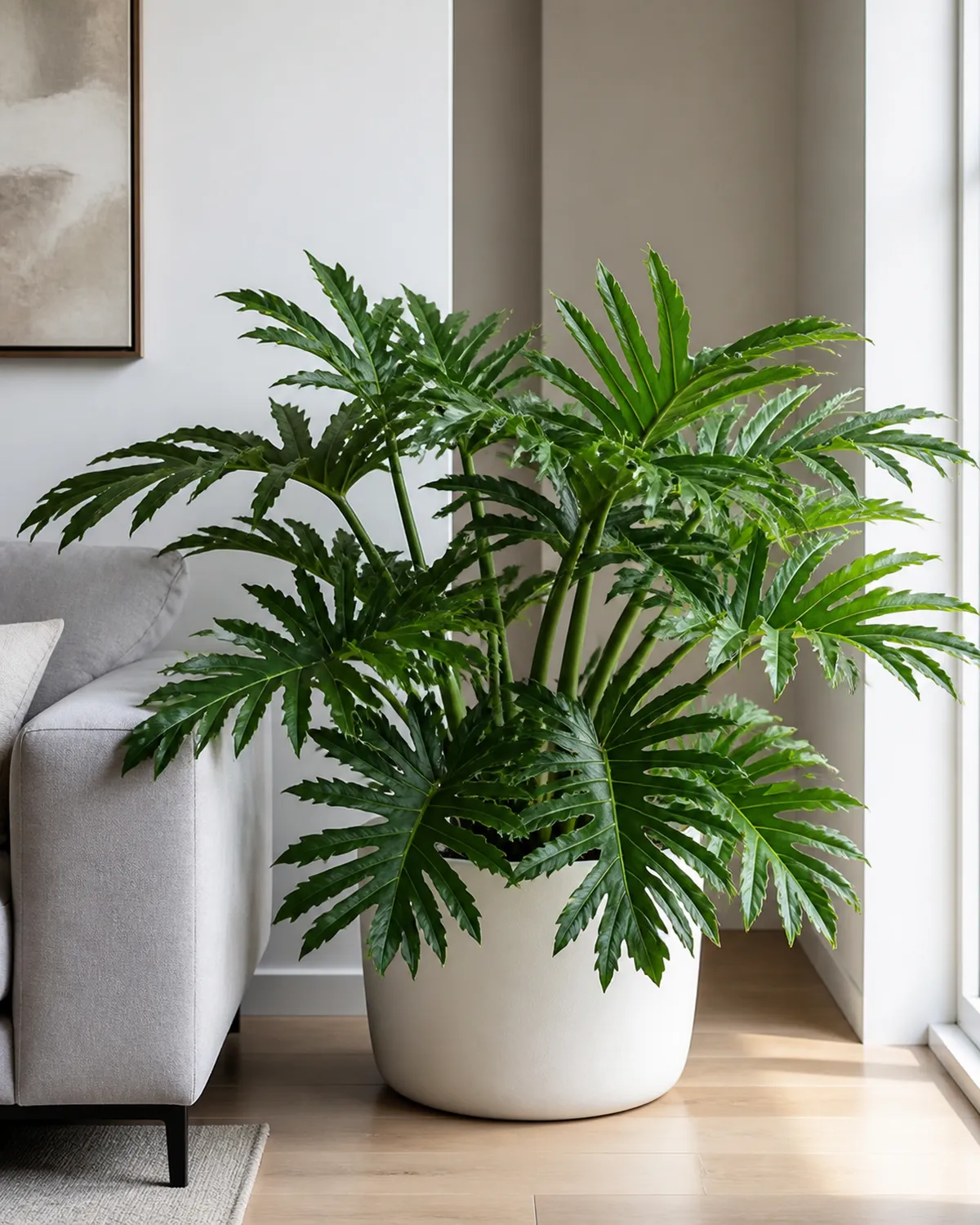
Philodendron xanadu — now reclassified as Thaumatophyllum xanadu but still universally sold under the old name — is the largest self-heading variety on this list.
Each mature leaf splits into fifteen to twenty finger-like lobes, creating a dramatic, almost fern-like silhouette. Juvenile leaves start simpler with fewer divisions, developing more lobes as the plant matures. The fully lobed form is genuinely architectural.
Xanadu grows outward in a symmetrical clump rather than climbing or trailing, which means no support structure is ever needed. It also means it needs floor space — mature specimens reach three to four feet tall and four to five wide.
The care profile is notably different from the tropical trailing types:
- Light: More tolerant of some direct morning sun without burning — the thick leathery leaves handle intensity that would scorch a heartleaf
- Cold tolerance: Handles brief dips to fifty degrees Fahrenheit, while most philodendrons suffer below fifty-five
- Water: The thick lobed leaves store more moisture — let soil dry more between waterings than you would for trailing types
- Placement: A statement floor plant beside a sofa or in a corner with room to spread — see our living room plant guide for positioning ideas
Xanadu is the philodendron for people who want structure and scale without any climbing hardware.
Gloriosum philodendron — the crawling velvet giant
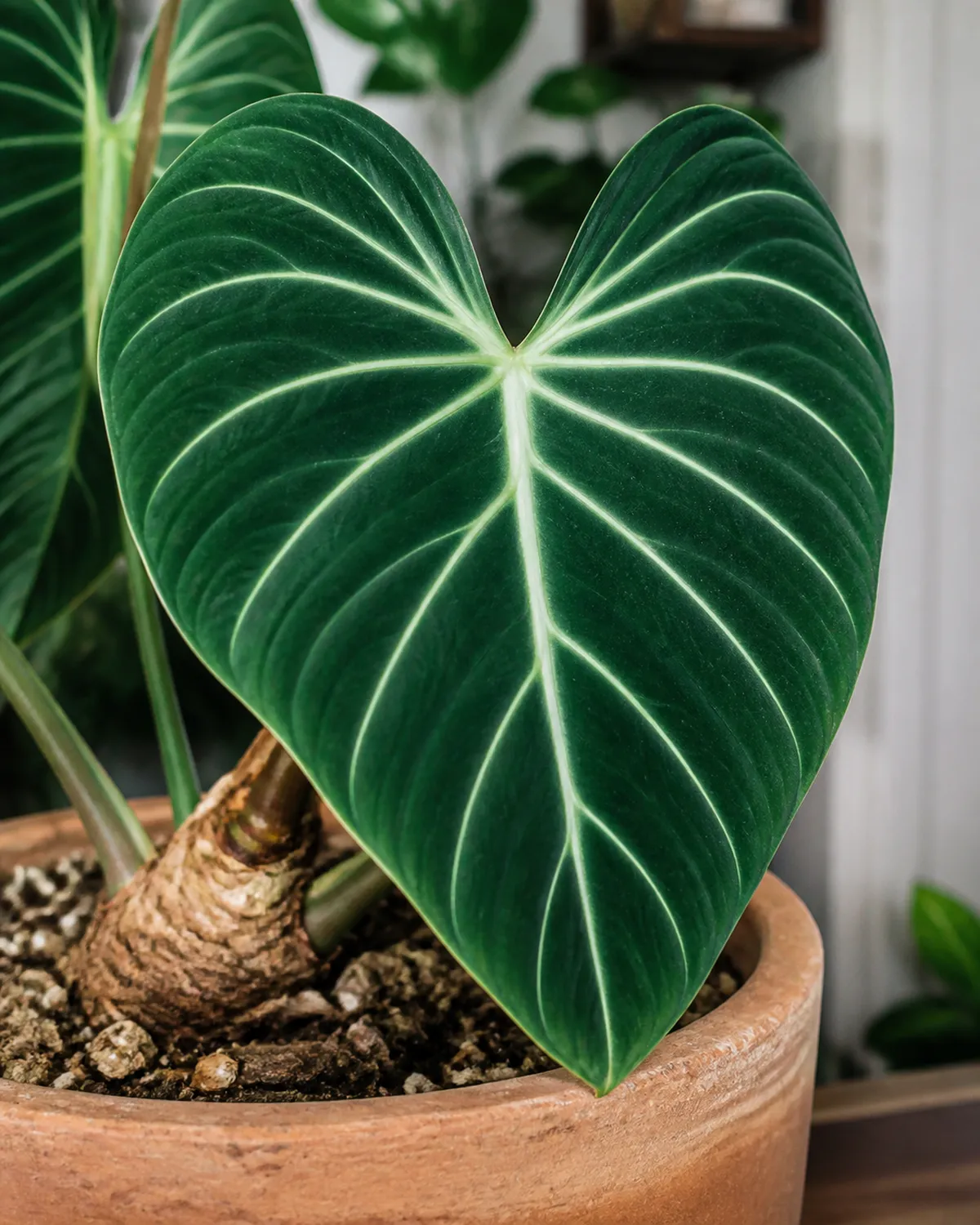
Philodendron gloriosum is the plant that makes collectors stop in their tracks. Massive heart-shaped leaves covered in deep green velvet with bright white veins radiating from the center — it is one of the most visually striking foliage plants in existence.
The growth habit confuses people: gloriosum does not climb. It is a terrestrial species that crawls along the ground via a thick rhizome. This means it needs a wide shallow pot rather than a tall one with a moss pole. Repotting should give the rhizome room to creep forward, not depth.
Gloriosum is where philodendron care gets genuinely demanding:
- Leaf size: Individual leaves can reach two to three feet across indoors — genuinely enormous
- Growth rate: Expect three to five new leaves per year — dramatically slower than heartleaf's weekly output
- Humidity: Truly needs sixty percent or higher consistently, or leaf edges brown and new leaves emerge smaller
- Temperature: Prefers sixty-five to eighty degrees with no cold drafts — more temperamental than common varieties
- Price: Forty to eighty dollars for small specimens
This is not a beginner plant. It is the plant you graduate to after you have kept a heartleaf alive for a year and want to understand what humidity actually means.
Melanochrysum philodendron — the dark velvet climber
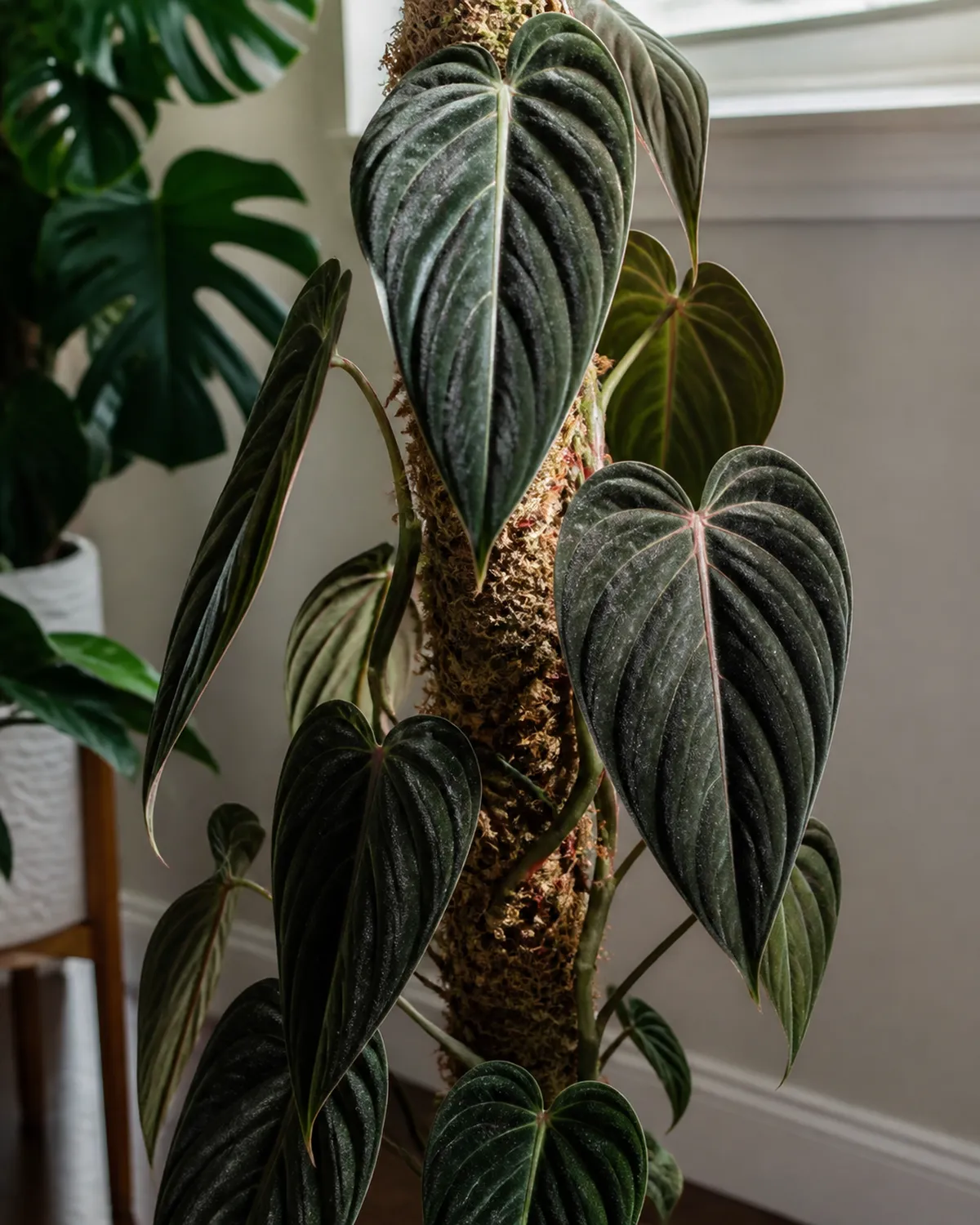
Philodendron melanochrysum is the aroid collector's grail plant. The name means "black gold" in Greek, and the leaves deliver exactly that — dark velvet covered in microscopic crystal-like cells that catch light and sparkle.
Unlike gloriosum, melanochrysum is an aggressive climber. It needs a moss pole or trellis, and the distinction matters: without vertical support, the leaves stay small and juvenile. Mount it on a pole and the mature leaves grow over two feet long — elongated narrow hearts that look nothing like the juvenile form.
The care demands are real:
- Humidity: Non-negotiable sixty to seventy percent or higher — this is genuinely not a dry-apartment plant
- Soil: Extremely well-draining chunky aroid mix — bark, perlite, charcoal, sphagnum — standard potting soil retains too much moisture
- Fertilizing: Quarter-strength balanced fertilizer monthly during the growing season — fine roots burn easily
- Growth: Moderate — faster than gloriosum once climbing, but nowhere near heartleaf speed
- Price: Fifty to one hundred twenty dollars depending on maturity
Melanochrysum combined with a humidifier and a moss pole is the setup that separates casual plant owners from committed collectors.
Silver Sword philodendron — metallic blades that transform
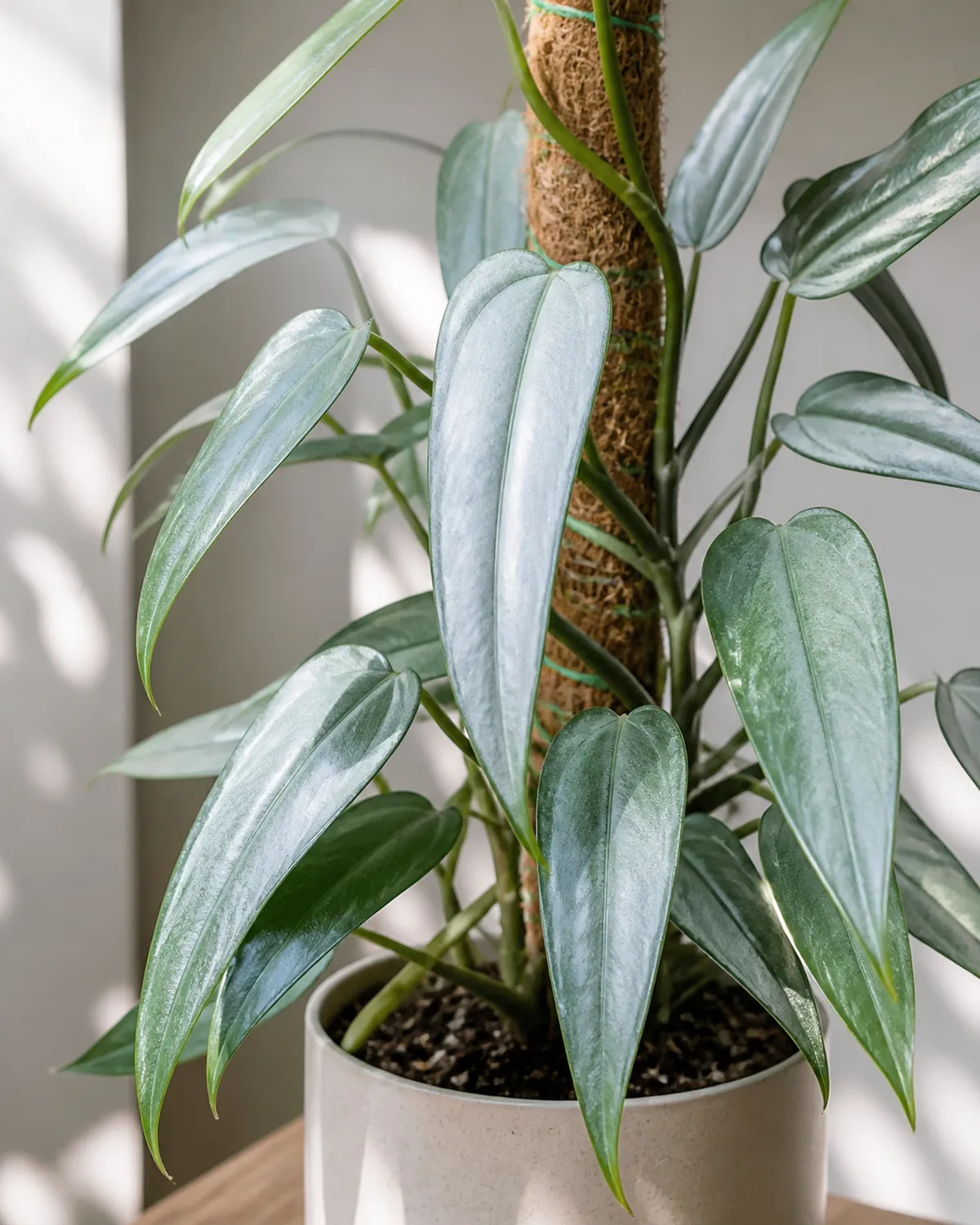
Philodendron hastatum, commonly sold as 'Silver Sword,' is named for its juvenile leaves — narrow, elongated blades coated in a silvery-blue metallic sheen that catches light like brushed aluminum.
The transformation is the hook: without a climbing pole, the plant stays compact with small silver leaves. Attach it to a moss pole and it rapidly produces increasingly larger and differently shaped leaves. Mature foliage on a pole becomes large, multi-lobed, and loses the silver color — the metallic sheen is a juvenile trait.
Some growers deliberately keep Silver Sword off a pole to maintain the namesake look longer. Others give it a tall support to watch the dramatic transformation unfold.
The best part is the care profile:
- Humidity: Fifty percent or above — manageable for most homes, far less demanding than melanochrysum or gloriosum
- Light: Standard bright indirect — no special requirements
- Water: Normal philodendron watering — top inch dry between drinks
- Growth: Fast once climbing, producing a new leaf every two to three weeks in the growing season
- Price: Was once rare and expensive, now widely available at fifteen to twenty-five dollars thanks to tissue culture
Silver Sword is the "looks rare, grows easy" philodendron — collector aesthetics without collector demands.
White Knight philodendron — rare tricolor variegation
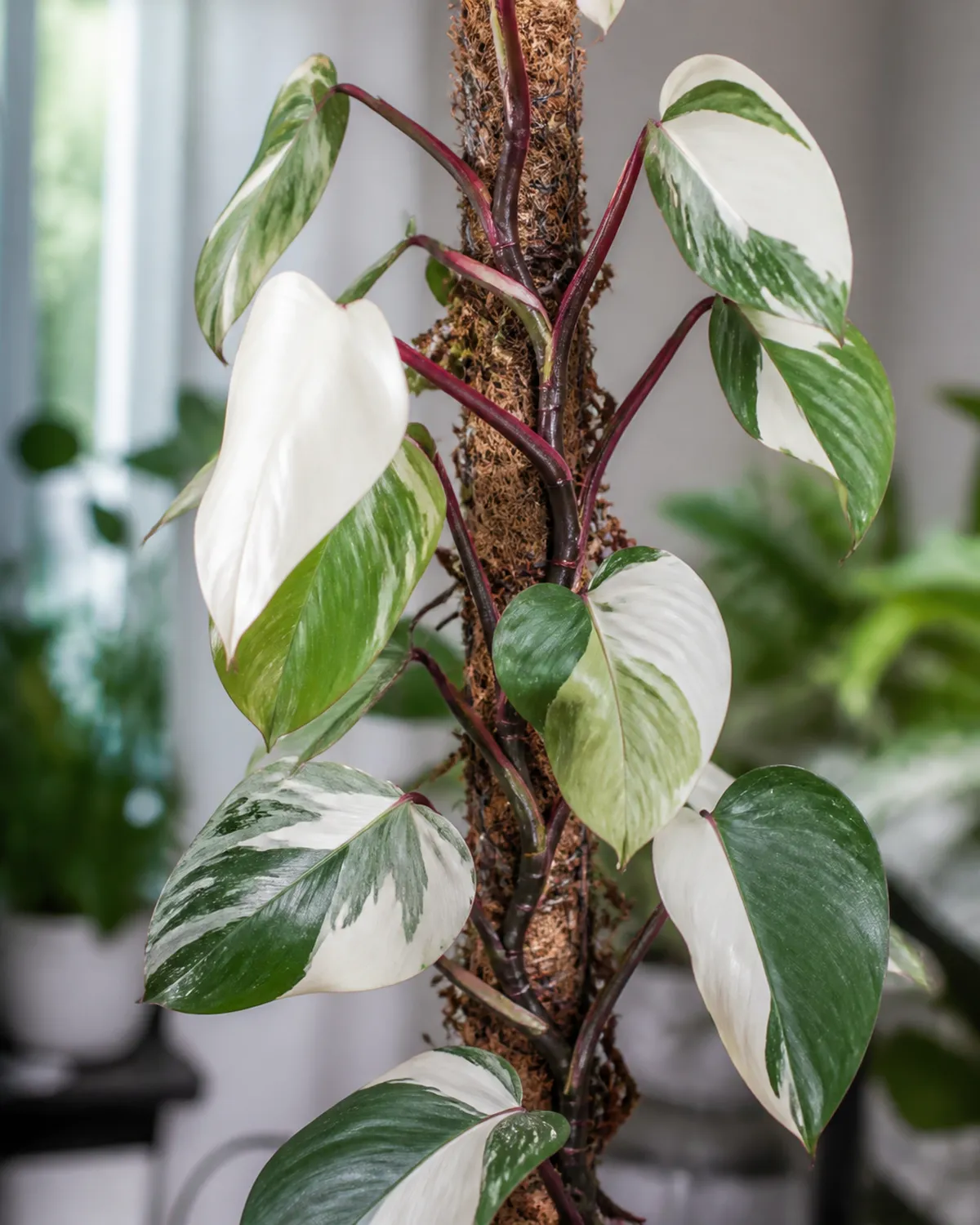
Philodendron 'White Knight' adds a third color that Pink Princess lacks: the stems and petioles are deep reddish-brown, creating a tricolor plant where most variegated philodendrons only manage two.
Each leaf is unpredictable — some emerge mostly white, some mostly green, some balanced. The variegation cannot be forced or controlled, which is part of both the appeal and the frustration.
Key differences from Pink Princess:
- The white sections are more prone to sunburn than pink sections — bright indirect light is essential, but direct sun scorches the chlorophyll-free areas faster
- Slower growth than Pink Princess because the white sections photosynthesize even less efficiently than pink ones
- Reversion management: Prune all-green growth to encourage variegated leaves from the next node
- Price: Fifty to one hundred fifty dollars depending on variegation quality — premium pricing reflects genuinely unstable genetics that tissue culture has not fully solved
Care-wise, White Knight is slightly more demanding than heartleaf but far easier than gloriosum. Standard aroid care with extra attention to light positioning.
Florida Ghost philodendron — leaves that appear from nowhere
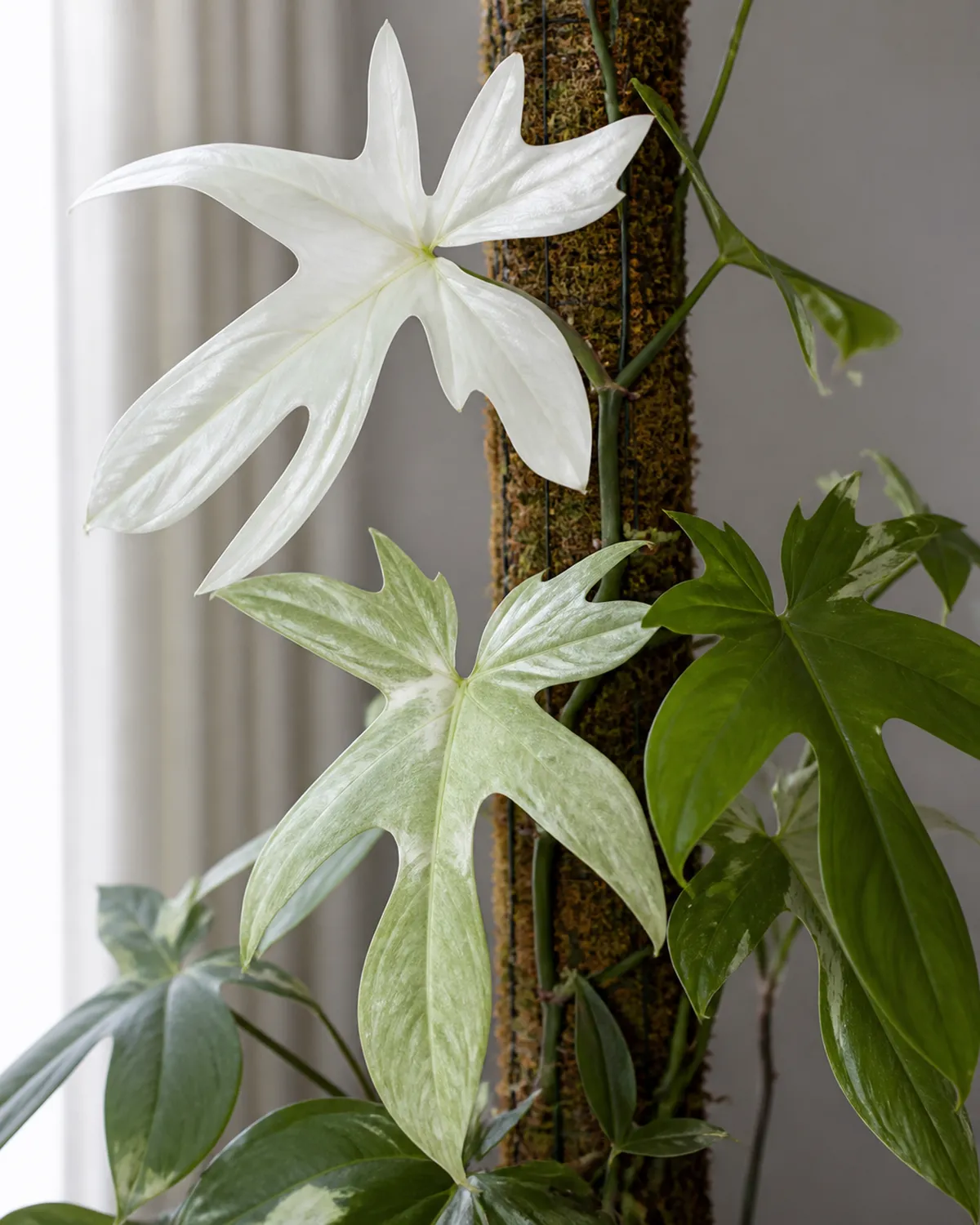
Philodendron 'Florida Ghost' earns its name when a new leaf unfurls completely white — translucent, otherworldly, and genuinely ghost-like. Over four to six weeks, the leaf slowly develops chlorophyll and darkens to pale mint, then green.
The effect is dramatic: a mature plant on a moss pole shows a stark gradient from a ghostly white newest leaf through progressively darker green older leaves. Combined with the irregularly shaped multi-lobed foliage — three to five lobes per leaf, unlike the typical philodendron heart shape — the plant looks like nothing else on the shelf.
The biological catch:
- Fully white leaves cannot photosynthesize and depend entirely on the plant's green mature leaves for energy
- Too many white leaves emerging simultaneously can weaken the entire plant
- Bright indirect light to some direct morning sun maximizes the duration of the white phase
- A grow light supplement helps maintain the contrast between white new growth and green mature leaves
Florida Ghost needs well-draining aroid soil, sixty percent or higher humidity preferred, and careful watering — the white leaves are more susceptible to fungal issues than pigmented ones.
Four philodendron variety mistakes that cost money
- 1Buying a rare variety before mastering heartleaf careA hundred-dollar pink princess dying from basic overwatering hurts more than a five-dollar heartleaf doing the same. Learn the genus on a cheap plant first. The watering rhythm, soil preference, and light reading skills transfer directly to expensive varieties.
- 2Putting variegated types in low light and expecting colorWithout bright indirect light, the plant defaults to survival mode and produces plain green leaves. Variegation needs light energy. No amount of fertilizer or special soil compensates for insufficient light.
- 3Skipping the moss pole for climbing varietiesSilver sword, melanochrysum, pedatum, and Florida ghost all produce dramatically smaller and differently shaped leaves without vertical support. A ten-dollar moss pole transforms the entire growth habit and leaf size.
- 4Assuming all philodendrons need the same humidityHeartleaf thrives at thirty percent humidity while gloriosum needs sixty percent or higher. Grouping them together without checking individual needs guarantees one of them struggles while you blame your watering schedule.
kultivy.com
Lemon Lime philodendron — the neon beacon in a dark room
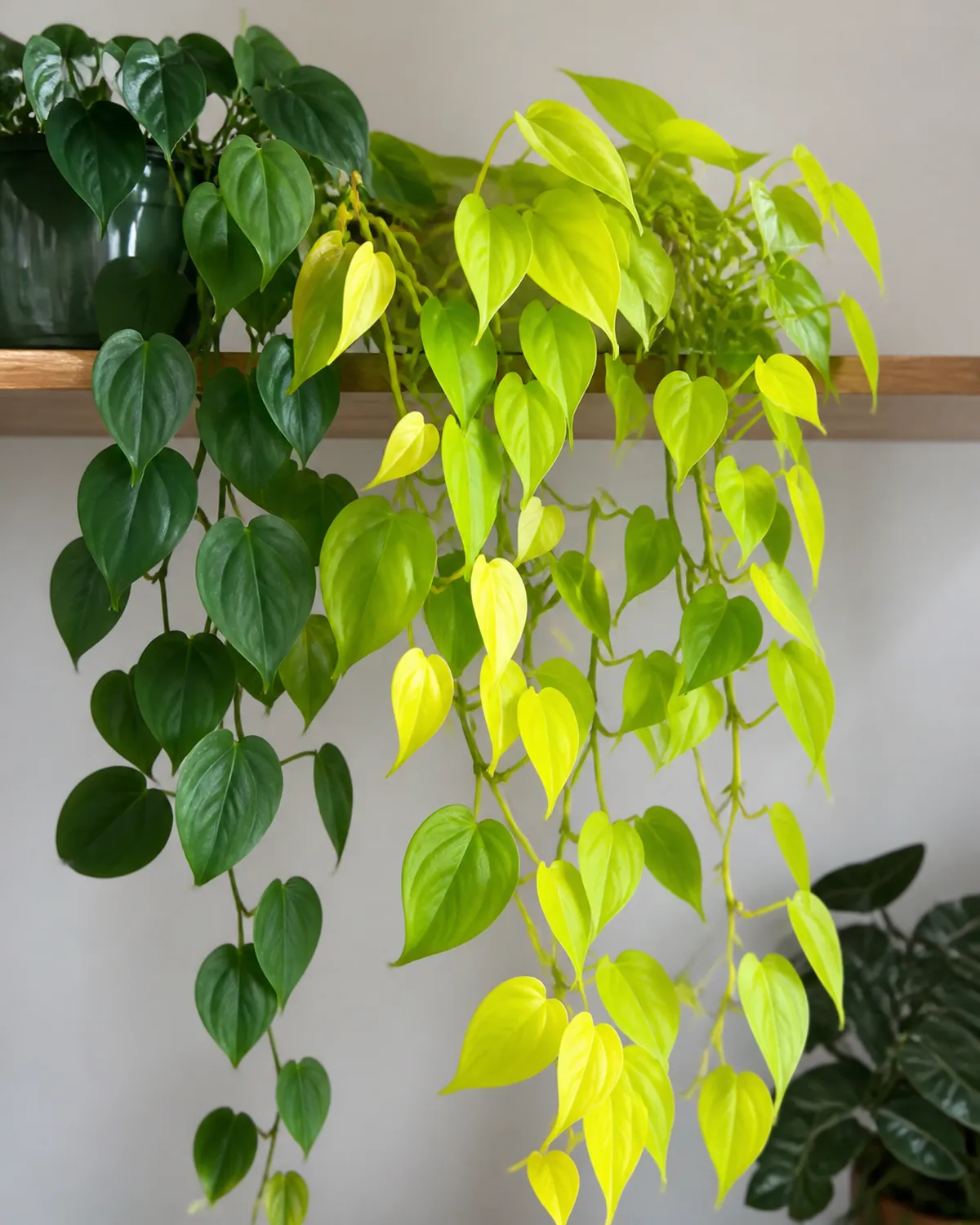
Philodendron hederaceum 'Lemon Lime' is a heartleaf sport with electric chartreuse-to-neon-yellow foliage that practically glows against darker plants.
The color is not variegation — the entire leaf is the same shade. This is a stable color mutation, meaning every leaf comes out chartreuse with no risk of reversion. New leaves emerge bright yellow and mature to neon lime-green, creating a built-in gradient.
The standout feature for low-light spaces:
- Unlike Brasil, Pink Princess, and every other colorful philodendron on this list, Lemon Lime maintains its color even in medium-low light
- The yellow-green pigmentation does not depend on intense light the way pink or white variegation does
- In very low light, the color shifts slightly more toward green, but it never loses its characteristic brightness
Same bombproof heartleaf care in every other dimension — drought-tolerant, humidity-flexible, pest-resistant. Trail it from a shelf next to a dark-green heartleaf or micans for maximum visual contrast.
One common confusion: Lemon Lime philodendron versus neon pothos. The philodendron has thinner leaves, smoother texture, and visible cataphyll sheaths at each node. Pothos has thicker waxy leaves and a slight groove along the stem.
Ring of Fire philodendron — serrated edges and variable variegation
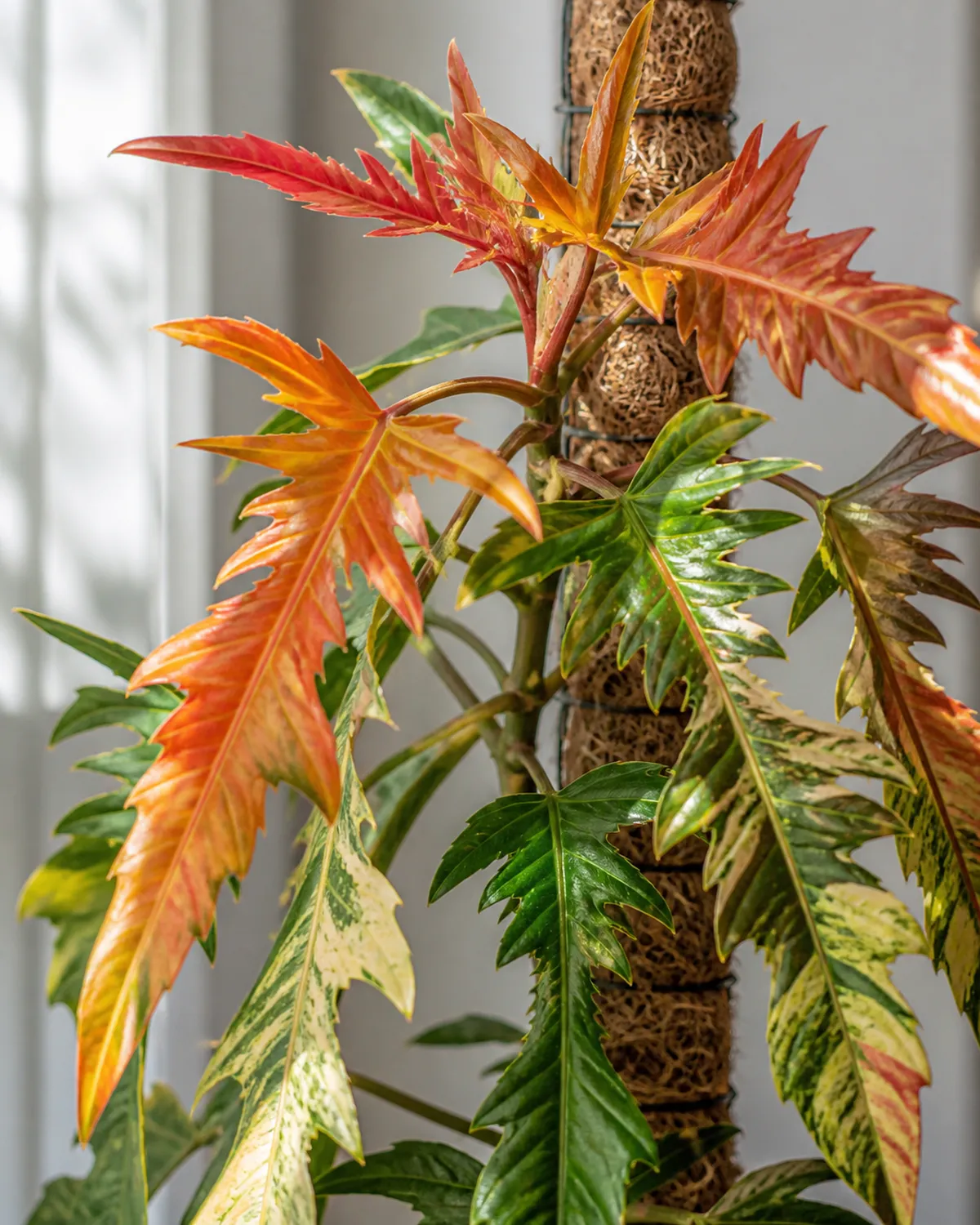
Philodendron 'Ring of Fire' breaks two conventions at once. The leaf margins are deeply serrated — toothed and spiky — which is unique among commonly grown philodendrons, where smooth edges are the norm. And the variegation contains not two but four or five colors simultaneously: orange, red, cream, green, and yellow can all appear on the same plant.
A single Ring of Fire can display the widest color range of any philodendron variety. Combined with the dramatic serrated silhouette, it is one of the most visually striking cultivars available.
The trade-offs:
- Very slow growth: Expect one new leaf every three to six weeks, even in optimal conditions — the multicolor variegation reduces photosynthetic efficiency
- High light demand: Bright indirect to some direct morning light — low light produces predominantly green leaves with minimal color expression
- Care level: Intermediate to advanced — needs chunky aroid mix, consistent moisture without soggy roots, and fifty-five to sixty-five percent humidity
- Climbing habit: Produces progressively larger and more serrated leaves with a support
- Price: Forty to one hundred dollars — once extremely rare, now more available through tissue culture
- Fertilizing: Light monthly feeding during the growing season with balanced formula, diluted to quarter-strength
Ring of Fire is for the collector who already has Pink Princess and wants the next level of visual drama.
Pedatum philodendron — the oak-leaf climber
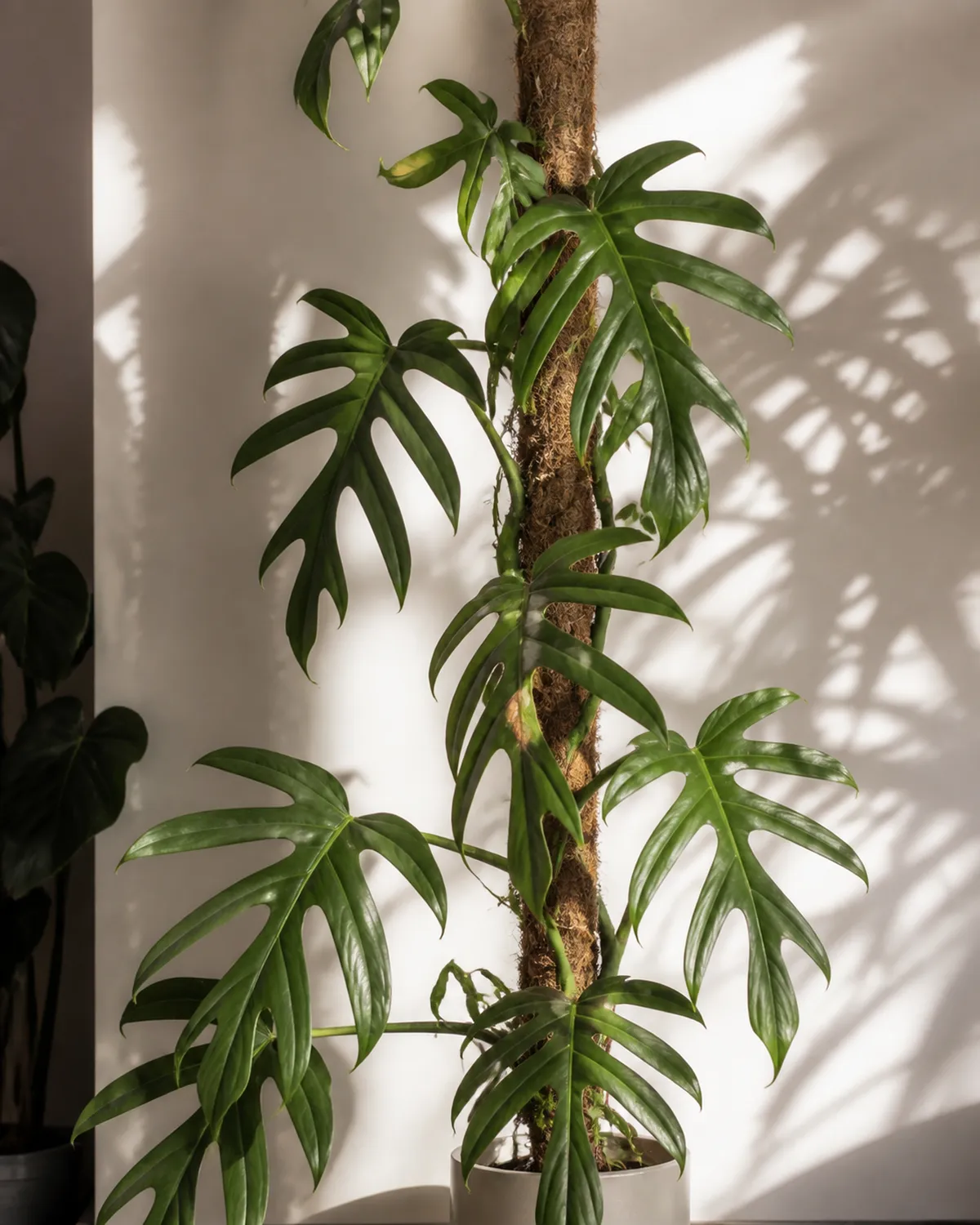
Philodendron pedatum produces deeply divided leaves that resemble oak leaves or a multi-fingered hand. Mature leaves split into five to seven lobes, creating fascinating negative space within each leaf — light filters through the gaps and casts shadow patterns on the wall behind.
The lobed form develops with maturity. Juvenile leaves are simpler with fewer divisions. Give the plant a moss pole or trellis to climb and the increasingly complex mature leaf shape emerges, with each new leaf typically more divided than the last.
What makes pedatum special among collector philodendrons:
- Easy care despite the unusual appearance — standard bright indirect light, well-draining aroid mix, dry the top inch between waterings
- Average humidity tolerance: Thrives at forty to sixty percent — no humidifier required
- Fast growth: New leaves every two to four weeks in the growing season, far faster than gloriosum or melanochrysum
- Price: Fifteen to thirty dollars — the combination of unusual appearance and easy care makes it the best "looks rare, grows easy" philodendron alongside Silver Sword
- Architectural form: The lobed leaves on a pole create a visual display that works well next to plant shelves or as a standalone accent
Pedatum is the variety I recommend most to people who have mastered heartleaf and want something unusual without the humidity demands of the velvet types.
Choosing your first (or next) philodendron
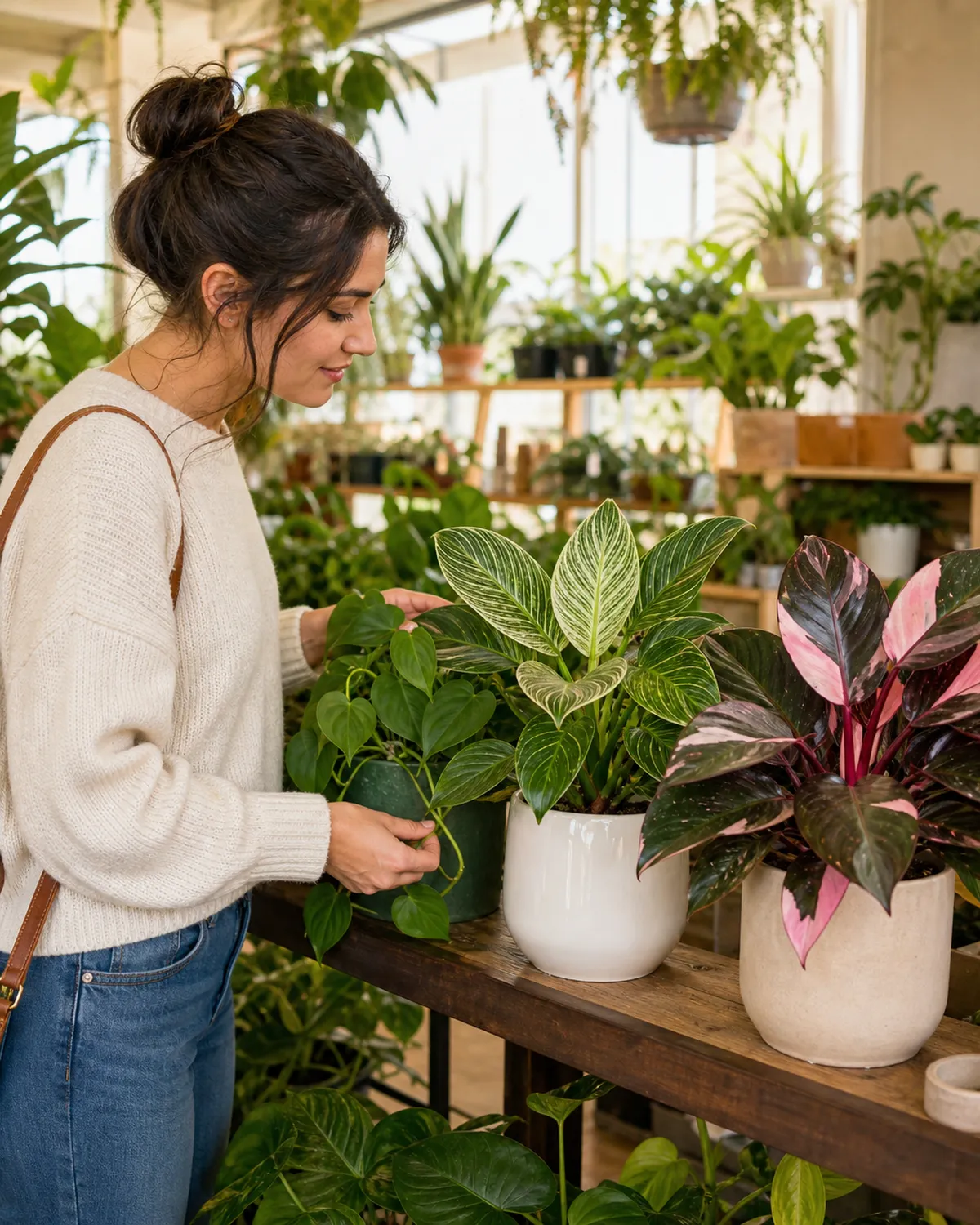
The genus has enough variety to keep you collecting for years. The key is matching each purchase to your actual conditions rather than choosing by Instagram aesthetics.
The two growth forms and what they mean for your space:
- Trailing and vining types (heartleaf, Brasil, micans, Lemon Lime) need hanging space or shelves to cascade from
- Self-heading types (Birkin, Prince of Orange, Xanadu) sit on tables and floors without any support structure
- Climbers (Silver Sword, melanochrysum, Florida Ghost, pedatum) need a moss pole to produce their mature leaf forms
The light-to-difficulty ladder:
| Light Level | Best Varieties | Care Level |
|---|---|---|
| Low light | Heartleaf, Lemon Lime | Beginner |
| Medium light | Brasil, Micans, Birkin | Easy |
| Bright indirect | Pink Princess, Silver Sword, Pedatum | Moderate |
| Bright + high humidity | Gloriosum, Melanochrysum | Advanced |
The honest cost conversation:
- Heartleaf: five to ten dollars
- Birkin, Prince of Orange: fifteen to twenty-five dollars
- Silver Sword, Pedatum: fifteen to thirty dollars
- Pink Princess: thirty to sixty dollars
- Gloriosum: forty to eighty dollars
- Melanochrysum: fifty to one hundred twenty dollars
- White Knight, Ring of Fire: fifty to one hundred fifty dollars
The collector strategy that works: Start with heartleaf or Brasil. Add Birkin or Prince of Orange. Try Silver Sword or Pedatum. Then decide whether you want the humidity-demanding velvet types. Each step teaches skills that transfer to the next level.
Humidity is the real dividing line. Everything from heartleaf through Silver Sword works at normal household humidity. Gloriosum, melanochrysum, and the rare variegated types genuinely need sixty percent or higher to thrive long-term. That is a humidifier purchase, not an adjustment to your watering routine.
For the genus-level care guide that covers every philodendron on this list — watering rhythm, soil mix, light reading, propagation, and toxicity — start with the hub article. Then come back here to choose which variety matches your specific space.

Mara writes plant care guides grounded in published botany and first-hand growing experience, not recycled social-media advice. Every recommendation on Kultivy is tested against real-world conditions before it reaches your screen. More about our editorial standards.