Peperomia is the genus that proves a houseplant does not need to be large to be interesting. Over 1,500 species grow in the wild, and the ones in the nursery trade share one quality: they stay compact enough for a shelf, a desk, or a windowsill.
Some peperomia look like succulents. Others trail. A few grow corrugated leaves that catch light in the ridges. What unites them is the root system — shallow and fine, adapted to thin organic debris on tropical forest floors.
That root structure is why the genus prefers smaller pots, airy soil, and the measured watering covered in the peperomia care guide.
- 1Peperomia Obtusifolia
- 2Peperomia Caperata
- 3Peperomia Argyreia
- 4Peperomia Polybotrya
- 5Peperomia Prostrata
- 6Peperomia Rosso
- 7Peperomia Hope
- 8Peperomia Clusiifolia
- 9Peperomia Graveolens
- 10Peperomia Ferreyrae
- 11Peperomia Scandens
- 12Peperomia Puteolata
- 13Peperomia Orba
- 14Peperomia Rotundifolia
- 15Peperomia Incana
Peperomia Obtusifolia — the baby rubber plant that forgives everything
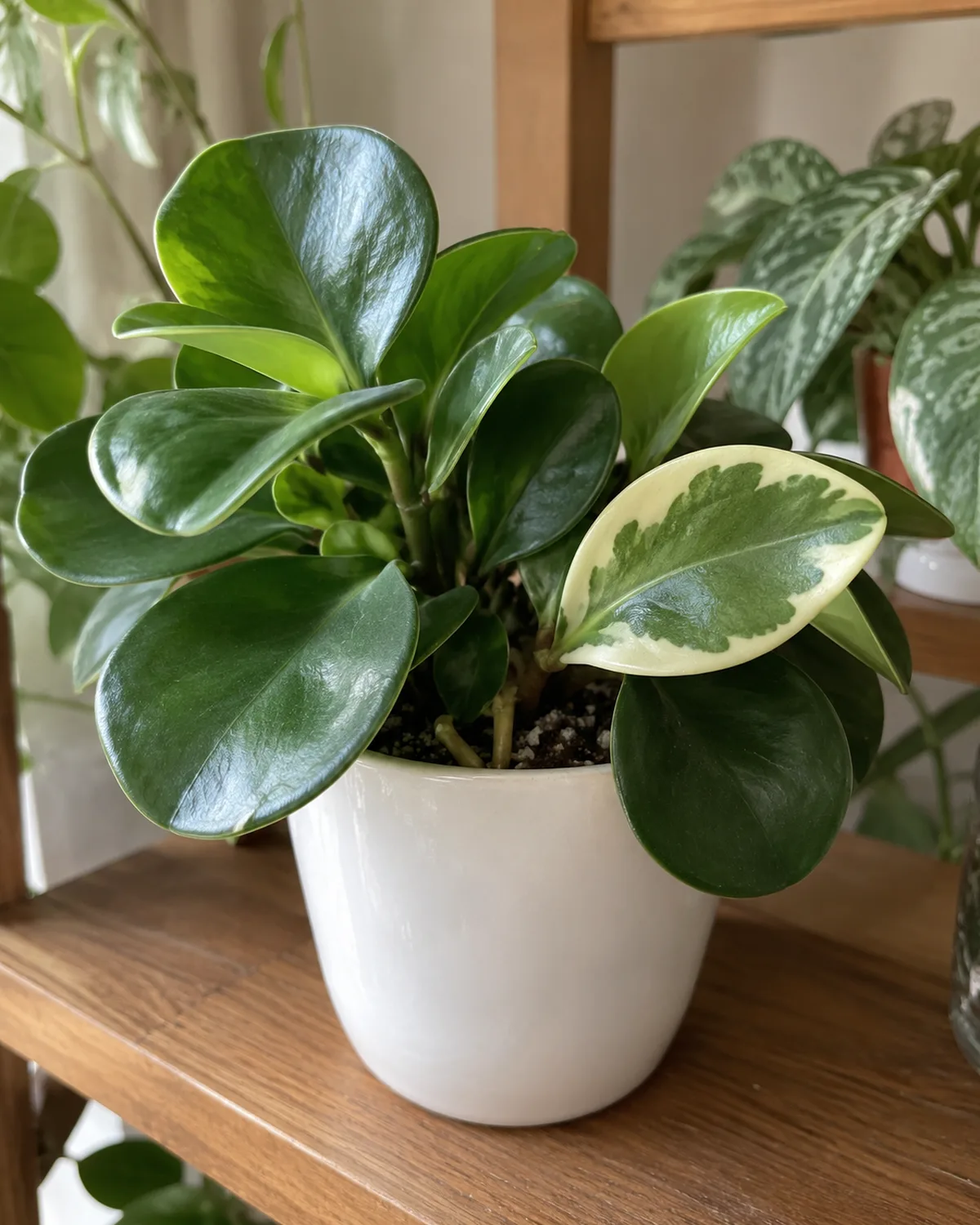
Peperomia obtusifolia is the variety most people encounter first, often sold as the baby rubber plant. The thick, glossy, spoon-shaped leaves store enough moisture to tolerate a missed watering — a trait that puts obtusifolia closer to a succulent than to a typical tropical foliage plant.
The species comes in solid dark green and several variegated forms. The 'Variegata' cultivar carries cream-white margins that widen in brighter light. 'Marble' has splashes of cream scattered randomly across each leaf rather than following the edge.
- Leaf texture: Thick, waxy, and almost rubbery to the touch — the source of the common name
- Variegation forms: Solid green, cream-edged 'Variegata', and scattered-cream 'Marble'
- Propagation: A single leaf with its petiole roots in water or moist perlite within three to four weeks
- Key care quirk: Overwatering kills faster than underwatering — let the top half of the soil dry between drinks
Obtusifolia is the peperomia to hand someone who has never grown a houseplant. It survives fluorescent office light, irregular watering, and the kind of neglect that would flatten a calathea in a week.
Peperomia Caperata — the ripple peperomia with corrugated texture
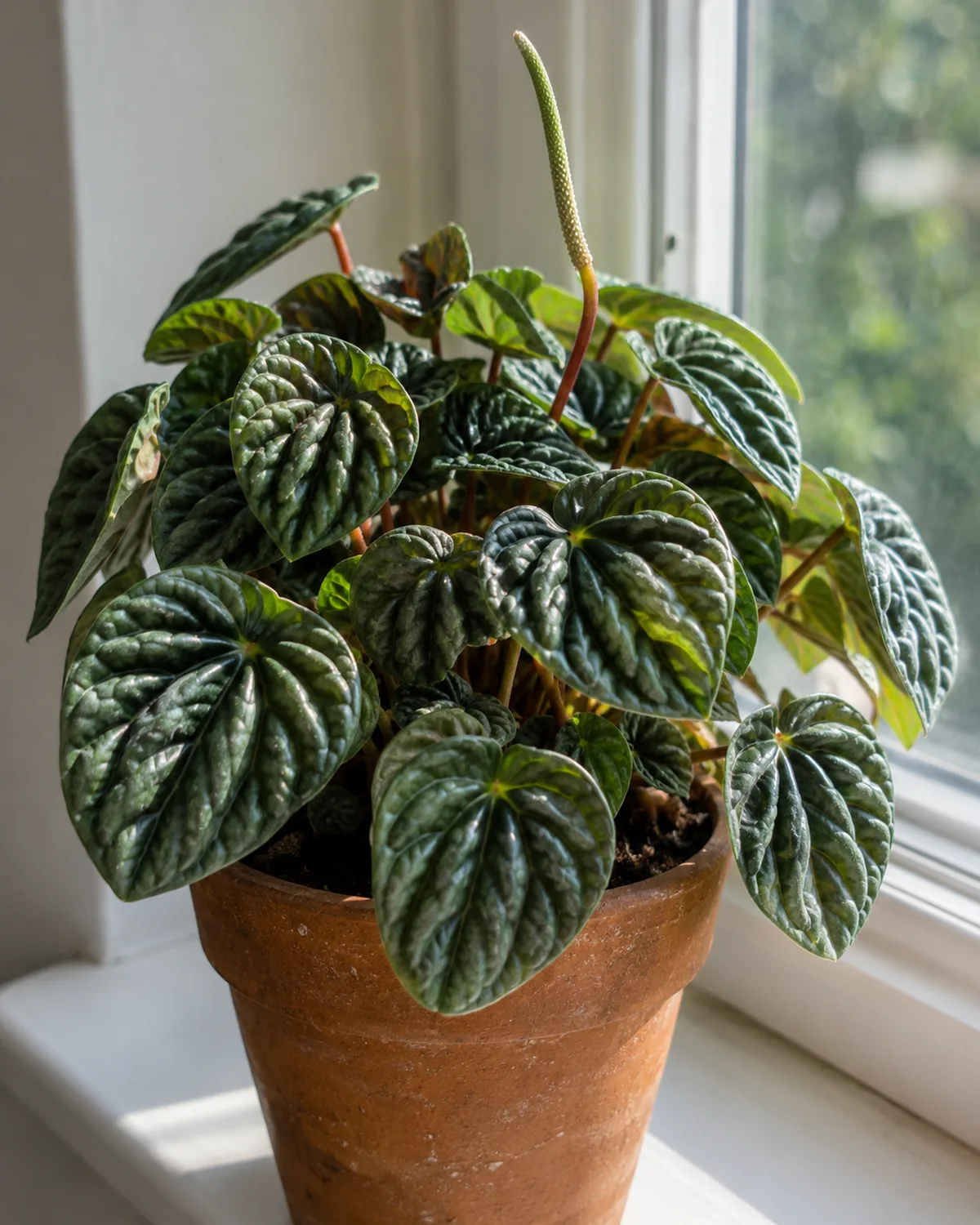
Peperomia caperata is the texture plant in the genus. The heart-shaped leaves are so deeply corrugated that side lighting creates shadows in every valley, making the plant look sculpted rather than grown. The classic form, sold as 'Emerald Ripple,' is a dark green so saturated it reads nearly black in low light.
The corrugated surface is not cosmetic. Those ridges increase the leaf's surface area, which helps it absorb more light in the understory conditions where the species evolved. The same ridges also trap a thin layer of humid air against the leaf surface, reducing transpiration loss.
- Surface: Deeply ridged, quilted — the defining visual trait, best displayed in side light
- Flower: Thin white or pale green rat-tail spikes that rise above the leaf mound on wiry stems
- Cultivars: 'Emerald Ripple' (dark green), 'Rosso' (red-backed, listed separately below), 'Luna Red' (burgundy tones)
- Size: Stays under twenty centimeters, making it a genuine desk plant
Caperata is the peperomia that makes people touch the leaves. That texture is its entire personality, and it costs nothing extra in care. Treat it like any other peperomia — bright indirect light, soil that dries between waterings — and the ridges take care of the rest.
Peperomia Argyreia — the watermelon peperomia everyone asks about
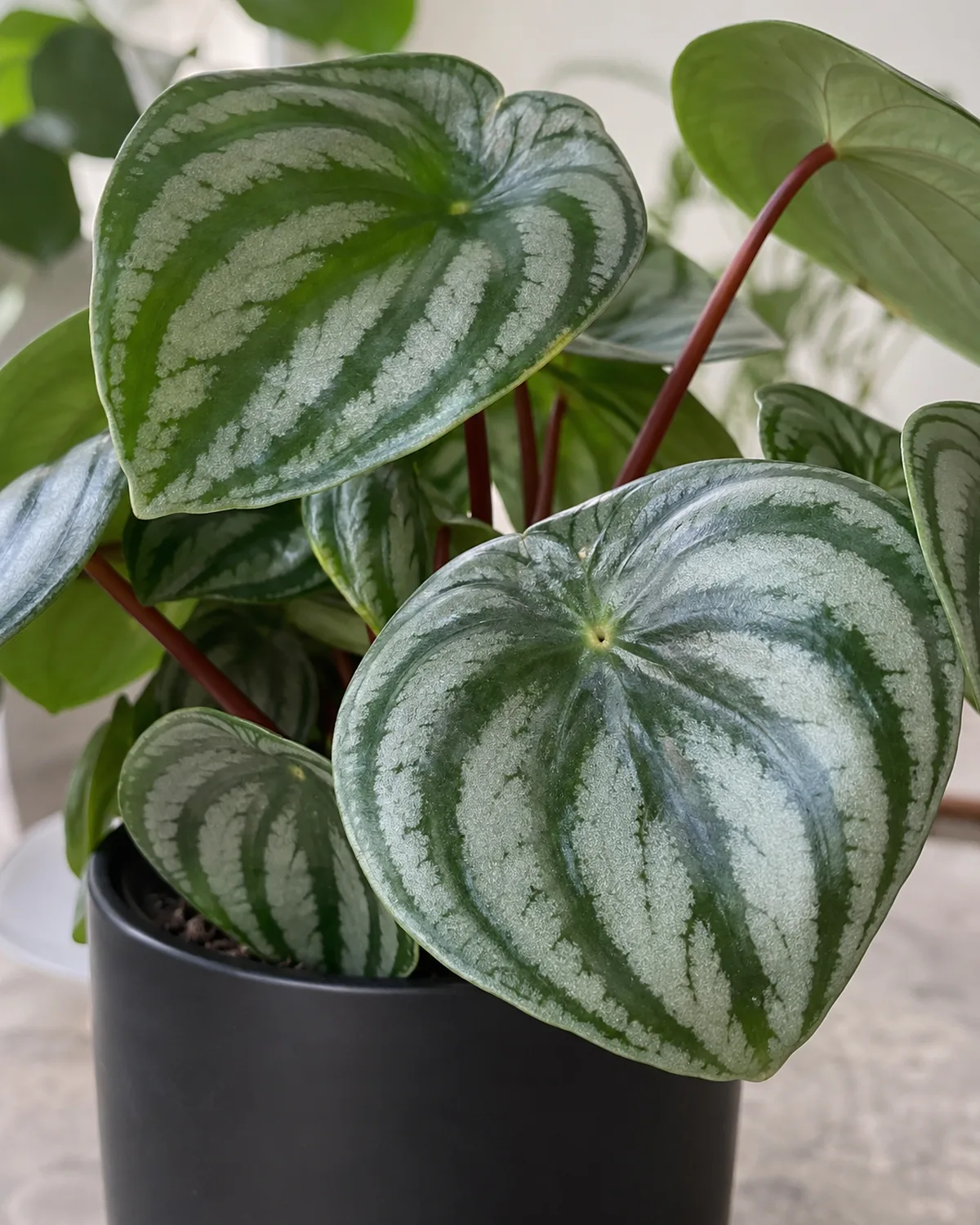
Peperomia argyreia is the species that put the genus on social media. The common name — watermelon peperomia — comes from the alternating silver and dark green curved stripes on each leaf, a pattern that looks almost exactly like the rind of a watermelon.
The leaf attachment is the detail most people miss. Argyreia leaves are peltate, meaning the petiole connects to the center of the leaf underside rather than the base. That central stalk gives each leaf a parasol shape when viewed from the side. If a seller labels a plant as watermelon peperomia but the petiole attaches at the leaf edge, it is a different species.
- Stripe pattern: Alternating silver and dark green bands curving from the center outward — unique in the genus
- Leaf attachment: Peltate — petiole joins the center of the leaf underside, not the edge
- Light needs: Brighter indirect light than most peperomia — low light causes the silver stripes to fade and the leaves to stretch
- Common mistake: Watering on a schedule instead of by soil moisture — the thick leaves hold water, and overwatering causes stem rot faster than in thin-leafed species
Argyreia is not difficult, but it is less forgiving than obtusifolia. The trade-off is the pattern. No other houseplant at this size produces stripes this vivid, and the peltate leaf structure adds a subtle sculptural quality that flat-attached leaves lack.
Peperomia Polybotrya — the raindrop peperomia
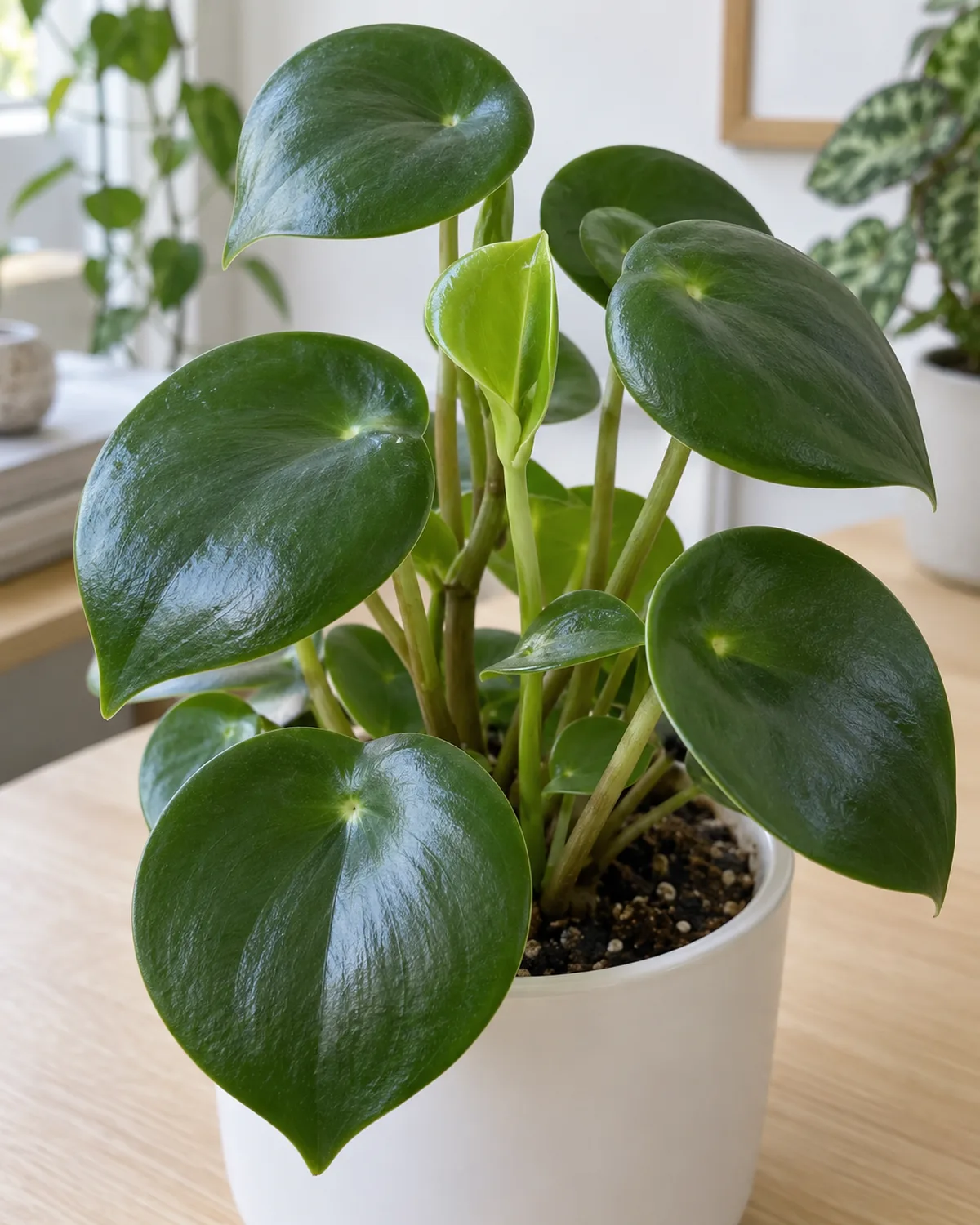
Peperomia polybotrya earns its common name from the leaf shape: a near-perfect teardrop, as if someone drew the outline of a raindrop and grew a plant to fill it. The leaves are thick, glossy, and dark green, carried on upright stems that keep the plant compact and vertical.
The raindrop peperomia is often confused with Pilea peperomioides at first glance, but the two are easy to tell apart. Polybotrya leaves taper to a point at the tip, while pilea leaves are perfectly round. Polybotrya petioles attach at the leaf base; pilea petioles attach at the center.
- Leaf shape: Teardrop to heart, with a distinct pointed tip — the identifier that separates it from pilea
- Texture: Thick and succulent-like, similar to obtusifolia but with a sharper gloss
- Growth habit: Upright and self-supporting, does not trail or sprawl
- Propagation: Stem cuttings with at least one node — leaf cuttings do not produce plantlets for this species
Polybotrya is the peperomia for someone who wants a sculptural plant without variegation or pattern. The leaf shape alone is the statement, and it holds that shape in moderate light without stretching.
Peperomia Prostrata — string of turtles for tight spaces
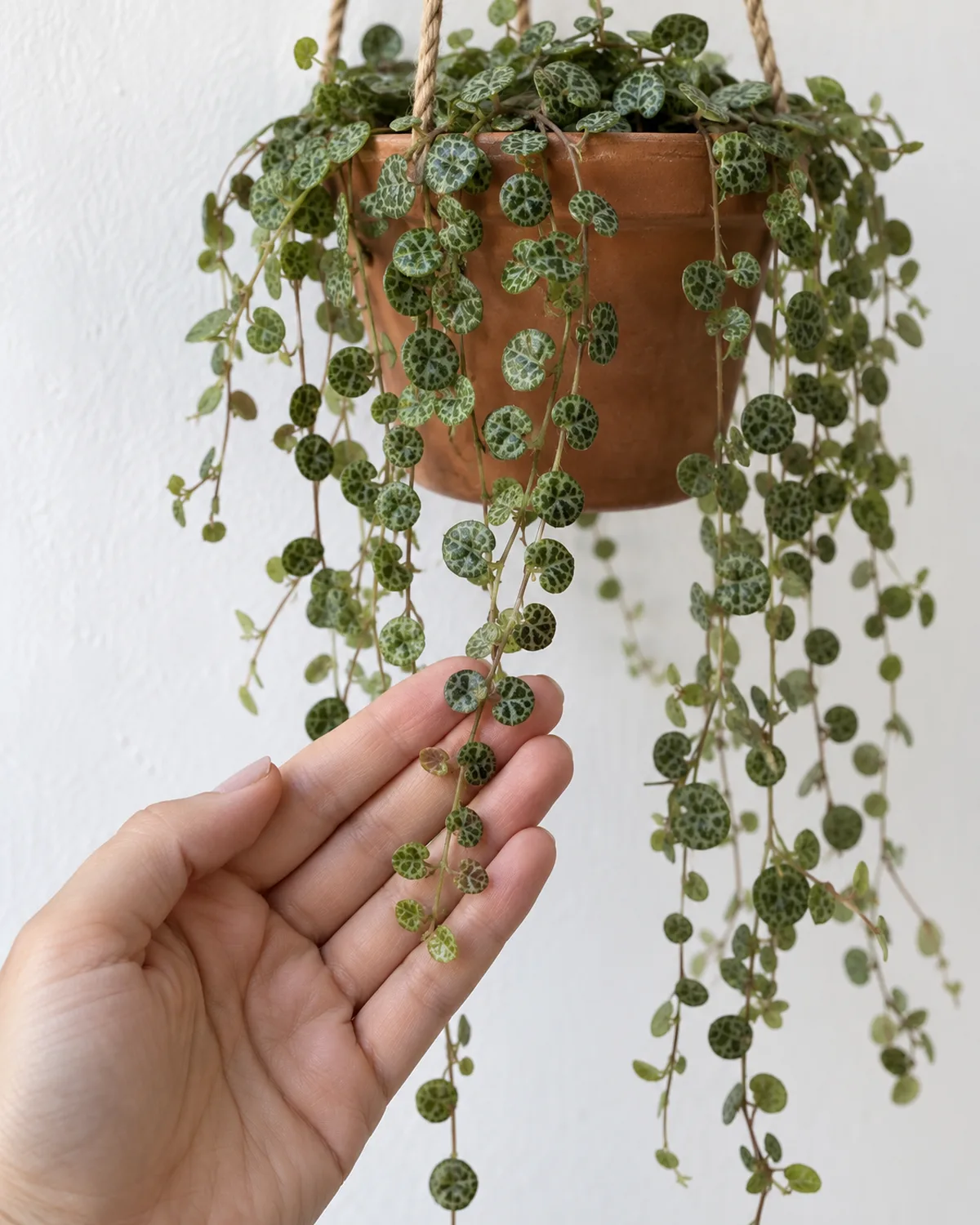
Peperomia prostrata is the miniature trailing species in the genus. Each leaf is smaller than a fingernail, round, and marked with a web of veins that looks exactly like a tiny turtle shell — the pattern that gives the plant its common name, string of turtles.
The stems are thread-thin and trail straight down, which makes prostrata a strong hanging plant or a candidate for mounting on a piece of driftwood. The entire plant stays light enough that a small nail can hold it, unlike the heavier trailing succulents like string of pearls.
- Leaf size: Five to eight millimeters in diameter — the smallest in common peperomia cultivation
- Pattern: Dark vein network on a lighter green background, creating the turtle-shell effect
- Growth rate: Slow, adding a few centimeters of trail per month under good conditions
- Watering caution: The tiny root system rots easily — water when the leaves lose their firmness, not on a calendar
Prostrata rewards patience. The growth is slow but the trailing curtain it eventually produces — dozens of tiny patterned leaves on thread-like stems — looks like nothing else in the genus or in houseplants generally.
Peperomia Rosso — the red-backed compact that needs no windowsill
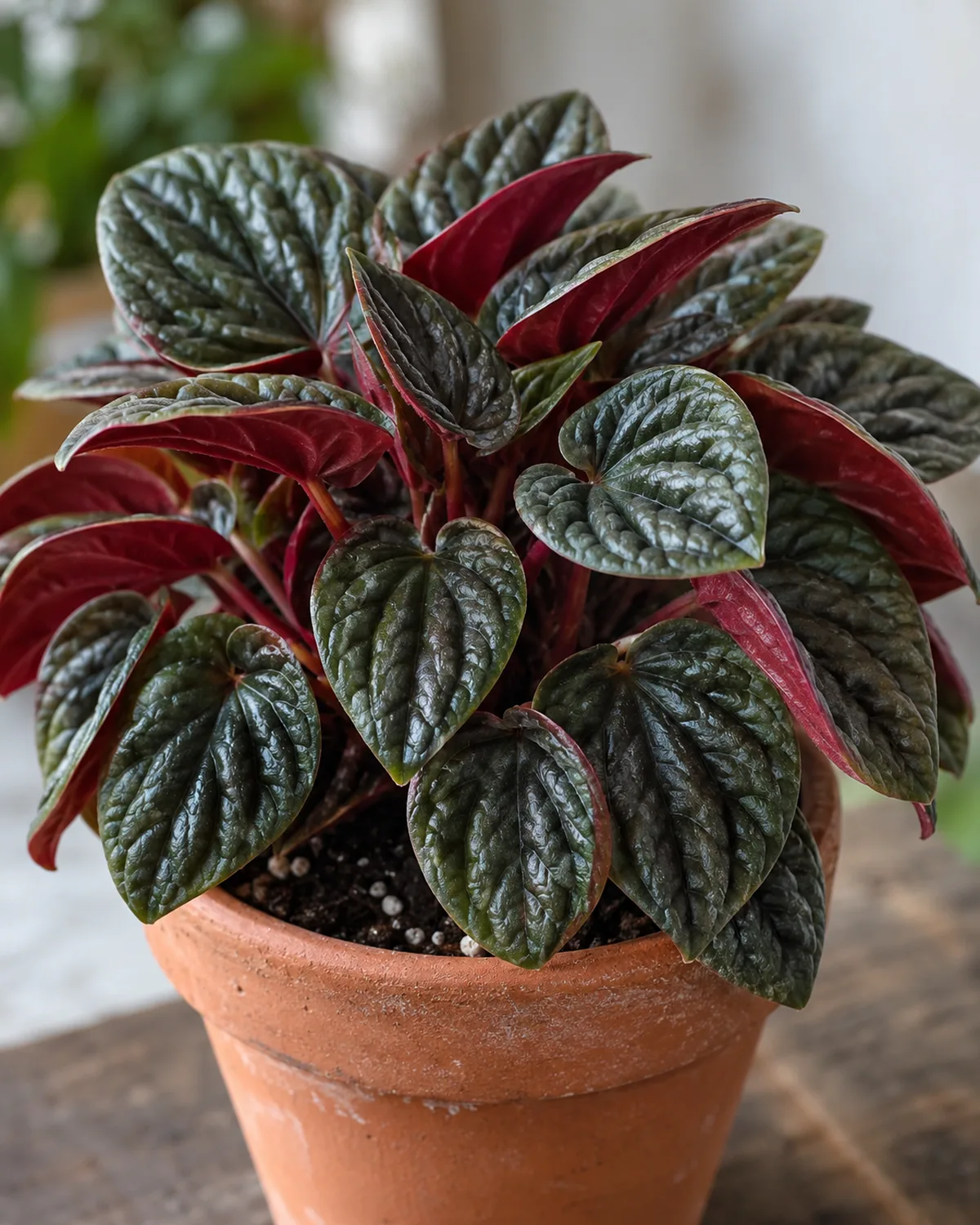
Peperomia caperata 'Rosso' is technically a cultivar of caperata, but it behaves differently enough in practice to earn its own entry. The top surface is the same corrugated dark emerald as 'Emerald Ripple.' The underside, however, is a deep wine-red that shows whenever a leaf angles upward or curls at the edges.
Rosso stays compact — under twenty centimeters in both height and spread — and holds its rosette shape without pruning. It tolerates lower light levels than most colorful peperomia because the dark green upper surface absorbs light efficiently, and the red pigment on the underside is anthocyanin, not variegation, so it does not fade in shade.
- Top surface: Corrugated dark emerald green, matching caperata 'Emerald Ripple'
- Underside: Deep wine-red from anthocyanin, not variegation — does not need bright light to keep its color
- Size: Rarely exceeds twenty centimeters in any direction — stays compact without pinching
- Repotting: Infrequent — the shallow root system fills a small pot and stays content for two or three years
Rosso is the low-effort color payoff in the genus. You get two-tone foliage without the light demands of watermelon peperomia or the fussiness of a trailing species.
Peperomia Hope — the trailing hybrid for hanging baskets
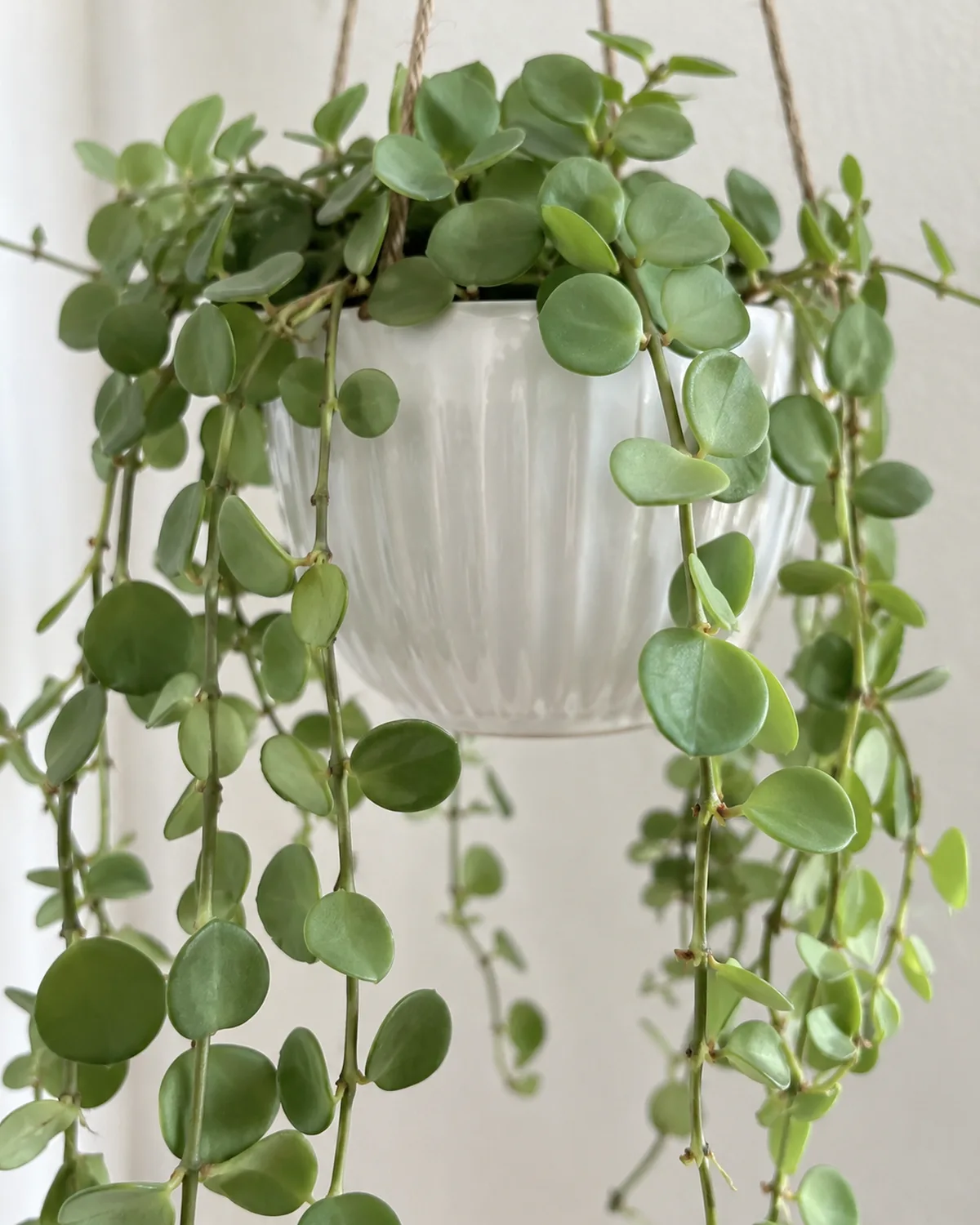
Peperomia Hope is a hybrid of P. deppeana and P. quadrifolia, and it combines traits from both parents. The round, fleshy leaves sit in pairs along trailing stems that can reach sixty centimeters or more. The leaves are thicker than those of rotundifolia and have a semi-succulent feel when squeezed gently between two fingers.
Hope trails predictably and evenly, which makes it one of the best peperomia for hanging baskets. Each node along the stem can root on contact with soil, so a single pot tends to fill in densely over time as stray stems touch the surface and anchor themselves.
- Leaf texture: Round and fleshy, noticeably thicker than rotundifolia — the hybrid vigor shows in leaf substance
- Trailing length: Up to sixty centimeters, with stems branching at nodes for a full cascading look
- Rooting: Nodes root on contact with soil — pin a trailing stem onto a small pot of moist mix to start a new plant
- Watering: Less frequent than most trailing plants because the fleshy leaves store water — wait until the leaves feel slightly soft
Hope is the trailing peperomia for people who have killed a string of hearts or string of pearls by overwatering. The thicker leaves provide a bigger buffer between too dry and too wet.
Peperomia Clusiifolia — the jelly peperomia with candy-colored edges
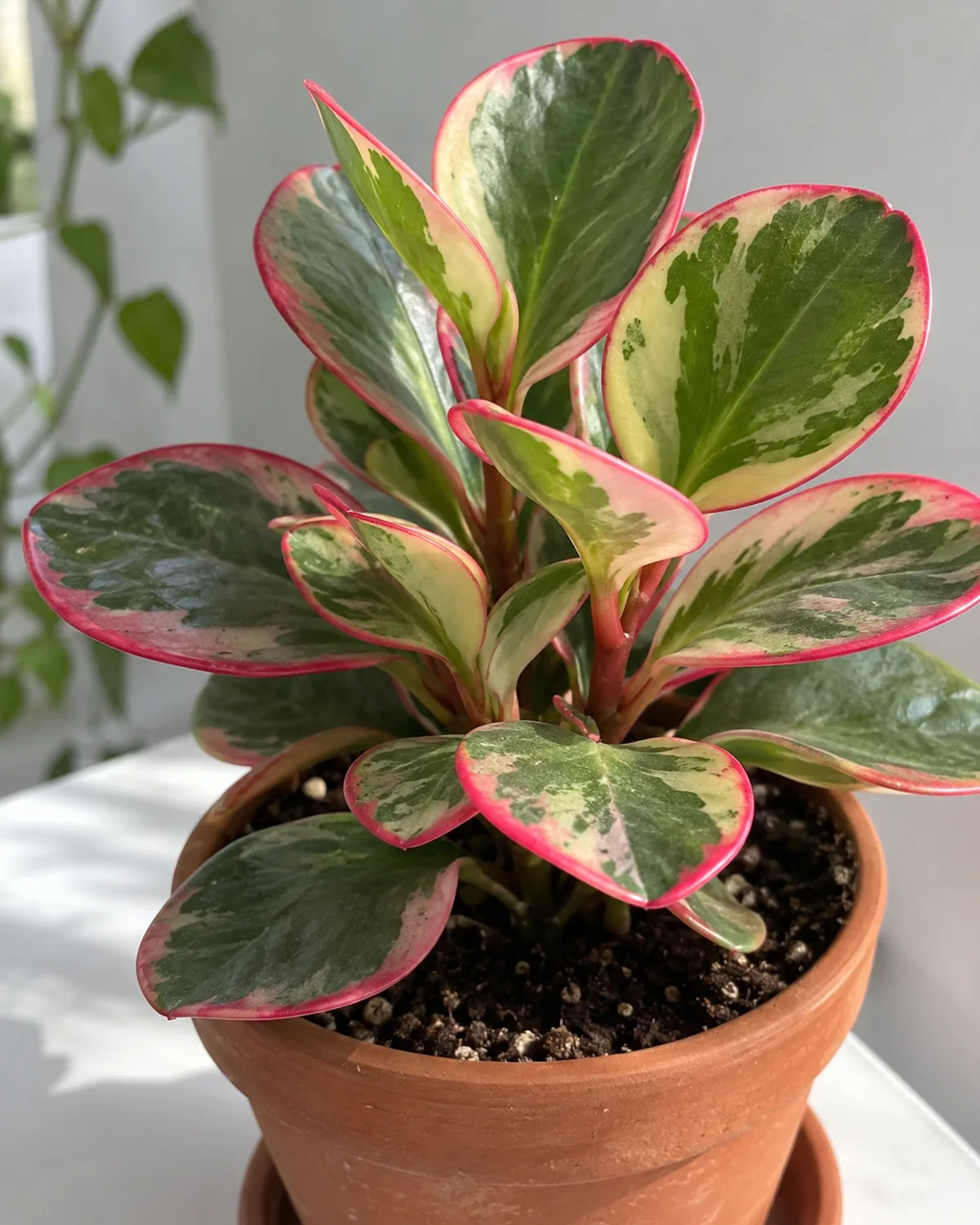
Peperomia clusiifolia in its plain green form looks like a slightly elongated obtusifolia. The cultivar that makes this species collectible is 'Jelly,' which carries thick oval leaves with cream centers that blush to green and finish with bold pink-to-red margins at the edges. The color shift is gradual and translucent, and when backlit it resembles a slice of candy — hence the common name.
The 'Tricolor' cultivar pushes the variegation further, adding bands of cream, pale green, and pink that shift with the seasons and the light level. Both cultivars need brighter light than solid-green peperomia to maintain the pink edge. In lower light the margins fade to cream and eventually to solid green.
- Color: Cream center transitioning to green with pink-red margins — strongest in bright indirect light
- Leaf shape: Thick and oval, slightly elongated compared to obtusifolia
- Height: Upright grower reaching thirty centimeters, wider than tall if given room
- Light sensitivity: The pink edge is a direct function of light exposure — more light means more pink, less light means more green
Clusiifolia 'Jelly' is the peperomia for someone who wants color without flowers. The leaf margins deliver a year-round blush that most flowering houseplants only manage for a few weeks.
Peperomia Graveolens — the ruby glow succulent peperomia
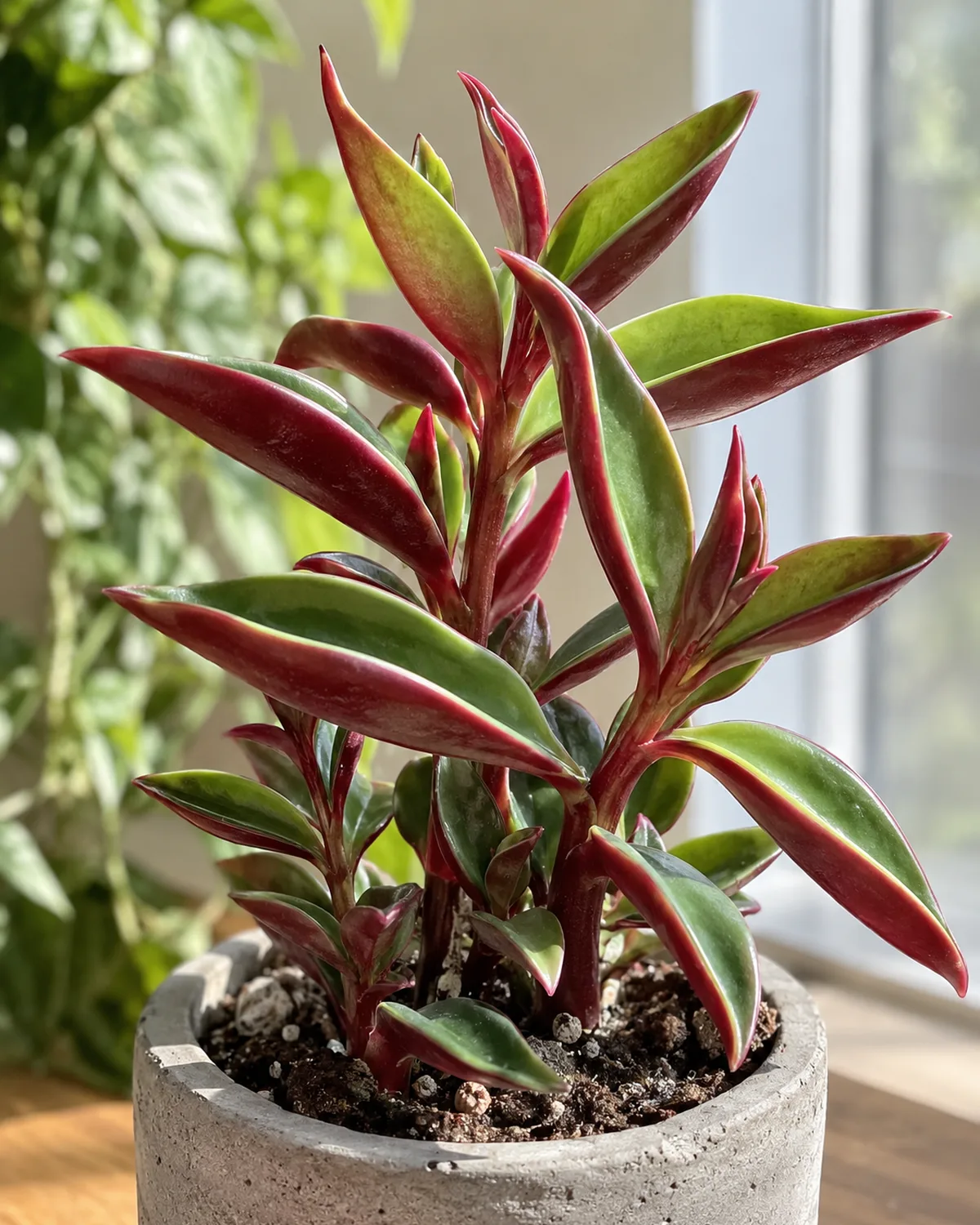
Peperomia graveolens does not look like a peperomia at first glance. The leaves are folded along the midrib like a canoe, thick enough to be truly succulent, and colored deep ruby red on the underside. Because the fold exposes the undersides at the leaf edge, the plant reads as more red than green from most viewing angles.
This species comes from arid mountain habitats in Ecuador, not the humid forest floor that most peperomia call home. That origin means graveolens needs more light, less water, and faster-draining soil than any other variety on this list. Treat it like a succulent that happens to be a peperomia, not the other way around.
- Leaf structure: Folded canoe shape, exposing deep red underside at the fold — the defining visual trait
- Succulent level: Truly succulent — the leaves store water and the plant survives extended dry periods
- Light needs: The highest in the genus — bright indirect to some direct morning sun to keep the red intense
- Soil: A gritty cactus mix with extra perlite, drying fully between waterings
Graveolens is the wild card on this list. It expands what the genus means — proof that peperomia is not limited to soft tropicals on a shelf.
Peperomia Ferreyrae — the happy bean with pencil-thin leaves
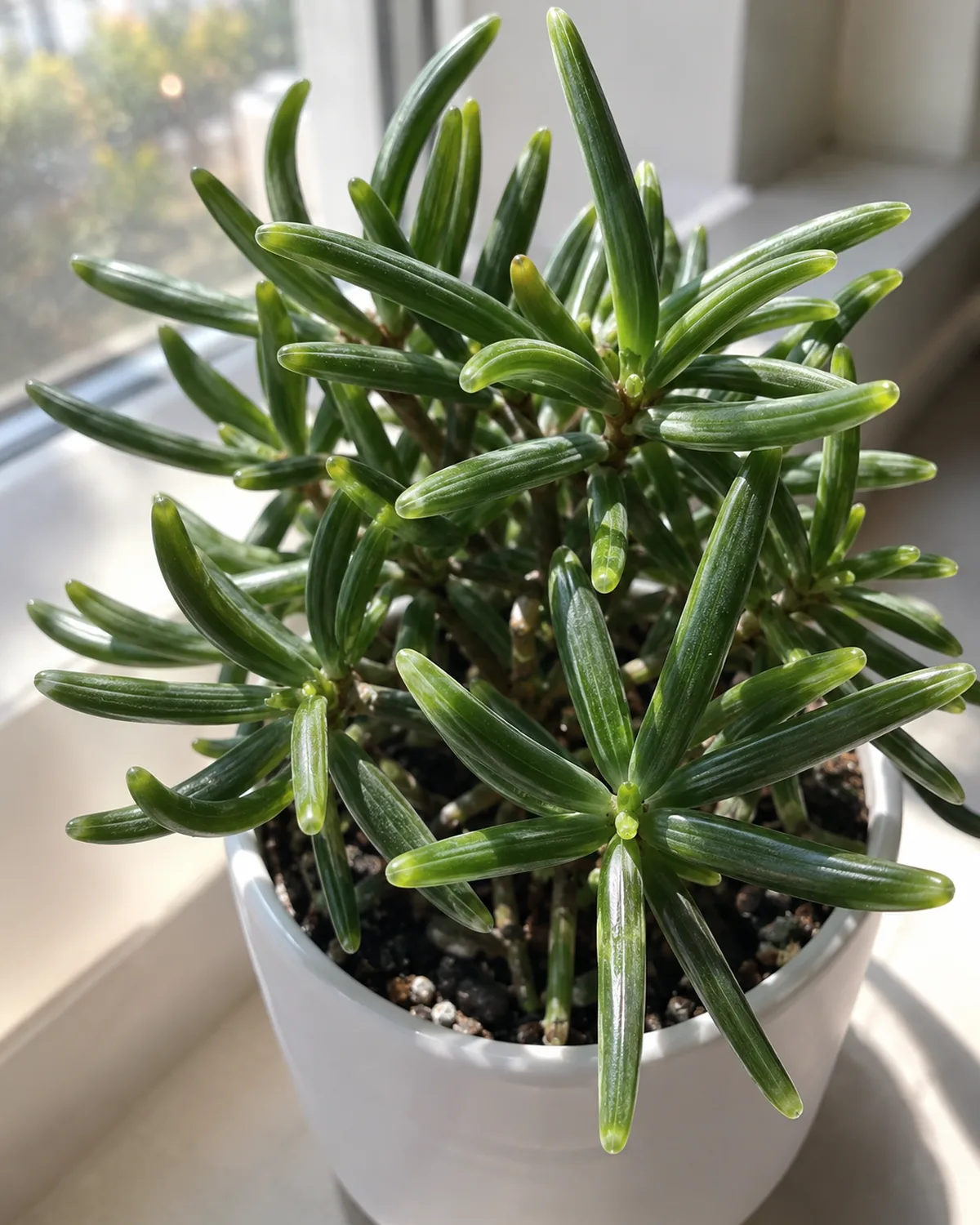
Peperomia ferreyrae looks like someone took a standard peperomia leaf and compressed it into a narrow rod. The leaves are pencil-thin, deep green, and arranged in a tight star pattern radiating from a central stem. Each leaf has a translucent window at the tip — a structure that channels light into the interior tissue, an adaptation found in a handful of succulent genera but unusual in peperomia.
The window-tip is the identification tell. Other narrow-leafed peperomia exist, but ferreyrae is the only commonly sold species with that transparent strip running along the top edge of each leaf.
- Leaf shape: Narrow, rod-like, crescent in cross-section — unlike any other common peperomia
- Window tip: A translucent line along the top edge that channels light into the leaf interior
- Growth habit: Upright and bushy, branching from the base to form a mounding shape
- Kill risk: Overwatering — the narrow leaves and compact root system rot fast in wet soil
Ferreyrae and graveolens together demonstrate the succulent end of the peperomia spectrum. If you keep both alive, you understand the genus range better than most growers.
Peperomia Scandens — the cupid peperomia that trails like pothos
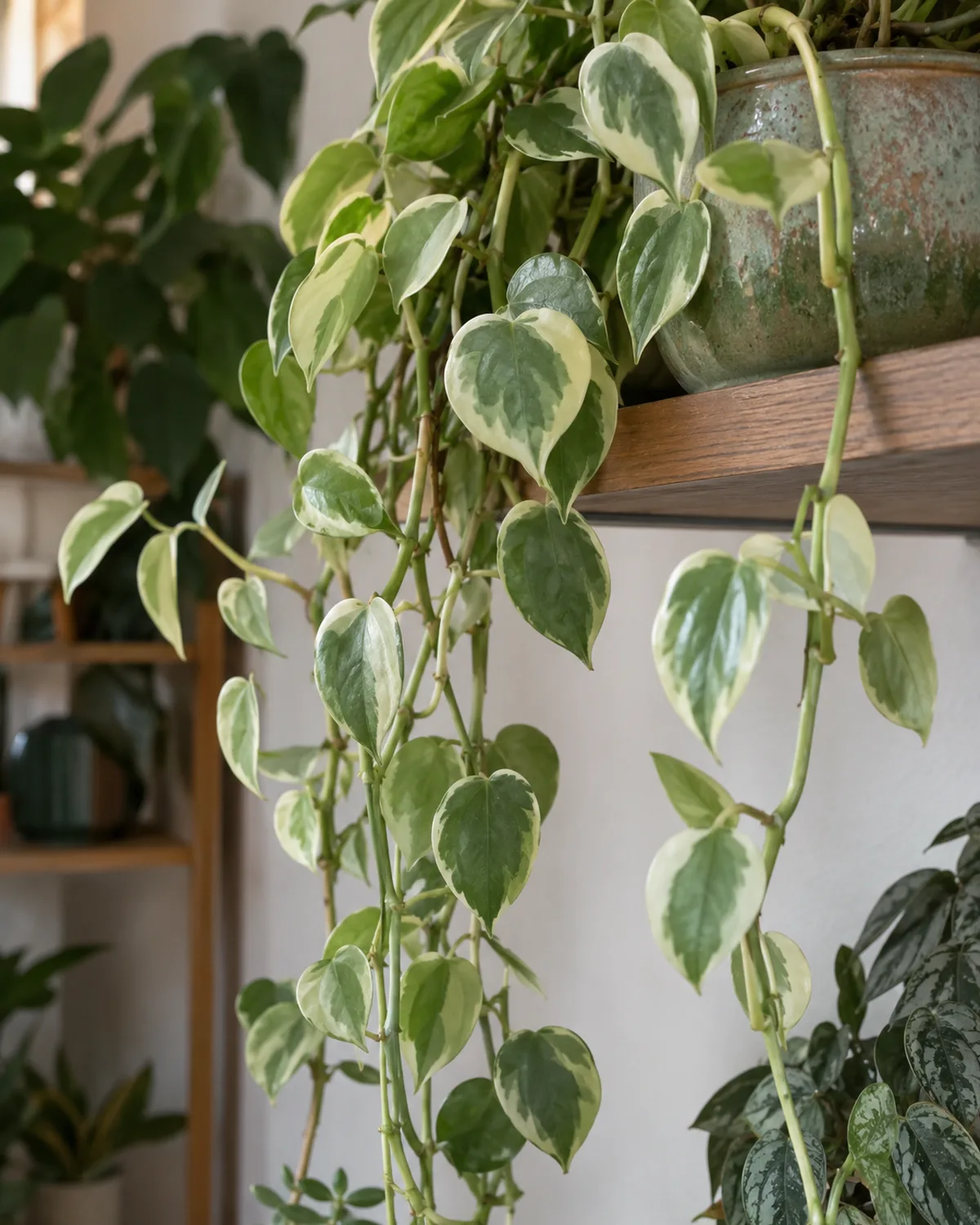
Peperomia scandens is the climbing and trailing species in the genus, and the 'Variegata' form is the one worth growing. Heart-shaped leaves with cream-and-green variegation line trailing stems that can reach a meter or more — a growth habit so similar to pothos that the two are often confused on shelves.
The difference is in the leaf substance. Scandens leaves are thinner and more matte than pothos leaves, and the stems are less rigid. The variegation pattern is also distinct: scandens 'Variegata' carries broad cream margins rather than the streaky marbling of a pothos 'Marble Queen.'
- Trailing length: Up to one meter, with stems that drape naturally or can be trained up a small trellis
- Variegation: Cream margins on green — stable and consistent, not prone to reverting
- Toughness: Tolerates lower light than most variegated plants because the green center of each leaf carries the photosynthetic load
- Propagation: Stem cuttings root quickly in water — similar ease to pothos
Scandens 'Variegata' is the peperomia for a high shelf or a hanging planter where you want trailing variegation without the weight or growth speed of a pothos.
Peperomia Puteolata — the parallel peperomia with striped leaf architecture
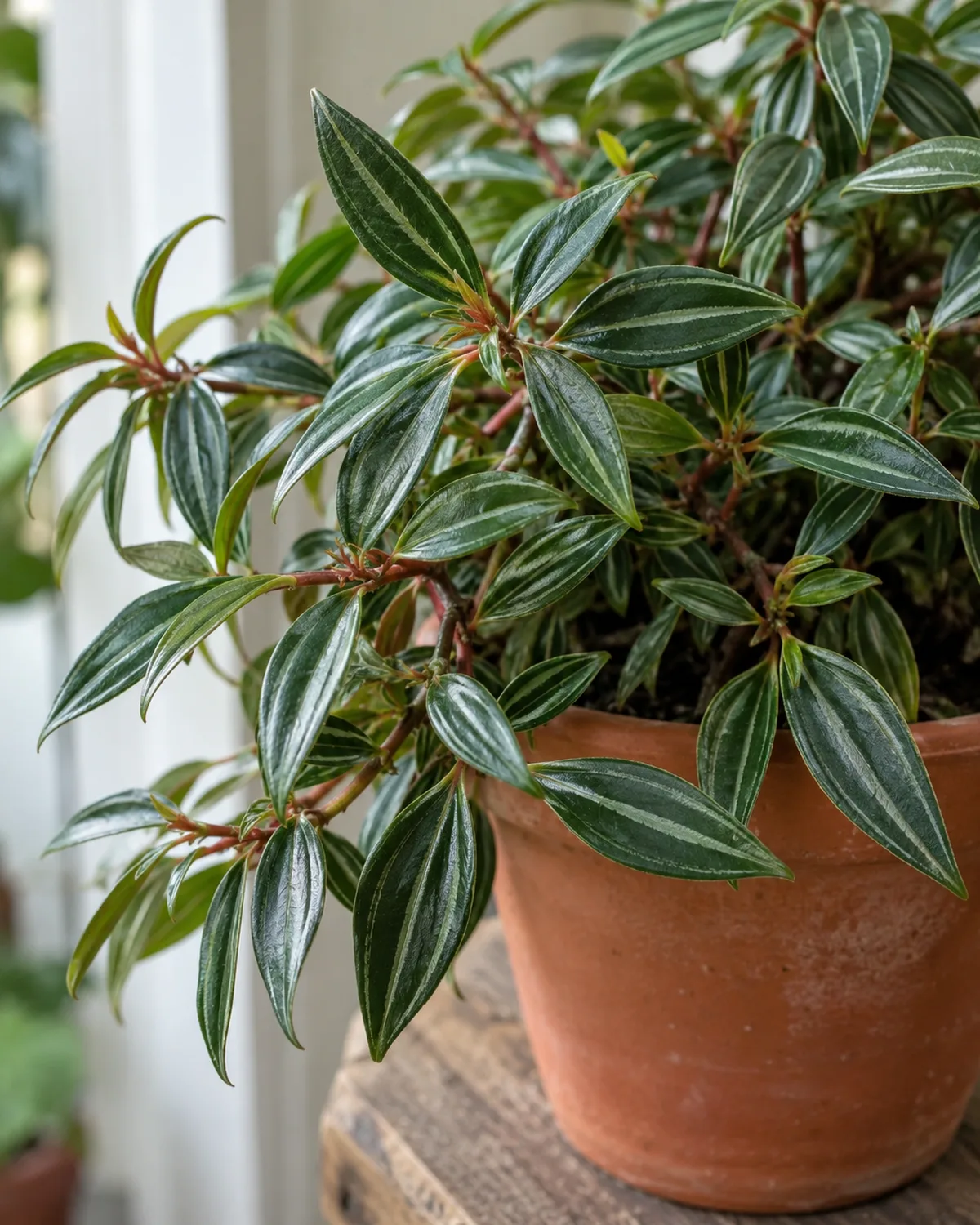
Peperomia puteolata carries dark green leaves with parallel silver stripes that run along the veins from base to tip. The stripes are straight, evenly spaced, and cover the entire leaf surface — a pattern that reads as architectural rather than organic.
The whorled leaf arrangement is the other standout trait. Puteolata leaves radiate outward from the stem in whorls of three to five, creating a layered look at each node. The stems have a red-to-burgundy tint that contrasts with the silver-striped foliage.
- Stripe pattern: Parallel silver lines on dark green, running base to tip along each vein
- Leaf arrangement: Whorled — three to five leaves radiating from each node, stacked vertically
- Growth habit: Semi-trailing, upright when young and cascading as the stems lengthen under weight
- Stem color: Red to burgundy, adding a secondary color accent to the green-and-silver foliage
Puteolata rewards bright indirect light. The silver stripes are most vivid when the plant sits two meters from a window. In lower light the stripes fade and the leaves stretch, losing the tight whorled arrangement that makes the species visually distinct.
Peperomia Orba — the pixie lime that stays palm-sized
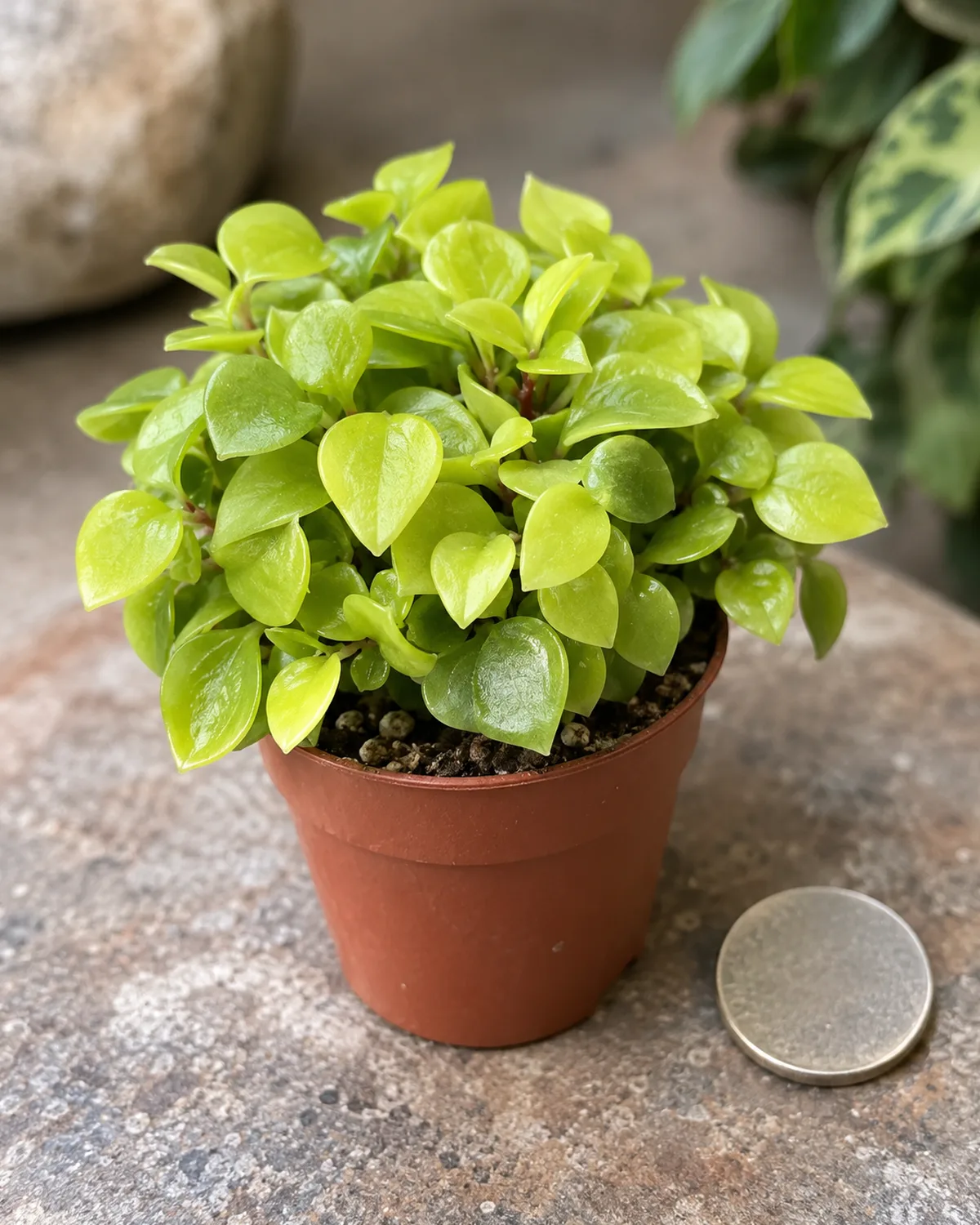
Peperomia orba in its 'Pixie Lime' form is one of the smallest peperomia in common cultivation. The entire plant fits in the palm of a hand, with tiny teardrop leaves in a chartreuse-gold tone that brightens any shelf or windowsill.
The miniature size is not a phase. Orba stays small at maturity, which makes it suitable for terrariums, dish gardens, or the narrow ledge above a kitchen sink where larger plants cannot fit. The leaves are semi-succulent, carrying enough water to tolerate a few days of forgotten watering.
- Leaf color: Chartreuse-gold in the 'Pixie Lime' cultivar, bright green with a subtle golden edge in the standard form
- Size: Palm-sized at maturity — the plant rarely exceeds ten centimeters in height or spread
- Terrarium use: Stays small enough for a closed or open terrarium without overwhelming other miniature plants
- Watering: Same as other peperomia — dry between waterings — but the tiny pot dries faster, so check more often
Orba 'Pixie Lime' is the peperomia for the collector who has run out of shelf space. It fits where nothing else can.
Peperomia Rotundifolia — the trailing jade with coin-sized leaves
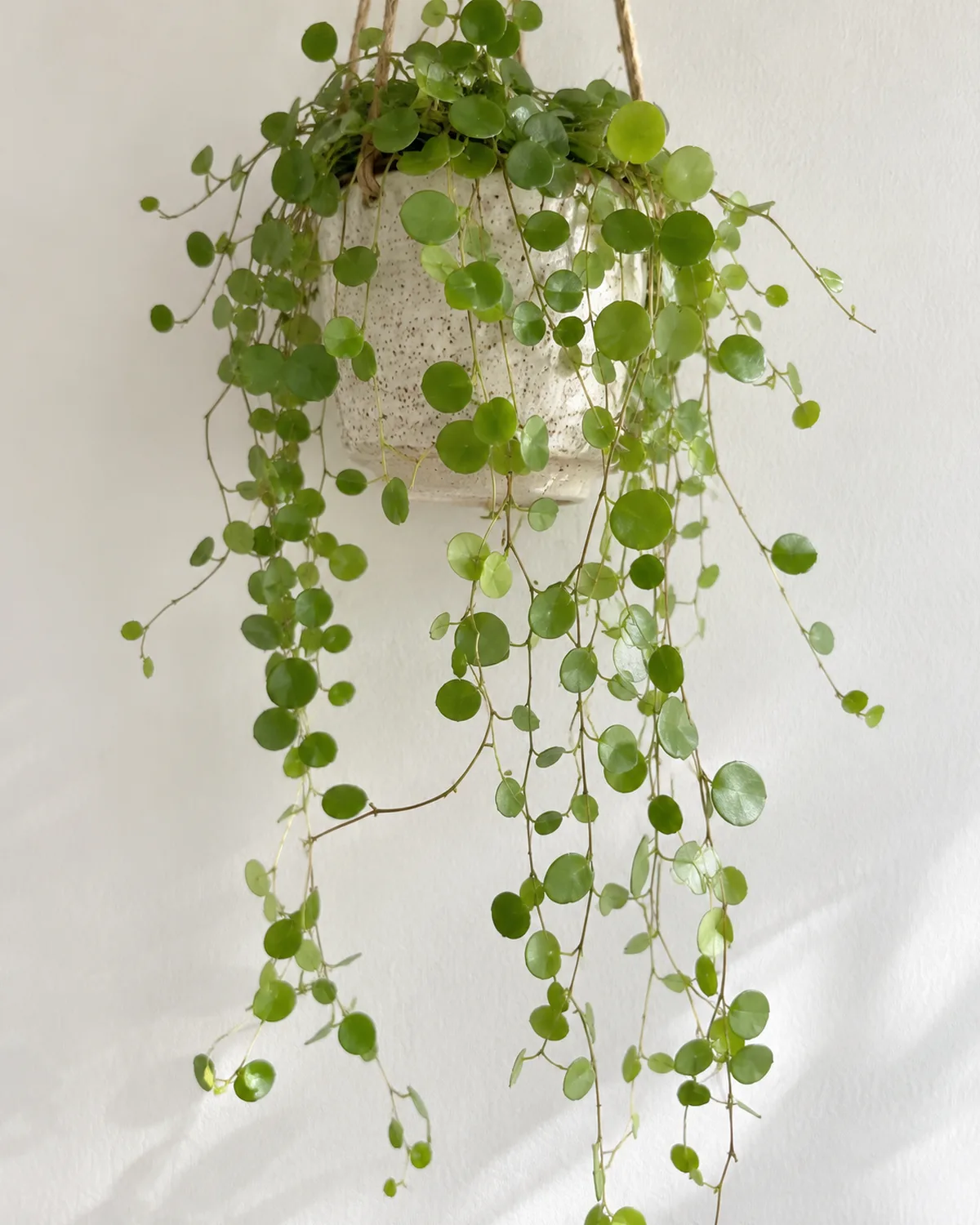
Peperomia rotundifolia is often confused with Peperomia Hope, and the two do share a trailing habit with round leaves. The difference is in the leaf thickness. Rotundifolia leaves are thin and flat — translucent when held against light — while Hope leaves are fleshy and opaque.
The stems of rotundifolia are also thinner, almost invisible at a distance. That gives the trailing curtain an airy quality that the sturdier Hope cannot replicate.
Rotundifolia is sometimes sold as trailing jade peperomia, which is misleading because it shares almost nothing with a jade plant beyond the round leaf shape. The care requirements are opposite: rotundifolia wants consistently moist (not wet) soil and higher humidity, while jade wants bone-dry conditions.
- Leaf thickness: Thin and flat, translucent against light — the key difference from the fleshy Hope
- Stem diameter: Thread-thin, nearly invisible from a distance — gives the trailing curtain an ethereal look
- Humidity: Prefers higher humidity than most peperomia because the thin leaves lose moisture quickly
- Best display: A hanging planter or a high shelf where the trailing stems can hang freely in the light
Rotundifolia is the delicate trailing peperomia. It needs a bit more attention than Hope, but the visual payoff is a lighter, airier cascade that suits minimalist interiors.
Peperomia Incana — the felted peperomia covered in silver fuzz
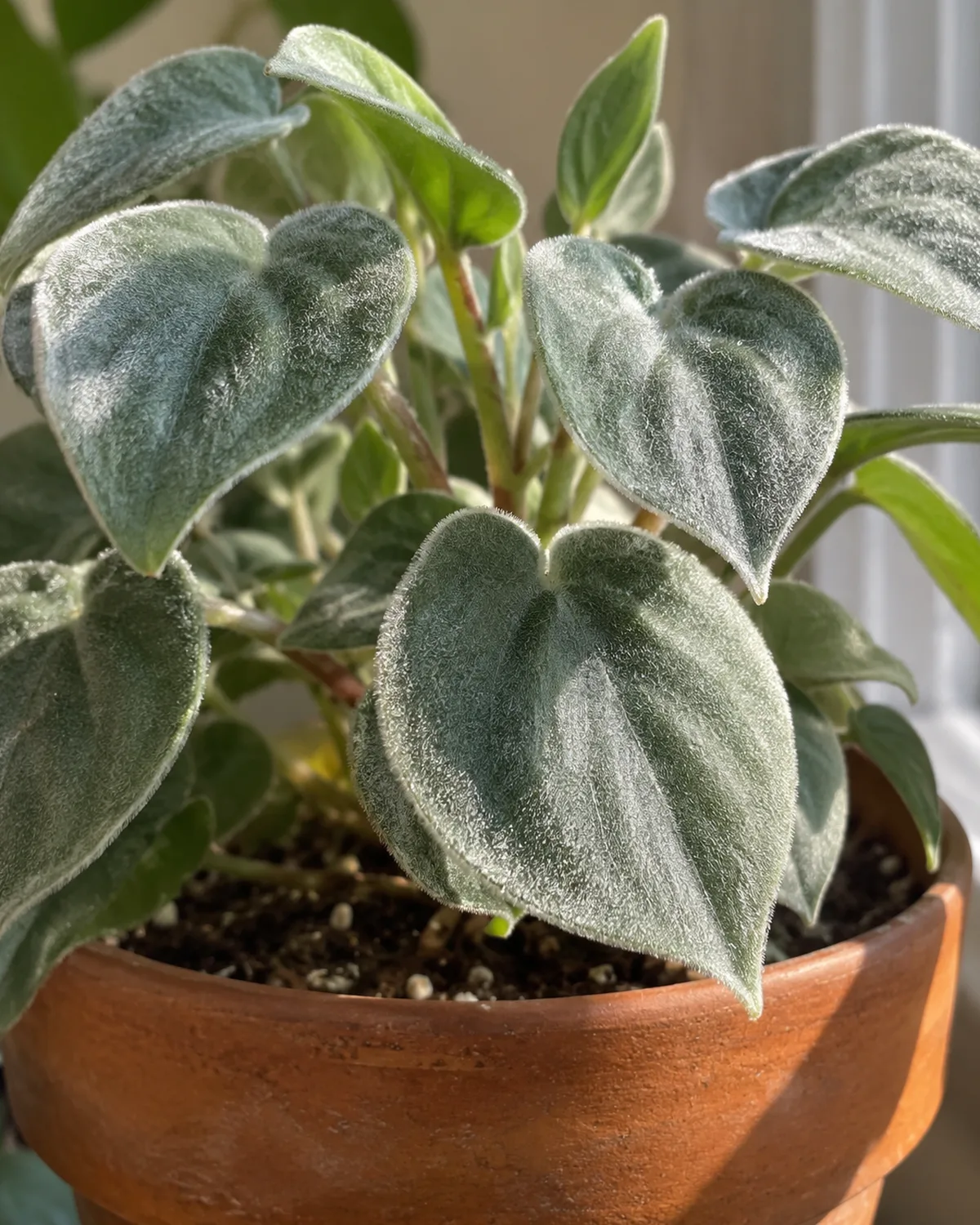
Peperomia incana closes this list with a texture that no other species in the genus produces. The heart-shaped leaves are covered in a fine layer of silver-white trichomes — tiny hairs that give the entire plant a frosted, velvety appearance. In side light, the trichomes catch and scatter photons, creating a soft glow around each leaf.
The fuzz is a drought adaptation. Trichomes reflect excess light and trap a boundary layer of still air against the leaf surface, reducing water loss through evaporation. That adaptation means incana tolerates lower humidity and less frequent watering than most foliage peperomia — the fuzz does the humidity management that other species rely on the grower to provide.
- Surface: Fine silver-white trichomes covering both leaf surfaces — soft to the touch, visible in any light
- Drought tolerance: Higher than average for the genus — the trichome layer reduces transpiration
- Growth habit: Upright when young, becoming semi-trailing as stems lengthen, reaching twenty to thirty centimeters
- Handling: Avoid wetting the leaves — water sitting on the trichomes can cause leaf spot
Incana is the collector's peperomia. It does not photograph as dramatically as watermelon peperomia or ripple peperomia, but in person the felted texture sets it apart from every other plant on a shelf.
15 Peperomia Varieties Worth Collecting
- 1Obtusifolia — the baby rubber plantGlossy thick spoon-shaped leaves. The most forgiving peperomia for beginners.
- 2Caperata — the ripple peperomiaDeeply corrugated heart-shaped leaves with rat-tail flower spikes.
- 3Argyreia — the watermelon peperomiaSilver-and-green watermelon-rind stripes on peltate shield-shaped leaves.
- 4Polybotrya — the raindrop peperomiaGlossy teardrop leaves on upright stems. Sculptural without pattern.
- 5Prostrata — string of turtlesTiny trailing leaves with turtle-shell vein tracery. Slow and rewarding.
- 6Rosso — the red-backed compactEmerald top with wine-red undersides. Tolerates lower light than most colorful peperomia.
- 7Hope — the trailing hybridRound fleshy leaves on trailing stems. Nodes root on contact with soil.
- 8Clusiifolia — the jelly peperomiaCandy-colored cream-to-pink leaf margins. More light means more pink.
- 9Graveolens — the ruby glowFolded canoe-shaped leaves with ruby red undersides. A true succulent peperomia.
- 10Ferreyrae — the happy beanPencil-thin leaves with translucent window-tips. Unusual star-shaped growth.
- 11Scandens — the cupid peperomiaHeart-shaped variegated leaves trailing like pothos. Easy and long-reaching.
- 12Puteolata — the parallel peperomiaSilver stripes along parallel veins in whorled leaf arrangement.
- 13Orba — the pixie limePalm-sized chartreuse-gold mound. Fits where nothing else can.
- 14Rotundifolia — the trailing jadeThin flat coin-sized leaves on invisible stems. Airy and delicate.
- 15Incana — the felted peperomiaSilver trichome fuzz on heart-shaped leaves. Drought-adapted texture plant.
Save this list · Kultivy
FAQ
Can you grow different peperomia varieties together in one pot?
Yes, as long as the varieties share similar water needs. Group obtusifolia, caperata, rosso, and polybotrya together — they all want the same dry-between-waterings rhythm. Avoid mixing a succulent type like graveolens with a high-humidity trailer like rotundifolia. Use a wide, shallow pot with drainage and an airy soil mix that dries evenly.
How do you tell peperomia apart from similar compact houseplants?
Look for three things:
- Rat-tail flower spikes: Thin, upright, pale green or white spikes that look nothing like typical flowers — no petals, no color
- Leaf thickness: Most peperomia leaves feel semi-succulent, thicker than they look
- Root system: Shallow and fine — a mature peperomia in a four-inch pot often has less root mass than a young pothos cutting
If the plant has all three, it is almost certainly a peperomia. The flower spike alone is diagnostic in most cases.
Which peperomia variety is the easiest for beginners?
Obtusifolia. It tolerates the widest range of light, recovers from both overwatering and underwatering faster than any other species on this list, and propagates from a single leaf. If you have killed a pothos or a spider plant, try obtusifolia — it is harder to kill than either.

Mara Quinn edits Kultivy, where she shares houseplant care, propagation, beginner-friendly plant picks, and plant-styling ideas for anyone who wants their indoor plants to actually thrive. Every guide is image-led and reviewed for clarity, usefulness, image accuracy, and Pinterest-to-page alignment before it goes live. Visit the About page.