Every strand on a string of hearts looks like someone threaded tiny silver-painted valentines onto fishing line. The leaves are barely bigger than a thumbnail, and the whole plant can trail six feet from a shelf without asking for much in return.
Ceropegia woodii earns its spot by being one of the most forgiving trailing plants indoors. It stores water in its tubers, shrugs off dry air, and propagates so easily that one pot turns into gifts for half your friends.
These ten steps cover the light that keeps those silver markings sharp and the butterfly-cut method that turns one vine into a dozen new plants.
What Makes String of Hearts Unlike Any Other Trailing Plant
Ceropegia woodii belongs to the Apocynaceae family, which it shares with hoya. The plant comes from the rocky cliff faces of KwaZulu-Natal in South Africa, where it trails downward from thin pockets of soil wedged between stones. That origin story explains almost everything about the way it behaves indoors.
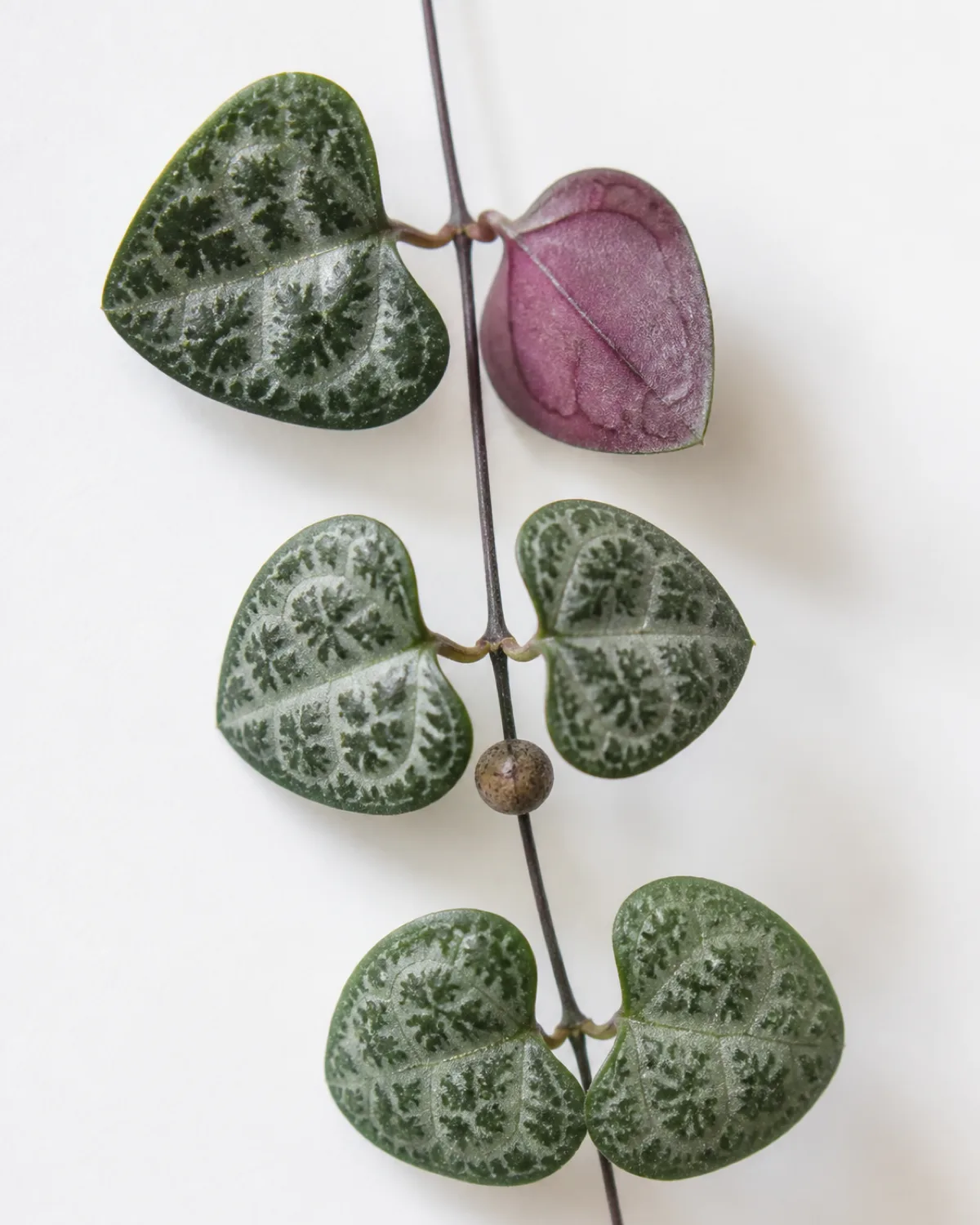
The leaves are small, heart-shaped, and rarely wider than two centimeters. Each one carries a layer of silver marbling on a dark green background that looks hand-painted. Flip a leaf over and the underside is a deep purple-magenta that most people never notice until someone points it out.
The stems are wire-thin, often less than two millimeters in diameter, yet they can stretch six to twelve feet from the pot when the plant is happy. A mature specimen cascading from a high shelf looks like a curtain of tiny green-and-silver hearts.
- Aerial tubers are the feature that sets this plant apart from every other trailing species in this guide series. Small round beads, roughly the size of a pea, form at nodes along the stem. Each one stores water and nutrients, and each one can grow into a completely independent plant if pressed into soil.
- Flowers appear on mature vines as small tubular lanterns that trap pollinating flies in the wild. They are unusual rather than showy, but they confirm that the plant is thriving.
- Growth habit is semi-succulent. The tubers and slightly thickened leaves store water, giving the plant a wider margin for under-watering than most tropical trailers.
The "string of" family shares a trailing habit but almost nothing else:
- String of pearls stores water in spherical leaves with translucent windows.
- String of dolphins has curved leaves shaped like leaping porpoises.
- String of turtles carries flat patterned leaves that look like tiny turtle shells.
Hearts stands out with its silver-on-green coloring, purple undersides, and aerial tubers that no other string species produces.
Light That Keeps the Silver Marbling Sharp
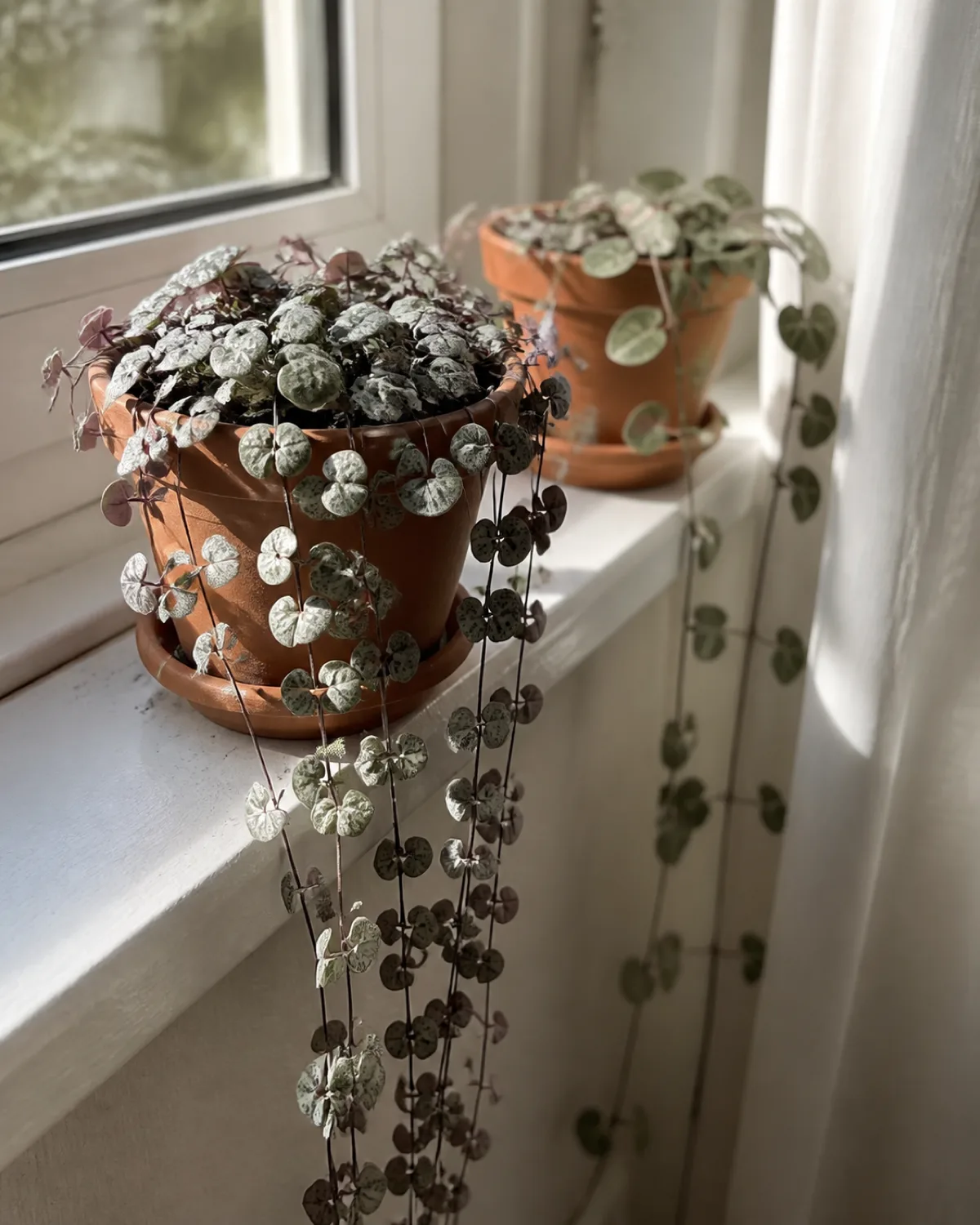
Bright indirect light for four to six hours per day keeps the silver marbling high-contrast and the leaf spacing tight. The silver patterns are the clearest visual meter for light quality on this plant.
An east-facing window delivers the ideal combination of direct morning sun and bright indirect light for the rest of the day. South-facing windows work well when filtered through a sheer curtain. West windows risk leaf scorch during the hottest afternoon hours, and north windows rarely provide enough light to maintain the silver coloring.
- Too little light turns the leaves uniformly dark green with faded silver. The internodes stretch from a compact one centimeter to three or four centimeters apart, and the stems become thin and leggy. This is the single most visible care mistake on this plant.
- Too much light dries and curls the leaf edges, bleaches the green to a washed-out yellowish tone, and can cause crispy brown patches on the leaf surface. Short bursts of direct sun are fine, but sustained afternoon exposure through west-facing glass is too much.
Rotate the pot a quarter turn every two weeks. The vine trails in one direction, and the back side of the cascade gets significantly less light than the front. Without rotation, the back strands thin out while the front ones thicken.
If the plant lives on a dark shelf or in a room without adequate windows, a grow light set on a timer for twelve hours at a distance of six to ten inches solves the problem completely.
Watering a Semi-Succulent Vine Without the Guesswork
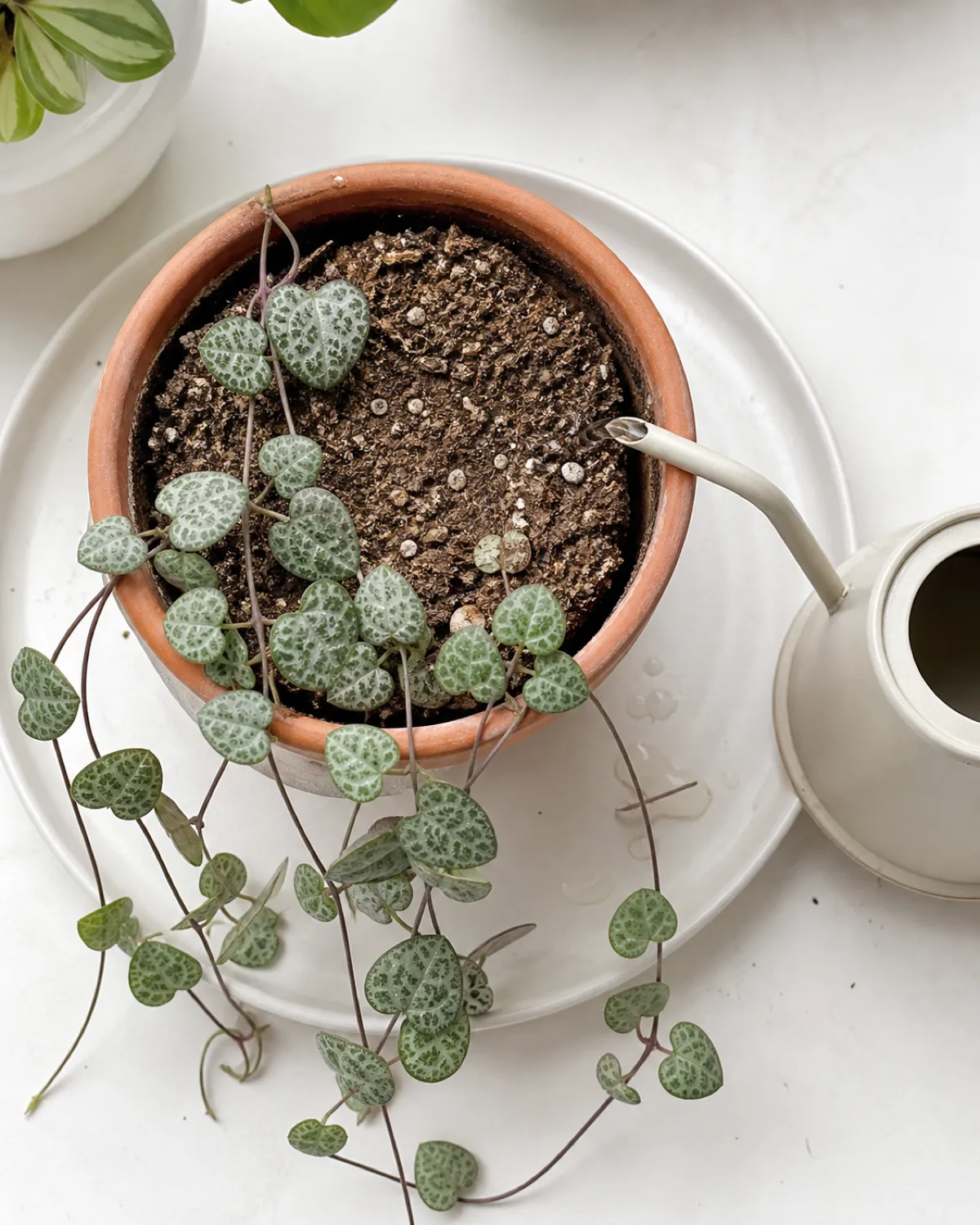
String of hearts stores water in its tubers and slightly thickened leaves, which means it can tolerate missed waterings far better than most trailing plants. The flip side is that it punishes overwatering faster than almost anything in the same size range.
Wait until the soil is completely dry from top to bottom before watering again. The pot-weight method works best here because the dense vine canopy makes it hard to see or touch the soil surface. Pick up the pot. When it feels dramatically lighter than it did the day after watering, the soil has dried through.
- Summer frequency lands around every seven to ten days in a terracotta pot with well-draining mix.
- Winter frequency stretches to every two to three weeks, sometimes longer. The tubers carry the plant through dormant periods with minimal water input.
- Watering method matters. Water along the pot rim or use the bottom-soak method. Pouring water from above onto the dense tangle of leaves traps moisture against the stems and invites rot.
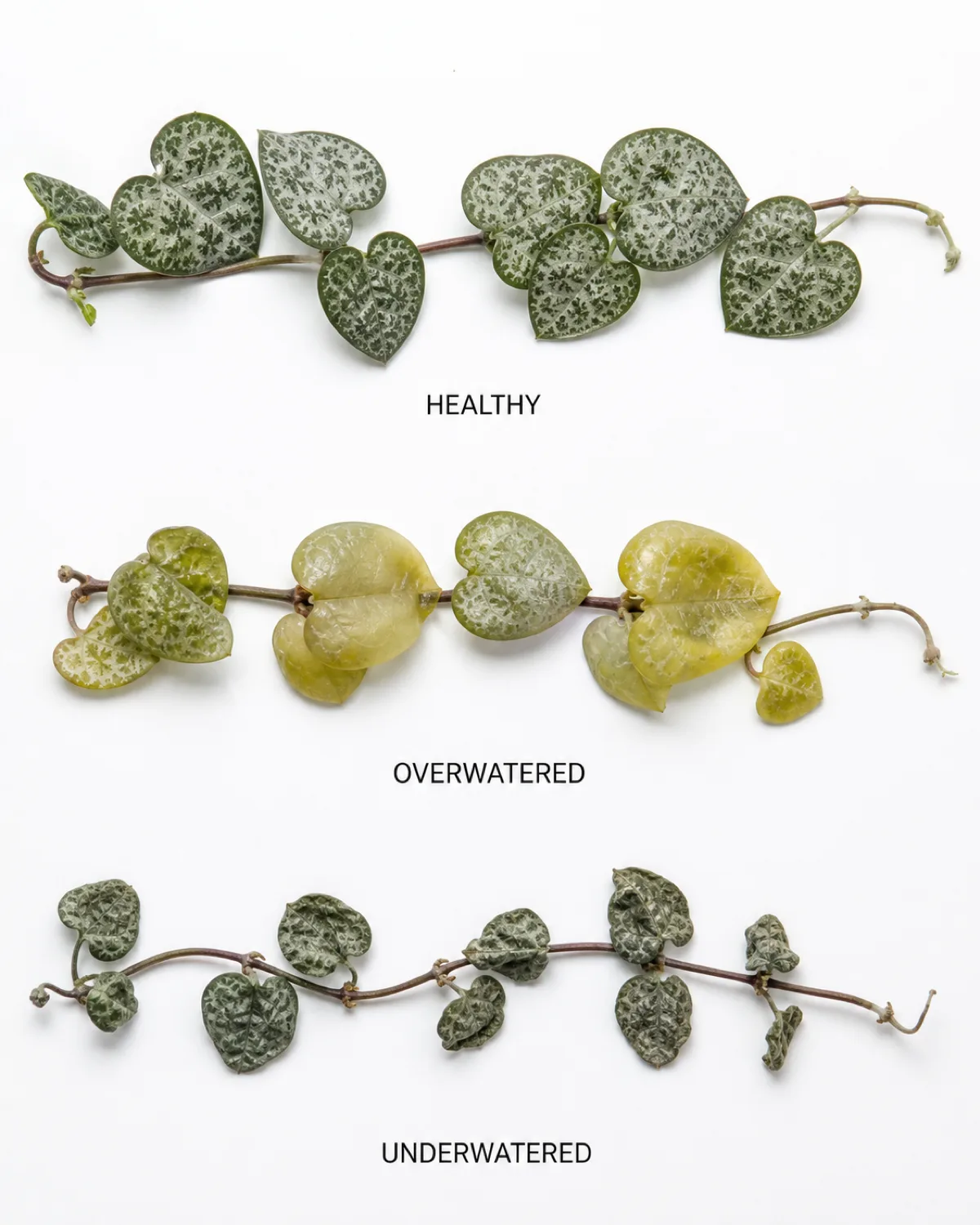
Overwatering shows up first as yellowed, translucent, swollen leaves. The cells absorb more water than they can hold and rupture, which is the exact same failure mode as string of pearls. If the stems at the base turn black and soft, the tubers have started to rot, and the damage is usually irreversible.
Underwatering looks like shriveled, wrinkled hearts that deflate like tiny pillows losing their stuffing. The purple on the undersides deepens. Recovery from underwatering is fast — a thorough soak brings the leaves back to plump within twenty-four to forty-eight hours.
The forgiveness window leans dry. A week of forgotten watering produces some wrinkling that reverses quickly. A week of sitting in wet soil produces stem rot that kills the vine from the base up.
Soil and Pots That Let Roots Breathe
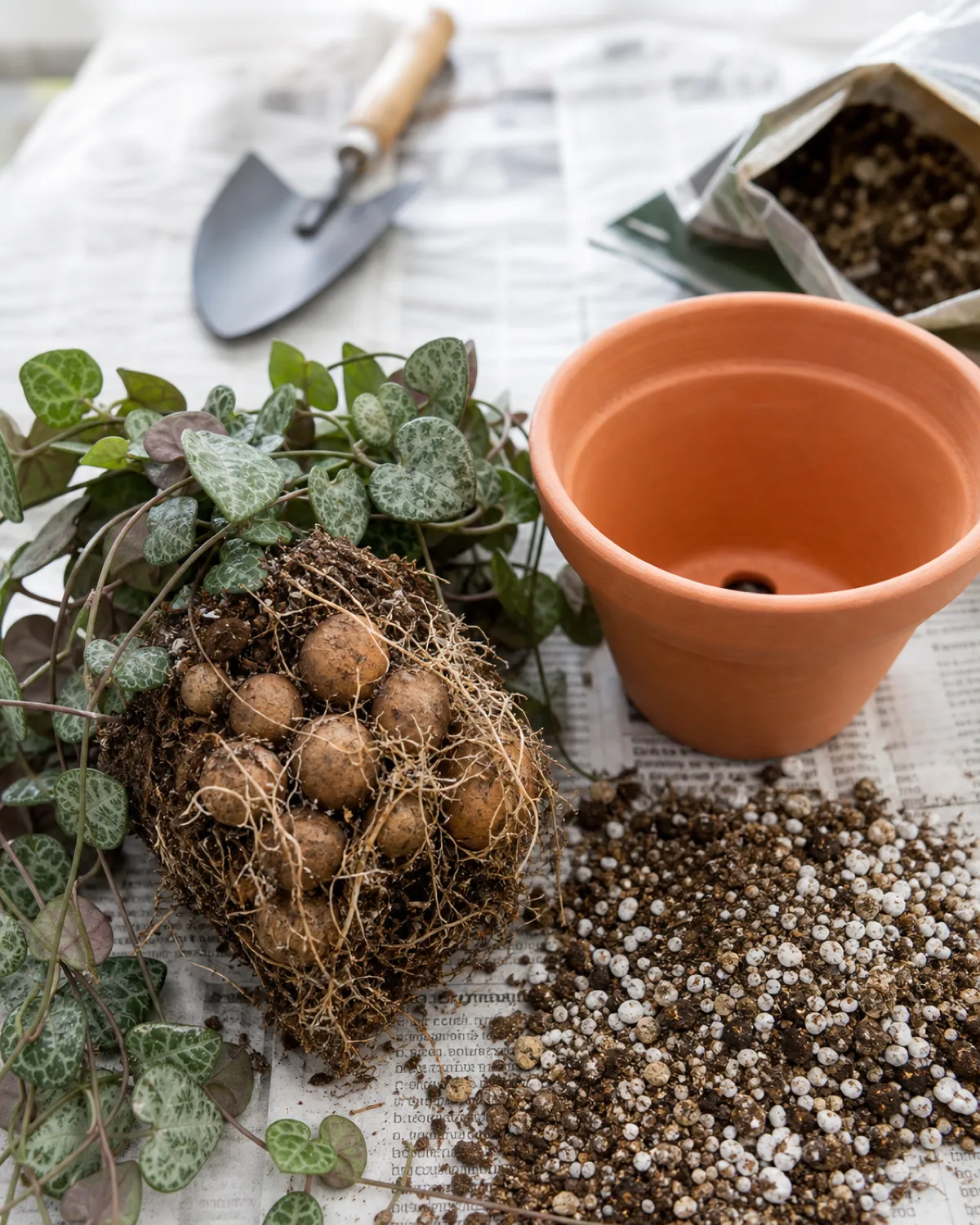
Standard potting soil stays wet for too long and puts the tubers at risk. The mix needs to drain fast enough that water passes through in under fifteen seconds after pouring.
A straightforward recipe that works every time:
- 60 percent cactus and succulent mix
- 20 percent perlite
- 20 percent coarse sand
A simpler version — half standard potting soil and half perlite — also gets the job done. The point is air reaching the roots quickly after each watering.
Terracotta is the best pot material for this plant. The porous clay wicks moisture away from the root zone and speeds the drying cycle, which reduces the overwatering risk that kills more string of hearts than any pest or disease. Plastic pots work but require extending the interval between waterings by about forty to fifty percent.
- Drainage holes are non-negotiable. A pot without drainage turns into a sealed container where tubers sit in standing water and rot within days.
- Pot sizing should be snug. The root system is compact and shallow, so a shallow wide pot fits the growth pattern better than a deep narrow one. When repotting, go up only one inch in diameter.
- Hanging considerations are worth thinking through if the pot will live in a macrame hanger. A terracotta pot full of wet soil weighs three to four times what it weighs empty. Confirm that the hanger, hook, and ceiling anchor can support the weight at its heaviest point — right after a thorough watering.
Temperature, Humidity, and the Low-Maintenance Sweet Spot
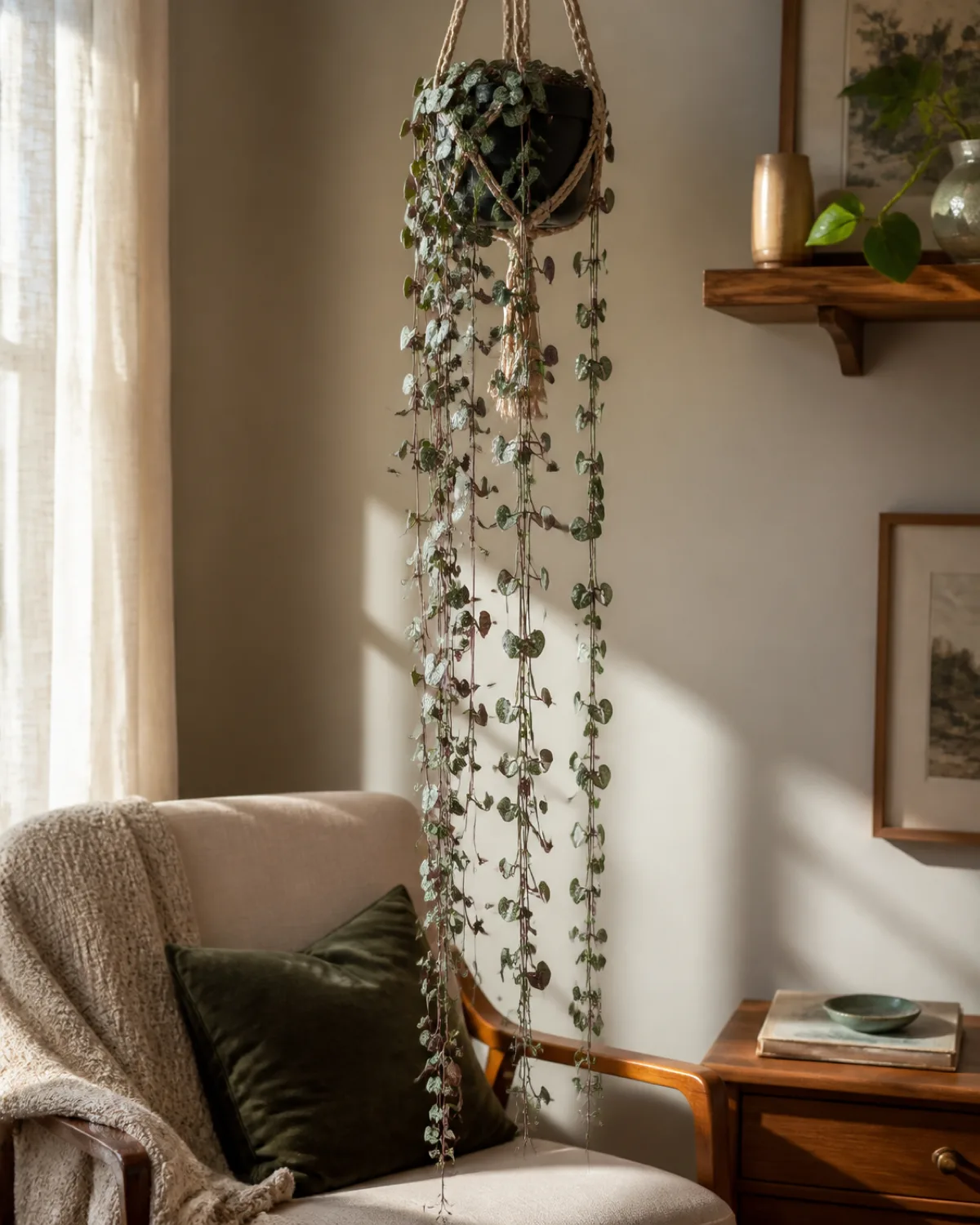
The temperature range that keeps string of hearts comfortable — sixty to eighty degrees Fahrenheit — matches standard indoor conditions in most homes without any adjustment. That overlap is one reason this plant has a reputation for being low-maintenance.
The lower tolerance sits around fifty degrees for brief exposure. Below that threshold, leaves blacken and drop. Keep the plant away from cold window glass in winter, where the surface temperature can run fifteen to twenty degrees below room temperature.
Humidity requirements are where string of hearts truly separates itself from most trailing houseplants. Standard indoor humidity of forty to fifty percent is ideal. The plant does not need a humidifier, a pebble tray, or a trip to the bathroom during showers.
- Boston fern needs fifty to eighty percent humidity and drops fronds in dry air. String of hearts does not.
- Calathea curls leaves when humidity drops below fifty percent. String of hearts does not.
- Maidenhair fern turns crispy in anything below sixty percent. String of hearts does not.
Skip the misting. Water droplets trapped in the dense leaf tangle take too long to evaporate and create conditions for leaf spot fungus and botrytis gray mold. The plant actively prefers the drier side of indoor conditions.
The only winter caution is direct contact with heating vents. Sudden blasts of hot, dry air from a floor register or wall unit cause mass leaf drop. Move the plant a few feet away from the vent or redirect the airflow.
Feeding and Repotting on a Slow Schedule
String of hearts is a slow grower that does not demand heavy feeding. A balanced liquid fertilizer diluted to half the label strength, applied once a month during the spring and summer growing season, covers the nutritional needs without risk.
Stop all feeding from fall through winter. The plant slows its metabolism significantly during shorter days, and fertilizer salts accumulate in the soil when the roots are not actively absorbing nutrients. Those salts burn the fine feeder roots that supply water to the tubers.
- Salt flush the soil every three to four months by running plain water through the pot until it flows freely from the drainage hole. This washes out accumulated mineral deposits before they reach damaging levels.
- New soil in a freshly repotted plant already contains enough nutrients for four to six weeks. Skip fertilizer entirely for the first month after repotting.
Repotting happens every two to three years, which is less frequent than most houseplants. The root system is compact, and string of hearts tolerates being slightly root-bound better than it tolerates a sudden increase in wet soil volume around its roots.
Repot in spring. The signal is tubers or roots pushing through the drainage hole, combined with water running straight through the pot in under two seconds because roots have displaced most of the soil. Go up only one inch in pot diameter.
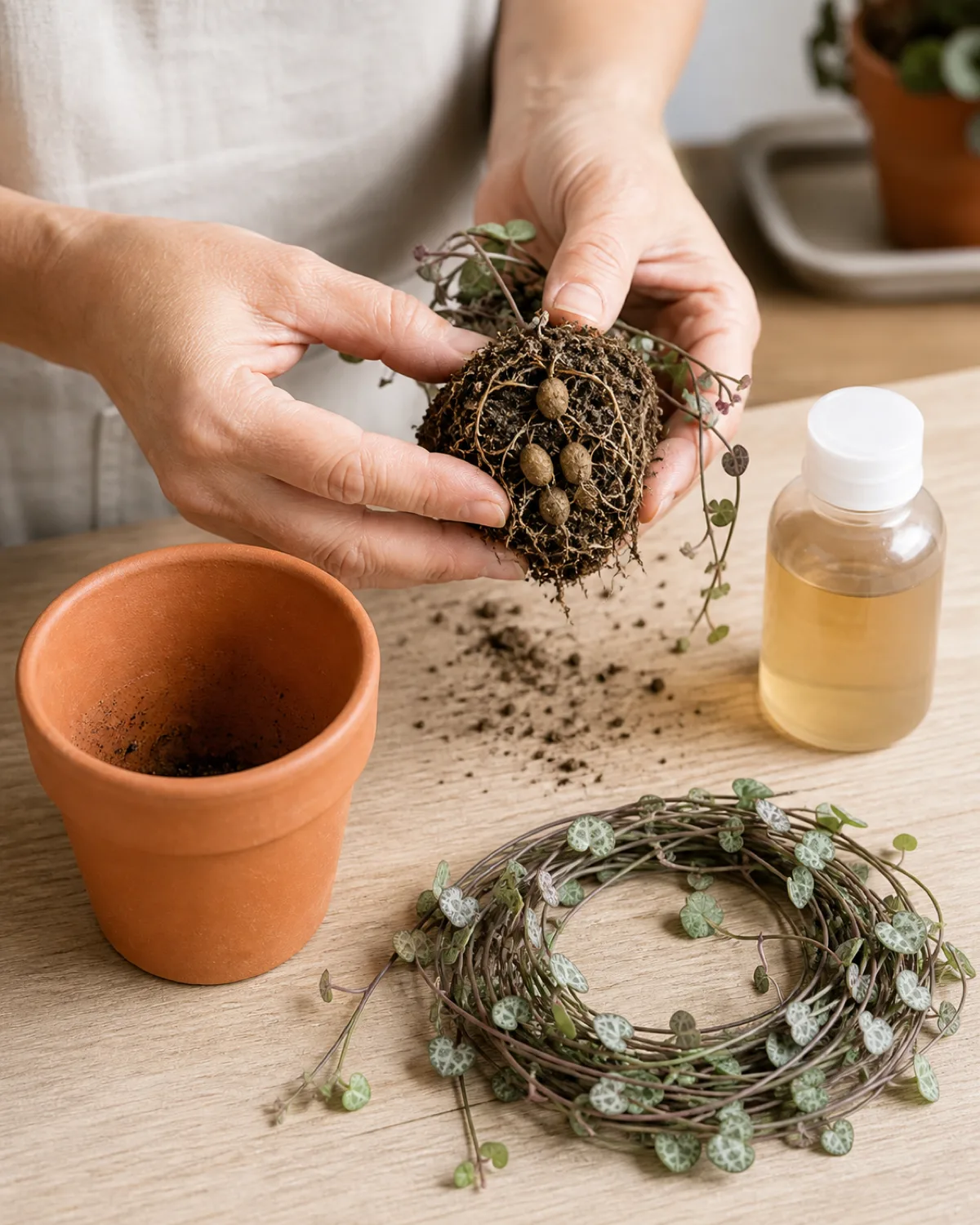
Handle the vines carefully during the process. Coil the trailing stems gently on the table surface before lifting the root ball. Tugging on the stems snaps them, and each break means a detached strand that needs to be re-rooted separately.
Check the tubers at the base during repotting. Healthy tubers are firm, brown, and shaped like small potatoes. Soft, mushy, or foul-smelling tubers indicate rot and need to be cut away with clean shears. Wait seven to ten days after repotting before watering to let any root wounds callus over.
Four Ways to Propagate (and the Butterfly Cut That Works Best)
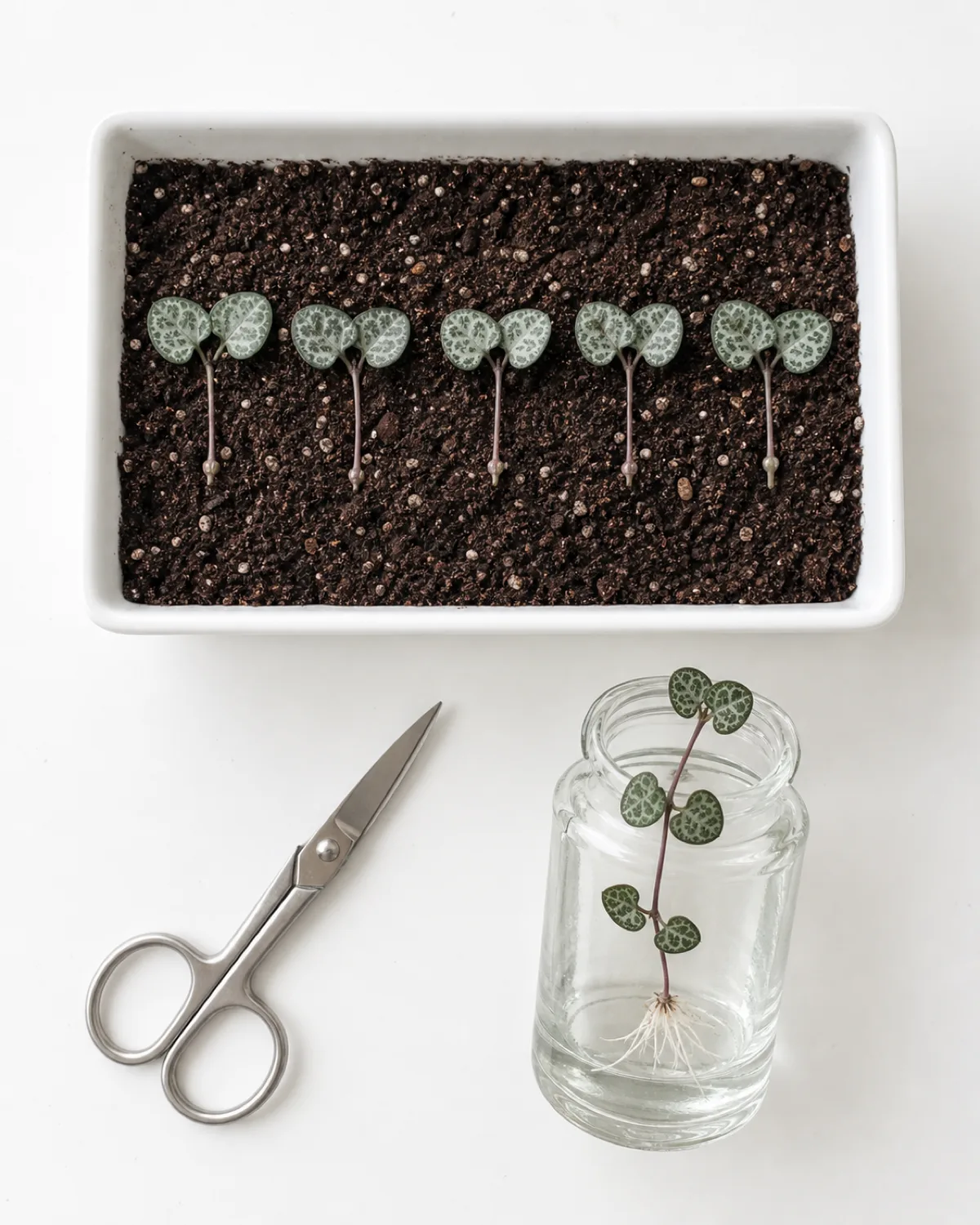
String of hearts offers more propagation methods than almost any other houseplant in the same category. Four approaches work, ranked here from most effective to least practical for indoor growers.
Butterfly cut is the signature method for this species and the one that produces the most new plants from a single vine. Cut a long strand into small segments, each containing one node and two opposing leaves. Lay each segment flat on the surface of moist seed-starting mix with the node pressed gently into the soil.
The two leaves spread outward like butterfly wings — hence the name. Cover loosely with a clear plastic bag or dome to hold humidity, and set the tray in bright indirect light.
- Roots emerge from the node in two to four weeks.
- New stems follow within another two to three weeks.
- A single twelve-inch vine yields six to ten independent new plants.
Aerial tuber method is the lowest-risk option because nothing gets cut from the mother plant. Find a node where a small round tuber has formed along the stem. Press that tuber into moist soil in a pot next to the mother plant, keeping the vine attached. Pin it with a U-shaped wire. The tuber roots in two to three weeks. Cut the connecting stem after new growth confirms establishment.
| Method | Success rate | Timeline | Best for |
|---|---|---|---|
| Butterfly cut | Very high | 2–4 weeks | Maximum new plants from one vine |
| Aerial tuber | High | 2–3 weeks | Zero risk to the mother plant |
| Water rooting | Moderate | 1–3 weeks | Watching root development in real time |
| Coiling | High | 4–6 weeks | Filling in a sparse-looking pot |
Water rooting works but carries more risk with this species than with pothos or philodendron. Cut a four-to-six-inch stem section, remove the bottom two pairs of leaves, and submerge the nodes in water. Change the water every three to four days — the thin stems rot in stale water. Roots appear in one to three weeks. Transfer to soil when roots reach one to two inches.
Coiling method makes the existing pot look fuller rather than creating separate plants. Coil a long trailing strand back onto the soil surface and pin each node down with small wire pins. The nodes root where they contact moist soil, filling in the empty gaps over four to six weeks.
All four methods work best when started in spring or early summer, when the plant is actively growing. Winter propagation is possible but significantly slower.
Pests, Problems, and the Signals This Vine Sends
String of hearts is not a pest magnet, but the dense trailing growth creates hiding spots that make early detection harder than on a plant with large, easily inspected leaves.
Mealybugs are the most common pest. They settle on the undersides of leaves and around the aerial tubers, where the cottony white clusters blend in against the purple leaf backs. Check the vine regularly by lifting a section and inspecting the undersides.
Treatment depends on severity:
- Small outbreak: cotton swab dipped in rubbing alcohol, applied directly to each visible cluster.
- Larger infestation: neem oil sprayed over the entire plant at label strength, repeated every seven days for three weeks to break the reproductive cycle.
Other issues are more often care-related than pest-related:
- Yellowed, translucent, swollen leaves signal overwatering. The cells have taken in more water than they can hold. Stop watering immediately and check the roots for rot.
- Shriveled, wrinkled, deflated leaves signal underwatering. The leaves look like tiny deflated balloons. A thorough soak reverses this within a day or two.
- Blackening stem base means the tubers are rotting. The only rescue is to cut all healthy stems above the rot line and propagate them using the butterfly or water methods. Discard the rotted base and soil. Sterilize the pot before reuse.
- Silver marbling fading plus elongated internodes means insufficient light. Move to a brighter location.
- Leaves dropping on touch points to either advanced overwatering or cold shock. Check the soil moisture and recent temperature exposure to determine which one.
- No aerial tubers forming is normal on younger plants. Tubers typically appear after the stems reach two feet or more in length. Not every stem produces them at the same rate, and the plant needs to reach a certain maturity threshold before they develop.
The general houseplant pest guide covers the full identification and treatment protocol for mealybugs, spider mites, and fungus gnats across all species.
Variegated String of Hearts and Three Other Forms Worth Knowing
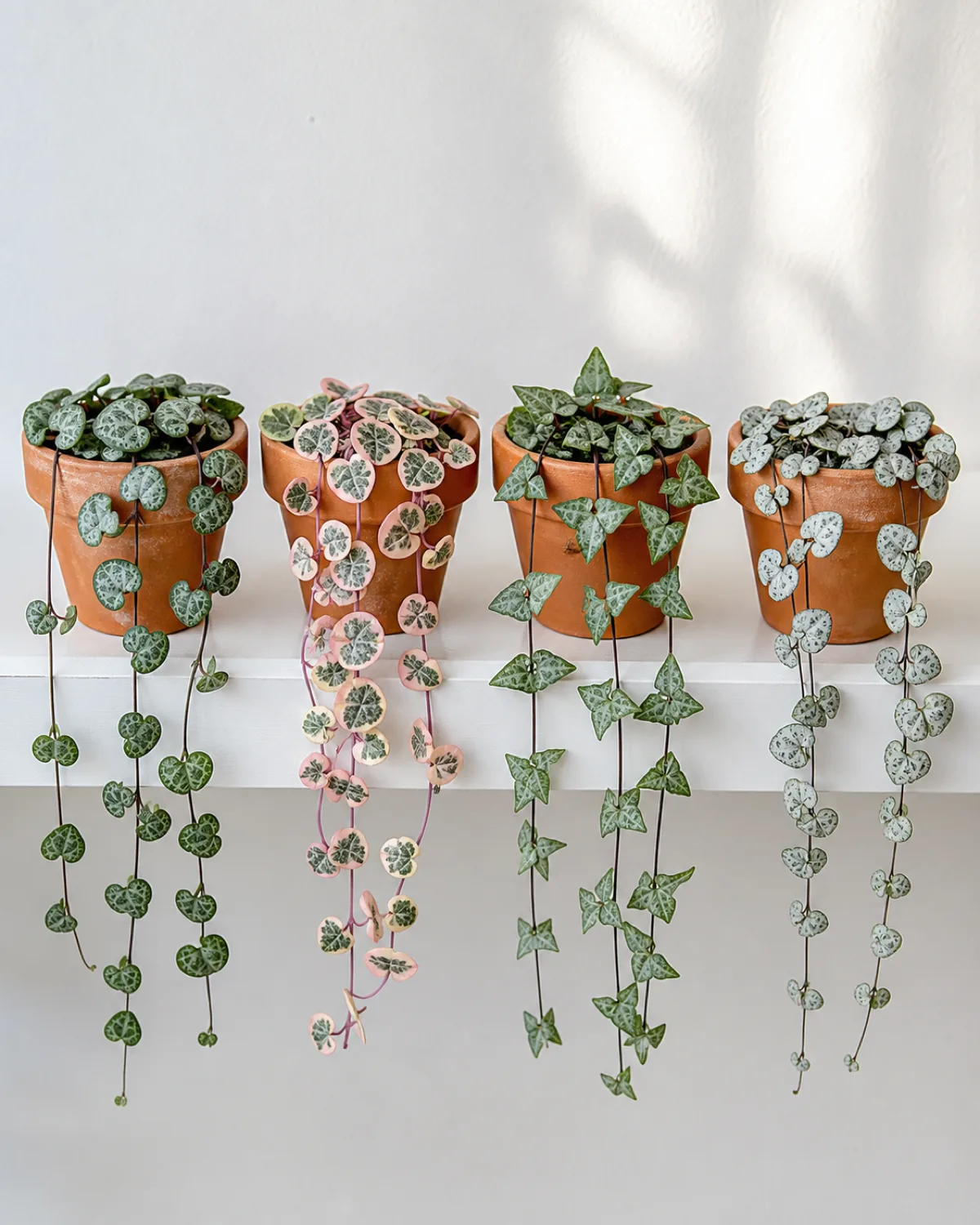
The standard Ceropegia woodii is the easiest to find and the easiest to keep alive. The cultivars below show up in plant shops and online listings with increasing frequency, and each one has a care wrinkle that differs from the standard.
- Ceropegia woodii 'Variegata' carries pink and cream margins on each leaf with green and silver in the center. The stems are often pink or reddish. This is the most sought-after form at three to five times the price of the standard. Variegated sections contain less chlorophyll, so the plant needs brighter conditions and grows noticeably slower.
- 'String of Spades' produces narrower, more pointed leaves closer to a playing-card spade. The silver marbling is typically less prominent, giving the plant a darker, moodier look. Care requirements are identical to the standard.
- 'Silver Glory' has the most silver coverage of any form — leaves are almost entirely silver-white with only a thin rim of green. The vine looks metallic in good light. Like the variegated form, it needs more light because reduced green area limits photosynthesis.
- 'Orange River' carries smaller, rounder leaves than the standard. In bright light, the leaf edges develop an orange-red blush. It tends to stay more compact, making it a good choice for smaller hanging pots.
For a first string of hearts, start with the standard form. It costs less, grows faster, forgives more mistakes, and still delivers the silver marbling that makes the species worth growing. Move to the variegated or Silver Glory forms after the basic care rhythm is dialed in.
Is String of Hearts Safe Around Pets and Children
String of hearts is listed as non-toxic by the ASPCA for both cats and dogs. It is also considered safe around children. No part of the plant — leaves, stems, tubers, or flowers — contains compounds that cause toxicity upon ingestion.
That makes this plant part of a small group of trailing species that combine non-toxicity with a genuine trailing habit:
- Safe trailers include string of hearts, spider plant (which can cause mild stomach upset but is not truly toxic), Boston fern, and peperomia.
- Toxic trailers include string of pearls, English ivy, and pothos (calcium oxalate irritant).
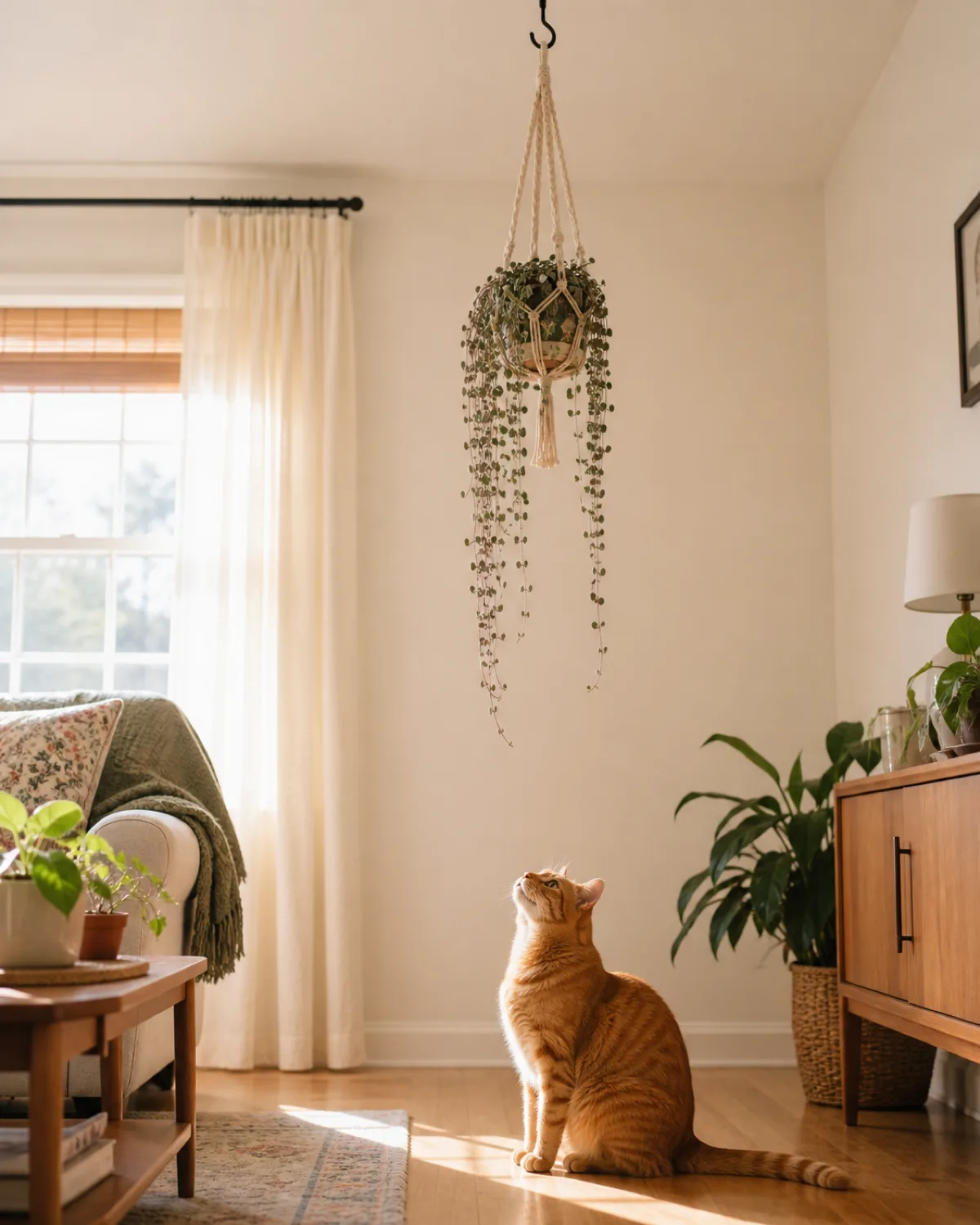
The practical concern is not poisoning but vine destruction. The thin, dangling stems move in air currents, and that movement is irresistible to cats. A cat batting at a trailing vine will snap stems and strip leaves in minutes, leaving the plant looking like a bald thread.
Hang the plant high enough that the longest trailing stem stays at least two feet above the cat's maximum jump height. A ceiling hook or a high wall shelf keeps the vine visible and the cat frustrated. Pinning any stray-long stems against the wall with a small adhesive hook prevents them from swinging freely and attracting attention.
For a broader list of plants that are safe for cats, including thirteen verified species with behavioral matching, see the dedicated guide.
Save for Later
10 string of hearts care essentials at a glance
- 1Silver-marbled hearts on wire-thin stemsCeropegia woodii trails six to twelve feet, stores water in aerial tubers along the vine, and carries purple-backed heart-shaped leaves with hand-painted silver markings.
- 2Bright indirect light keeps the silver sharpEast or filtered south window, four to six hours daily. Fading silver and stretched internodes mean more light is needed. Rotate the pot every two weeks.
- 3Dry soil completely before soakingPot-weight test beats finger test on this vine. Every seven to ten days in summer, every two to three weeks in winter. Water along the rim, never on the leaves.
- 4Fast-draining mix in a terracotta potSixty percent cactus mix, twenty percent perlite, twenty percent coarse sand. Drainage hole mandatory. Shallow wide pot matches the compact root system.
- 5Normal room conditions, no humidity fussSixty to eighty degrees Fahrenheit, forty to fifty percent humidity. No misting, no pebble tray, no humidifier. Skip the extras this time.
- 6Half-strength fertilizer, spring and summer onlyBalanced liquid feed once a month during the growing season. Zero feeding in winter. Repot every two to three years when tubers crowd the drainage hole.
- 7Butterfly cut turns one vine into ten plantsSnip between each leaf pair, lay segments on moist soil like butterfly wings. Roots in two to four weeks. Aerial tuber method is the zero-risk alternative.
- 8Mealybugs hide under the purple leaf backsLift sections of vine to inspect regularly. Cotton swab with alcohol for small outbreaks, neem oil spray every seven days for three weeks for larger ones.
- 9Variegated form costs more and grows slowerPink and cream margins need brighter light. Standard green-silver form is cheaper, faster, and more forgiving for a first plant.
- 10ASPCA non-toxic for cats, dogs, and childrenSafe to grow around pets. Hang high anyway — cats treat the dangling vines like toys and will strip the leaves in minutes.
kultivy.com
The line between a healthy string of hearts and an unhappy one is almost always about water. Get the watering rhythm right — dry soil, thorough soak, long pause — and the rest falls into place. The silver stays sharp, the tubers stay firm, and the vine keeps adding tiny hearts to a chain that already has more than enough to go around.

Mara writes plant care guides grounded in published botany and first-hand growing experience, not recycled social-media advice. Every recommendation on Kultivy is tested against real-world conditions before it reaches your screen. More about our editorial standards.